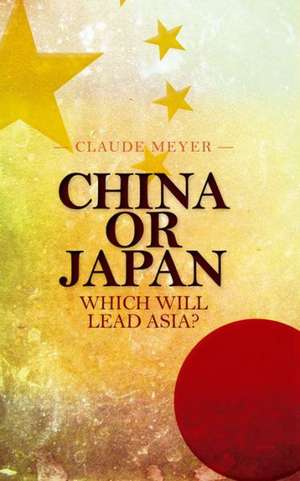
China or Japan
Autor Claude Meyeren Limba Engleză Hardback – 31 ian 2012
Preț: 284.91 lei
Puncte Express: 427
Carte disponibilă
Livrare economică 13-27 noiembrie
Livrare prin curier în România Termenul estimat este afișat lângă disponibilitate.
Transport gratuit de la 400.00 lei Plată online sau ramburs, în funcție de opțiunile comenzii.
Retur gratuit în 14 zile Comandă securizată și suport în română.
Specificații
ISBN-13: 9780199327614
ISBN-10: 0199327610
Pagini: 208
Dimensiuni: 148 x 224 x 18 mm
Greutate: 0.36 kg
Editura: Oxford University Press
ISBN-10: 0199327610
Pagini: 208
Dimensiuni: 148 x 224 x 18 mm
Greutate: 0.36 kg
Editura: Oxford University Press
V-ar putea interesa
-
 Preț: 371.20 lei
 -
 Hiroshima: The World's BombAndrew J. Rotter-19%Preț: 125.16 lei155.20 lei
 -
 Defeat Into VictoryWilliam Slim-32%Preț: 85.35 lei124.83 lei
 -
 The Great WallJohn Man-30%Preț: 65.17 lei92.76 lei
 -
 -29%Preț: 73.37 lei104.06 lei
 -
 History of India 2eB SteinPreț: 429.29 lei
 -
 Nazarbayev and the Making of KazakhstanJonathan Aitken-36%Preț: 166.86 lei260.03 lei
 -
 -17%Preț: 91.19 lei109.90 lei
 -
 Sahner, C: Among the RuinsChristian C. Sahner-18%Preț: 129.87 lei158.24 lei
 -
 The Blood TelegramGary Jonathan Bass-20%Preț: 205.89 lei256.05 lei
 -
 From Deep State to Islamic StateJean-Pierre Filiu-24%Preț: 160.11 lei209.55 lei
Notă biografică
Dr Claude Meyer, Senior Fellow at GEM-Sciences Po, teaches international economics at Sciences Po (Paris) and abroad. He has pursued a dual career as an academic and as an executive in a Japanese bank. He holds a PhD in Economics and degrees in Philosophy, Sociology and Japanese Studies. His research and publications deal mainly with Asian economies with an emphasis on the interaction between economic power and strategic issues.
Recenzii
'In his provocative and important book Claude Meyer argues against the conventional wisdom that Japan's future is past and that China will necessarily dominate the region. Drawing on his long years of experience with China and Japan as a businessman and scholar, Meyer explains why the next decades in East Asia are going to be dominated by competition between China and Japan for political and economic power. In contrast to so many observers who have written Japan off as a declining power, Meyer puts his focus on Japan's strengths as well as its weaknesses and the likelihood that it will play a central role in shaping the Asia of the future. It should be required reading for anyone interested in the future of the world economy's most important region.' - - Professor Gerald Curtis, Columbia University