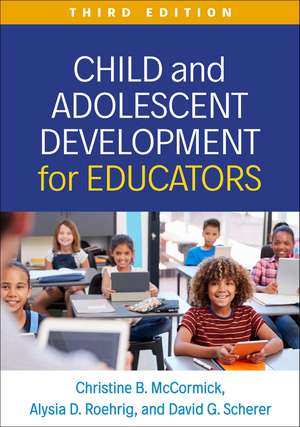
Child and Adolescent Development for Educators, Third Edition
Autor Christine B. McCormick, Alysia D. Roehrig, David G. Schereren Limba Engleză Paperback – 28 noi 2025
New to This Edition
- Reflects key developments in cognitive science, neuroscience, genetics, and other areas; nearly 25% of the research citations are new.
- Expanded coverage of executive functioning, dyslexia, social–emotional learning, character education, ethnic–racial identity development, and gender diversity.
- Practical discussions of timely topics: social media and mental health, cyberbullying, the impact of the COVID-19 pandemic, and more.
Preț: 484.76 lei
Preț vechi: 570.31 lei
-15%
Puncte Express: 727
Carte disponibilă
Livrare economică 02-16 noiembrie
Livrare express 16-22 octombrie pentru 95.46 lei
Livrare prin curier în România Termenul estimat este afișat lângă disponibilitate.
Transport gratuit pentru acest produs Plată online sau ramburs, în funcție de opțiunile comenzii.
Retur gratuit în 14 zile Comandă securizată și suport în română.
Specificații
ISBN-13: 9781462558346
ISBN-10: 1462558348
Pagini: 539
Dimensiuni: 178 x 254 x 31 mm
Greutate: 0.96 kg
Ediția:3. Auflage
Editura: Guilford Publications
Colecția Guilford Press
ISBN-10: 1462558348
Pagini: 539
Dimensiuni: 178 x 254 x 31 mm
Greutate: 0.96 kg
Ediția:3. Auflage
Editura: Guilford Publications
Colecția Guilford Press
Cuprins
Preface
I. Theoretical Perspectives in Child Development
1. Introduction to Child Development and Education
2. Biological Development
3. Cognitive Development: Piaget’s Stage Theory
4. Cognitive Development: Information-Processing Theory
5. Social Theories of Development and Learning
6. Sociocultural Theories of Development and Education
II. Key Topics in Child Development and Education
7. Language Development and Linguistic Diversity
8. Intelligence and Individual Differences in Academic Competence
9. The Development of Academic Motivation
10. Family and Peer Relationships
11. Gender Role Development
12. Recognizing and Understanding Student Mental Health Problems
13. Integrative Review of Major Concepts
References
Index
I. Theoretical Perspectives in Child Development
1. Introduction to Child Development and Education
2. Biological Development
3. Cognitive Development: Piaget’s Stage Theory
4. Cognitive Development: Information-Processing Theory
5. Social Theories of Development and Learning
6. Sociocultural Theories of Development and Education
II. Key Topics in Child Development and Education
7. Language Development and Linguistic Diversity
8. Intelligence and Individual Differences in Academic Competence
9. The Development of Academic Motivation
10. Family and Peer Relationships
11. Gender Role Development
12. Recognizing and Understanding Student Mental Health Problems
13. Integrative Review of Major Concepts
References
Index
Recenzii
"I am thrilled to see the third edition of this text! I have required this book for my Child Growth and Development courses since the first edition, and advise my preservice teacher candidates to keep it as a reference after their classwork is done. The third edition includes updated developmental research as well as additional guidance related to how technology influences child development and the impacts of the COVID-19 pandemic. Information is presented in a logical, learner-oriented manner, and the ancillary materials are great. The text helps preservice teachers understand what they can expect from children and teens in PreK-12 classrooms and how to address the needs of both typically and atypically developing students."--Elizabeth "Beth" Hammond, PhD, Department of Education, University of South Carolina Beaufort
"This book is comprehensive, well organized, and illuminating in its coverage, as well as accessible and engaging. McCormick, Roehrig, and Scherer have produced an invaluable third edition that informs educators about contemporary theory, research, and application in the developmental science of children and adolescents."--Richard M. Lerner, PhD, Bergstrom Chair in Applied Developmental Science; Director, Institute for Applied Research in Youth Development, Tufts University
"The third edition of this outstanding child and adolescent development text reviews theoretical and research innovations and integrates critical historical and emerging findings from the field. McCormick and colleagues weave together a tapestry of theoretical and applied work. They highlight the mechanisms and determinants of biological, cognitive, social, language, intellectual, motivational, relational, gender role, and mental health development. In the third edition, interdisciplinary and interprofessional developmental research is more prominent, as are evidence-based home, school, and community practices that can enhance all students' learning, socialization, and well-being. The in-depth coverage of critical issues in each chapter is highly relevant to contemporary international and national contexts, making this an essential text for advanced education and psychology courses."--Gloria E. Miller, PhD, Morgridge College of Education (Emeritus), University of Denver
“This text offers a comprehensive and accessible overview of developmental theories relevant to professionals in educational settings. By integrating biological, social, cognitive, and cultural dimensions, the book provides a holistic understanding of child and adolescent development. The authors place a strong and timely emphasis on cultural diversity and youth mental health--areas of increasing importance in today’s classrooms. The structure of the book supports usability, promotes integration across chapters, and encourages meaningful application to practice. This is an ideal text for undergraduate and graduate teacher preparation programs and for undergraduate psychology courses focused on development. It is a valuable resource for future educators and mental health professionals seeking to apply developmental theory in culturally responsive, developmentally appropriate ways.”--Lyndsay Jenkins, PhD, Michael and Jean Shahnasarian Endowed Professor, Department of Educational Psychology and Learning Systems, Florida State University-
"This book is comprehensive, well organized, and illuminating in its coverage, as well as accessible and engaging. McCormick, Roehrig, and Scherer have produced an invaluable third edition that informs educators about contemporary theory, research, and application in the developmental science of children and adolescents."--Richard M. Lerner, PhD, Bergstrom Chair in Applied Developmental Science; Director, Institute for Applied Research in Youth Development, Tufts University
"The third edition of this outstanding child and adolescent development text reviews theoretical and research innovations and integrates critical historical and emerging findings from the field. McCormick and colleagues weave together a tapestry of theoretical and applied work. They highlight the mechanisms and determinants of biological, cognitive, social, language, intellectual, motivational, relational, gender role, and mental health development. In the third edition, interdisciplinary and interprofessional developmental research is more prominent, as are evidence-based home, school, and community practices that can enhance all students' learning, socialization, and well-being. The in-depth coverage of critical issues in each chapter is highly relevant to contemporary international and national contexts, making this an essential text for advanced education and psychology courses."--Gloria E. Miller, PhD, Morgridge College of Education (Emeritus), University of Denver
“This text offers a comprehensive and accessible overview of developmental theories relevant to professionals in educational settings. By integrating biological, social, cognitive, and cultural dimensions, the book provides a holistic understanding of child and adolescent development. The authors place a strong and timely emphasis on cultural diversity and youth mental health--areas of increasing importance in today’s classrooms. The structure of the book supports usability, promotes integration across chapters, and encourages meaningful application to practice. This is an ideal text for undergraduate and graduate teacher preparation programs and for undergraduate psychology courses focused on development. It is a valuable resource for future educators and mental health professionals seeking to apply developmental theory in culturally responsive, developmentally appropriate ways.”--Lyndsay Jenkins, PhD, Michael and Jean Shahnasarian Endowed Professor, Department of Educational Psychology and Learning Systems, Florida State University-
Notă biografică
Christine B. McCormick, PhD, is Professor Emerita and former Dean of the College of Education at the University of Massachusetts Amherst. She has also been a faculty member and held administrative roles at the University of New Mexico and the University of South Carolina. During her academic career, Dr. McCormick taught graduate and undergraduate courses in human growth and development, educational psychology, learning and cognition, and classroom assessment. She has served on the editorial boards of the Journal of Educational Psychology and Educational Psychology Review and is a Fellow of the American Psychological Association. Dr. McCormick is author or coauthor of many publications on a variety of topics in child development and education and has coauthored several textbooks.
Alysia D. Roehrig, PhD, is Professor and Chair of the Department of Educational Psychology and Learning Systems in the Anne Spencer Daves College of Education, Health, and Human Sciences at Florida State University. She teaches graduate courses in learning and cognition, methods of educational research, and college teaching, and has supervised undergraduate sections of classroom assessment and educational psychology. Dr. Roehrig has served on the editorial boards of Educational Psychology for Policy and Practice, Journal of Educational Psychology, and Journal of Psychoeducational Assessment. A Fellow of the American Psychological Association, she is coauthor of several books and other publications about effective teaching and the successes of minoritized students.
David G. Scherer, PhD, is a retired clinical psychologist and Professor Emeritus of Psychological and Brain Sciences at the University of Massachusetts Amherst. A family systems theorist and psychotherapist, he is an advocate for developmental and multisystemically informed treatment models. Dr. Scherer's research and clinical work have focused on issues related to adolescent autonomy and innovative models of psychotherapy for troubled and substance-abusing adolescents. He has taught undergraduate and graduate courses in adolescent psychology, psychology and public policy, professional issues and ethics, psychopathology, and child, adolescent, and family psychotherapy.
Alysia D. Roehrig, PhD, is Professor and Chair of the Department of Educational Psychology and Learning Systems in the Anne Spencer Daves College of Education, Health, and Human Sciences at Florida State University. She teaches graduate courses in learning and cognition, methods of educational research, and college teaching, and has supervised undergraduate sections of classroom assessment and educational psychology. Dr. Roehrig has served on the editorial boards of Educational Psychology for Policy and Practice, Journal of Educational Psychology, and Journal of Psychoeducational Assessment. A Fellow of the American Psychological Association, she is coauthor of several books and other publications about effective teaching and the successes of minoritized students.
David G. Scherer, PhD, is a retired clinical psychologist and Professor Emeritus of Psychological and Brain Sciences at the University of Massachusetts Amherst. A family systems theorist and psychotherapist, he is an advocate for developmental and multisystemically informed treatment models. Dr. Scherer's research and clinical work have focused on issues related to adolescent autonomy and innovative models of psychotherapy for troubled and substance-abusing adolescents. He has taught undergraduate and graduate courses in adolescent psychology, psychology and public policy, professional issues and ethics, psychopathology, and child, adolescent, and family psychotherapy.