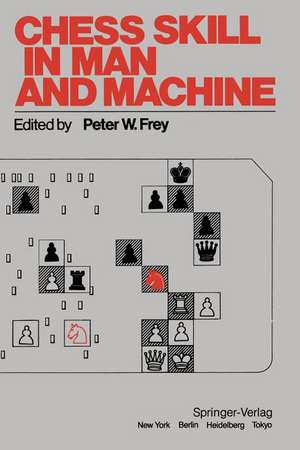
Chess Skill in Man and Machine
Editat de P. W. Freyen Limba Engleză Paperback – 14 mai 1984
Preț: 673.71 lei
Preț vechi: 842.15 lei
-20%
Puncte Express: 1011
Carte tipărită la comandă
Livrare economică 30 noiembrie-14 decembrie
Livrare prin curier în România Termenul estimat este afișat lângă disponibilitate.
Transport gratuit pentru acest produs Plată online sau ramburs, în funcție de opțiunile comenzii.
Retur gratuit în 14 zile Comandă securizată și suport în română.
Specificații
ISBN-13: 9780387908151
ISBN-10: 0387908153
Pagini: 348
Ilustrații: XIII, 329 p. 6 illus.
Dimensiuni: 155 x 235 x 19 mm
Greutate: 0.53 kg
Ediția:Second Edition 1983
Editura: Springer
Locul publicării:New York, NY, United States
ISBN-10: 0387908153
Pagini: 348
Ilustrații: XIII, 329 p. 6 illus.
Dimensiuni: 155 x 235 x 19 mm
Greutate: 0.53 kg
Ediția:Second Edition 1983
Editura: Springer
Locul publicării:New York, NY, United States
V-ar putea interesa
-
 -38%Preț: 451.87 lei733.99 lei
 -
 The Most Human HumanBrian Christian-19%Preț: 64.51 lei79.22 lei
 -
 Machine LearningKevin P. Murphy-20%Preț: 731.22 lei918.37 lei
 -
 Bayesian Networks and Decision GraphsThomas Dyhre Nielsen-18%Preț: 768.51 lei937.21 lei
 -
 -20%Preț: 557.40 lei696.75 lei
 -
 Bayesian Reasoning and Machine LearningDavid Barber-20%Preț: 547.92 lei684.90 lei
 -
 Pattern RecognitionM Narasimha Murty-20%Preț: 255.90 lei319.87 lei
 -
 Rough-Fuzzy Pattern RecognitionPradipta Maji-20%Preț: 710.39 lei887.99 lei
 -
 Fractals in EngineeringJacques Levy Vehel-20%Preț: 655.69 lei819.61 lei
 -
 Machine Learning for HackersDrew Conway-20%Preț: 258.29 lei322.85 lei
 -
 Computational IntelligenceAlexandru Floares-35%Preț: 1012.79 lei1567.33 lei
 -
 Embedded Computer VisionBranislav Kisačanin-20%Preț: 675.79 lei844.74 lei
 -
 Educational Data MiningAlejandro Peña-Ayala-41%Preț: 816.45 lei1383.18 lei
 -
 -20%Preț: 662.85 lei828.56 lei
 -
 -20%Preț: 672.48 lei840.60 lei
 -
 Tactile ScoreYasuhiro Suzuki-20%Preț: 309.71 lei387.15 lei
Public țintă
ResearchCuprins
1 A brief history of the computer chess tournaments: 1970–1975.- Background.- The tournaments.- The Soviet Union vs. USA match, 1966–67.- First United States computer chess championship (New York, 1970).- KAISSA vs. the Soviet Public (Moscow, 1972).- First world computer chess championship (Stockholm, 1974).- Fifth United States computer chess championship (San Diego, 1974).- Sixth North American computer chess championship (Minneapolis, 1975).- Significance.- 2 Human chess skill.- Should a computer be more like a man?.- The choice-of-move problem.- The role of perception.- The first few seconds.- Search through the tree of moves.- Visualizing positions.- Evaluation.- Motivation.- The road to mastery for man and machine.- 3 An introduction to computer chess.- Machine representation of the chess board.- Static evaluation functions.- The look-ahead procedure.- Backward pruning.- Quiescence.- Plausible-move generators.- Full-width searching.- The opening.- The endgame.- Improvement through competition.- Future prospects.- 4 CHESS 4.5—The Northwestern University chess program.- Background.- The development of CHESS 4.0.- Data base.- Move generation.- Tree-searching strategy.- The evaluation function.- Tree searching in CHESS 4.5.- Program performance.- Conclusions and perspective.- 5 PEASANT: An endgame program for kings and pawns.- The rules of play.- A description of the program.- The program–s performance.- Final observations.- 6 Plans, goals, and search strategies for the selection of a move in chess.- Search strategies.- Search strategies in the movement of the pieces.- A program to play speed chess.- 7 The heuristic search: An alternative to the alpha-beta minimax procedure.- 8 Man and machine: Chess achievements and chess thinking.- Why program a computer toplay chess?.- Past achievements of computer-chess programs.- Chess thinking: Man versus machine.- Computer chess: Omens, prospectives, and values.- Concluding comments.- 9 Belle.- Background.- Chess-specific hardware.- Second generation.- Third generation.- The book.- An experiment.- Conclusion.- 10 Using chess knowledge to reduce search.- Overview of PARADISE.- Concepts and knowledge sources.- Plans.- Creating plans.- How detailed should plans be?.- Using plans to guide the search.- A typical medium-sized search.- Measuring PARADISE’S performance.- Summary and long-term prospects.- Appendix Chess 4.5: Competition in 1976.- The Paul Masson American Chess Championship.- ACM Computer Chess Championships, 1976.- Second Appendix Chess 4.5 and Chess 4.6: Competition in 1977 and 1978.- The Minnesota Open, February, 1977.- The First Wager Match with Levy, April, 1977.- The Second World Computer Championship, August, 1977.- Blitz Chess against Michael Stean in London, September, 1977.- Twin-Cities Open, April, 1978.- Walter Browne Simultaneous Exhibition, May, 1978.- Appendix to the second edition.- References and bibliography.