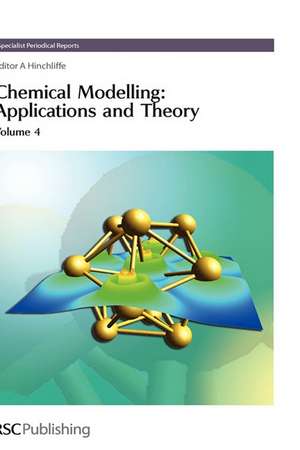
Chemical Modelling
en Limba Engleză Hardback – 30 oct 2006
Sub coordonarea editorilor Michael Springborg și Jan-Ole Joswig, volumul 11 din seria Specialist Periodical Reports reprezintă o sinteză riguroasă a progreselor recente în chimia teoretică și computațională. Editorii, recunoscuți pentru autoritatea lor pedagogică și științifică, în special prin lucrări fundamentale precum Quantenchemie sau Einführung in die Physikalische Chemie, reușesc să mențină echilibrul între rigoarea matematică și aplicabilitatea practică. Suntem de părere că această ediție este esențială pentru înțelegerea modului în care modelarea chimică a evoluat de la simple simulări la instrumente predictive de înaltă precizie. Comparabil cu Advances in Chemical Modeling de Mihai V Putz în ceea ce privește profunzimea teoretică, acest volum este actualizat pentru provocările contemporane ale designului de materiale și dinamicii cuantice. Structura cărții urmărește o progresie logică: începe cu metodele de corelare electronică prin teoria F12, trece prin studiul sistemelor complexe precum lichidele ionice și cinetica reacțiilor, și culminează cu aplicații avansate în designul molecular invers. Această abordare reflectă viziunea autorilor din lucrările lor anterioare, unde înțelegerea mecanismelor cuantice este prezentată ca fiind indispensabilă pentru orice chimist modern. Credem că includerea unor teme precum modelarea PAHs și proprietățile electrice ale moleculelor poliatomice oferă o acoperire cuprinzătoare, transformând acest manual într-o resursă de referință pentru bibliotecile academice.
Preț: 2224.14 lei
Preț vechi: 3046.76 lei
-27%
Carte tipărită la comandă
Livrare economică 14-28 decembrie
Specificații
ISBN-10: 0854042431
Pagini: 544
Dimensiuni: 156 x 234 x 30 mm
Greutate: 0.94 kg
Ediția:Edition.
V-ar putea interesa
-
 Quantum Theory: A Very Short IntroductionJohn Polkinghorne-20%Preț: 56.74 lei70.53 lei
-
 Bonding and Structure of Molecules and SolidsD. G. Pettifor-27%Preț: 406.55 lei557.55 lei
-
 -29%Preț: 590.80 lei835.89 lei
-
 The Lost Elements: The Periodic Table's Shadow SideMarco Fontani-27%Preț: 360.08 lei490.60 lei
-
 Molecular Quantum MechanicsPeter W. Atkins-19%Preț: 549.81 lei678.77 lei
-
 Quantum Mechanics: Theory and ExperimentMark Beck-23%Preț: 961.88 lei1249.19 lei
-
 Handbook of Nuclear EngineeringDan Gabriel Cacuci-18%Preț: 12469.76 lei15207.03 lei
-
 -23%Preț: 494.13 lei641.72 lei
-
 Molecular Symmetry & Group TheAlan VincentPreț: 348.38 lei
-
 A Life Scientist's Guide to Physical ChemistryMarc R. RousselPreț: 524.35 lei
-
 Unimolecular ReactionsWendell Forst-25%Preț: 675.14 lei896.16 lei
-
 Discovering ChemistryWeinhold-8%Preț: 589.65 lei640.93 lei
-
 Molecular Electronic-Structure TheoryTrygve Helgaker-19%Preț: 596.41 lei736.31 lei
-
 Molecular Modeling BasicsJan H. Jensen-15%Preț: 470.15 lei553.11 lei
-
 Interaction of Radiation with MatterHooshang Nikjoo-5%Preț: 1454.34 lei1530.89 lei
De ce să citești această carte
Recomandăm acest volum cercetătorilor care au nevoie de o actualizare factuală asupra metodelor de modelare moleculară și cuantică. Cititorul câștigă acces la studii de caz de ultimă oră, de la dinamica transferului de electroni la reactivitatea mineralelor, într-un format structurat care facilitează integrarea noilor teorii în proiectele de laborator curente.
Descriere scurtă
Cuprins
Descriere
Notă biografică
Textul de pe ultima copertă
The tenth volume of the series brings Jan Ole Joswig to the editorial team, and a wealth of new reviews spanning several disciplines. For example, materials scientists will benefit from the review on Inverse Molecular Design for Materials and Modelling PAHs will be of interest to environmental scientists. Other reviews have detailed focus on modelling, such as Reaction Kinetics and Accurate Modelling of Electric Properties of Polyatomic molecules from the first principles.
Each chapter provides a selective review of recent literature, incorporating sufficient historical perspective for the non-specialist to gain an understanding.
With chemical modelling covering such a wide range of subjects, this Specialist Periodical Report serves as the first port of call to any chemist, biochemist, materials scientist or molecular physicist needing to acquaint themselves with major developments in the area.