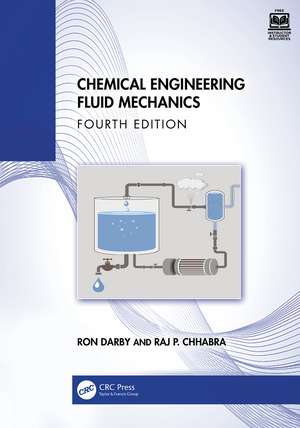
Chemical Engineering Fluid Mechanics
Autor Ron Darby, Raj P. Chhabraen Limba Engleză Hardback – 29 iul 2026
Features:
- Revised and expanded new edition of the well-loved previous edition, a Choice “Highly Recommended” title
- Presents the fundamental (macroscopic and microscopic) conservation equations that govern the behavior of fluids and applies these to a wide variety of practical situations
- Includes both Newtonian and non-Newtonian incompressible fluids and compressible fluids in subsonic through choked flow regimes as well as internal and external flows
- Delivers broad coverage of topics from multiphase flows and gas–liquid to separations
- Features a new chapter on Differential Mass and Momentum Balances
- Offers end-of-chapter summaries and problems to reinforce learning
A solutions manual and PowerPoint slides are available to adopting professors.
Preț: 965.57 lei
Preț vechi: 1177.52 lei
-18% Nou
Puncte Express: 1448
Carte tipărită la comandă
Livrare economică 30 noiembrie-14 decembrie
Livrare express 23-29 octombrie pentru 75.90 lei
Livrare prin curier în România Termenul estimat este afișat lângă disponibilitate.
Transport gratuit pentru acest produs Plată online sau ramburs, în funcție de opțiunile comenzii.
Retur gratuit în 14 zile Comandă securizată și suport în română.
Specificații
ISBN-13: 9781032777061
ISBN-10: 1032777060
Pagini: 576
Ilustrații: 374
Dimensiuni: 178 x 254 mm
Greutate: 1.21 kg
Ediția:4. Auflage
Editura: CRC Press
Colecția CRC Press
ISBN-10: 1032777060
Pagini: 576
Ilustrații: 374
Dimensiuni: 178 x 254 mm
Greutate: 1.21 kg
Ediția:4. Auflage
Editura: CRC Press
Colecția CRC Press
V-ar putea interesa
-
 -39%Preț: 663.98 lei1090.76 lei
 -
 Chemical Process Equipment: Selection and DesignJames R. Couper-24%Preț: 795.68 lei1044.54 lei
 -
 Green and Sustainable Manufacturing of Advanced MaterialMrityunjay Singh-24%Preț: 460.76 lei602.79 lei
 -
 Chemical Engineering Process SimulationNishanth G. Chemmangattuvalappil-31%Preț: 615.87 lei888.36 lei
 -
 Encapsulated CatalystsSamahe Sadjadi-26%Preț: 759.91 lei1020.35 lei
 -
 Pretreatment for Reverse Osmosis DesalinationNikolay Voutchkov-28%Preț: 1062.58 lei1471.69 lei
 -
 Sensors in Bioprocess ControlJohn Twork-15%Preț: 530.47 lei624.09 lei
 -
 Catalyst Preparation: Science and EngineeringJohn RegalbutoPreț: 477.59 lei
 -
 Micellar CatalysisMohammad Niyaz KhanPreț: 477.59 lei
 -
 Structured Catalysts and ReactorsAndrzej CybulskiPreț: 477.59 lei
 -
 Preț: 477.59 lei
 -
 Concise Handbook of Waste Treatment TechnologiesSaleh S. Al Arni-18%Preț: 1542.59 lei1881.21 lei
 -
 Fuel Cells: Current Technology Challenges and Future Research NeedsNoriko Hikosaka Behling-30%Preț: 1133.52 lei1616.52 lei
 -
 Methanol: Science and EngineeringAngelo Basile-26%Preț: 1082.83 lei1461.16 lei
 -
 -25%Preț: 1131.73 lei1518.81 lei
 -
 Numerical Methods for Chemical EngineeringKenneth J. Beers-23%Preț: 728.18 lei945.69 lei
 -
 ThermodynamicsWilliam C. Reynolds-23%Preț: 820.05 lei1065.00 lei
 -
 A Modern Course in Transport PhenomenaDavid C. Venerus-23%Preț: 772.89 lei1003.75 lei
 -
 Soap Manufacturing TechnologyLuis Spitz-27%Preț: 761.98 lei1048.62 lei
 -
 -19%Preț: 657.92 lei812.24 lei
 -
 Geopolymer Chemistry and Applications, 4th EdJoseph Davidovits-23%Preț: 931.92 lei1210.29 lei
 -
 Microfluidics for Single-Cell AnalysisJin-Ming Lin-15%Preț: 618.05 lei727.12 lei
Public țintă
Postgraduate, Professional Reference, and Undergraduate CoreCuprins
0. FRONT MATTER. 1. BASIC CONCEPTS. 2. DIMENSIONAL ANALYSIS AND SCALE-UP. 3. FLUID PROPERTIES IN PERSPECTIVE. 4. FLUID STATICS. 5. CONSERVATION PRINCIPLES. 6. DIFFERENTIAL MASS AND MOMENTUM BALANCES. 7. PIPE FLOW. 8. INTERNAL FLOW APPLICATIONS. 9. PUMPS AND COMPRESSORS. 10. COMPRESSIBLE FLOWS. 11. FLOW MEASUREMENT. 12. SAFETY RELIEF AND CONTROL VALVES. 13. EXTERNAL FLOWS. 14. FLUID–SOLID SEPARATIONS BY FREE SETTLING. 15. FLOW IN POROUS MEDIA. 16. FLUIDIZATION AND SEDIMENTATION. 17. TWO-PHASE FLOW. Appendixes.
Notă biografică
Ron Darby was born in La Veta, Colorado on September 12, 1932. He earned his BS (1955) and PhD (1963) in chemical engineering from Rice University, Houston, Texas. After working briefly for Ling-Temco-Vought (LTV) in Dallas, Texas, he returned to academia and joined the Department of Chemical Engineering at Texas A&M University (TAMU) in 1965 as an assistant professor. He remained a faculty member at TAMU until his formal retirement in 2001. Thereafter, he was Professor Emeritus until his death on July 14, 2017.
During his long career at Texas A&M, Ron taught a variety of courses in chemical engineering. His research interests were in the areas of non-Newtonian and viscoelastic fluid mechanics and two phase flows in the context of safety relief valves, and he published extensively on these topics. In addition to a large number of research publications in archival journals, Ron authored two books, Viscoelastic Fluids: An Introduction to their Properties and Behavior (Dekker, 1976) and Chemical Engineering Fluid Mechanics (3rd ed., CRC Press, 2017).
He was elected fellow of the AIChE in 1994, and he was honored with numerous awards for his research contributions. These included the Faculty Distinguished Achievement Award (1971) from his department and the Publication Award from AIChE in 1984. He was also the recipient of the Distinguished Service Award (2003) of the Texas AIChE and the Former Students Award from Texas A&M for excellence in teaching. In 1981, he was designated “Minnie Stevens Piper Professor of Chemical Engineering.”
Ron was, in addition, a captain in the U.S. navy. In 1975, he earned “First commanding officer,” USNR’s outstanding leadership award.
Prof Raj P. Chhabra is Distinguished Professor in the Department of Chemical Engineering at Shiv Nadar University, Delhi NCR. Prof Chhabra wrote the previous edition with the late Prof Ron Darby (formerly of Texas A&M University).
During his long career at Texas A&M, Ron taught a variety of courses in chemical engineering. His research interests were in the areas of non-Newtonian and viscoelastic fluid mechanics and two phase flows in the context of safety relief valves, and he published extensively on these topics. In addition to a large number of research publications in archival journals, Ron authored two books, Viscoelastic Fluids: An Introduction to their Properties and Behavior (Dekker, 1976) and Chemical Engineering Fluid Mechanics (3rd ed., CRC Press, 2017).
He was elected fellow of the AIChE in 1994, and he was honored with numerous awards for his research contributions. These included the Faculty Distinguished Achievement Award (1971) from his department and the Publication Award from AIChE in 1984. He was also the recipient of the Distinguished Service Award (2003) of the Texas AIChE and the Former Students Award from Texas A&M for excellence in teaching. In 1981, he was designated “Minnie Stevens Piper Professor of Chemical Engineering.”
Ron was, in addition, a captain in the U.S. navy. In 1975, he earned “First commanding officer,” USNR’s outstanding leadership award.
Prof Raj P. Chhabra is Distinguished Professor in the Department of Chemical Engineering at Shiv Nadar University, Delhi NCR. Prof Chhabra wrote the previous edition with the late Prof Ron Darby (formerly of Texas A&M University).
Descriere
The Fourth Edition continues to provide a balanced treatment of the basics and applications the practicing chemical engineer needs to know. Emphasizing problem solving, the book demonstrates how to make approximations and solve complex fluid mechanics problems and offers a new chapter on Differential Mass and Momentum Balances.