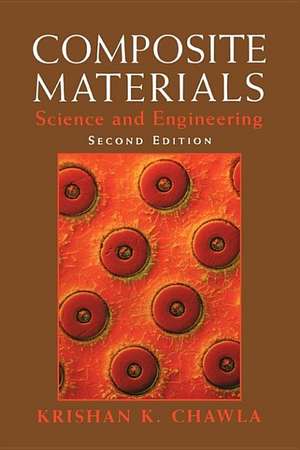
Chawla, K: Composite Materials
en Limba Engleză Paperback – 9 dec 2010
Preț: 595.79 lei
Preț vechi: 700.93 lei
-15%
Puncte Express: 894
Carte disponibilă
Livrare economică 16-30 noiembrie
Livrare prin curier în România Termenul estimat este afișat lângă disponibilitate.
Transport gratuit pentru acest produs Plată online sau ramburs, în funcție de opțiunile comenzii.
Retur gratuit în 14 zile Comandă securizată și suport în română.
Specificații
ISBN-13: 9781441931245
ISBN-10: 1441931244
Pagini: 500
Ilustrații: XIII, 483 p. 212 illus.
Dimensiuni: 155 x 235 x 27 mm
Greutate: 0.69 kg
Ediția:2. Auflage
Editura: Springer Verlag GmbH
Locul publicării:New York, NY, United States
ISBN-10: 1441931244
Pagini: 500
Ilustrații: XIII, 483 p. 212 illus.
Dimensiuni: 155 x 235 x 27 mm
Greutate: 0.69 kg
Ediția:2. Auflage
Editura: Springer Verlag GmbH
Locul publicării:New York, NY, United States
V-ar putea interesa
-
 Comprehensive Composite Materials IICarl H. Zweben-27%Preț: 22419.29 lei30922.17 lei
 -
 -23%Preț: 369.34 lei480.57 lei
 -
 Materials: Engineering, Science, Processing and DesignMichael F. Ashby-29%Preț: 429.07 lei601.54 lei
 -
 Aircraft Structures for Engineering StudentsT. H. G. Megson-30%Preț: 482.03 lei692.90 lei
 -
 Materials Selection in Mechanical DesignMichael F. Ashby-30%Preț: 455.82 lei654.07 lei
 -
 Leading-Edge Composite Material ResearchTobias G Wouters-26%Preț: 1259.00 lei1708.80 lei
 -
 Essentials of Advanced Composite Fabrication and RepairLouis C Dorworth-8%Preț: 448.81 lei487.83 lei
 -
 -30%Preț: 97.81 lei139.80 lei
 -
 -18%Preț: 1544.73 lei1883.81 lei
 -
 Composite MaterialsBrian Wisner-18%Preț: 1430.56 lei1744.58 lei
 -
 The Engineer's Guide to MaterialsK. T. Voisey-15%Preț: 523.99 lei616.46 lei
 -
 -18%Preț: 1453.87 lei1773.00 lei
 -
 -18%Preț: 1001.14 lei1220.91 lei
 -
 Advances in Material Science and MetallurgyBhingole Pramod P.-18%Preț: 954.26 lei1163.72 lei
 -
 Advances in Materials and ProcessingSupratik Roychowdhury-18%Preț: 1264.94 lei1542.61 lei
 -
 -24%Preț: 1915.67 lei2520.62 lei
 -
 Advancements in Multifunctional Composite MaterialsB. K. Behera-18%Preț: 1614.11 lei1968.42 lei
 -
 Advances in Materials EngineeringPramod Bhingole-18%Preț: 1274.10 lei1553.78 lei
 -
 Structural Composite MaterialsSatish Babu Boppana-18%Preț: 1156.49 lei1410.34 lei
 -
 Recent Advances in Composites Engineering and ResearchMulakaluri Rama Manohara Babu-18%Preț: 1165.03 lei1420.78 lei
Public țintă
GraduateCuprins
1 Introduction.- 2 Reinforcements.- 3 Matrix Materials.- 4 Interfaces.- 5 Polymer Matrix Composites.- 6 Metal Matrix Composites.- 7 Ceramic Matrix Composites.- 8 Carbon Fiber Composites.- 9 Multifilamentary Superconducting Composites.- 10 Micromechanics of Composites.- 11 Macromechanics of Composites.- 12 Monotonic Strength and Fracture.- 13 Fatigue and Creep.- 14 Designing with Composites.- Appendices.- A Matrices.- B Fiber Packing in Unidirectional Composites.- C Some Important Units and Conversion Factors.- Problems.- Author Index.
Recenzii
From the reviews:
"… Well-organized, up-to-date, informative … filled with useful tables, graphs, references, suggested readings, and illustrations. The book is well designed for its intended market …" American Scientist
From reviews of the first edition:
"covers polymer, metal, and ceramic matrix composites in a well-organized, up-to-date manner. It is filled with useful tables, graphs, references, suggested readings and illustrations." -- American Scientist
"Overall, this is an excellent book for composite materials research. It can be used as a text book for undergraduate seniors,... and as a reference book for engineers." -- Applied Mechanics Review
MRS BULLETIN
"Prof. Chawla has attempted the formidable task of including essentially all types of fiber composite materials and their properties in a single text. By employing an economic writing style and carefully selected references, figures, and suggested readings, he has successfully produced a relatively short but thorough 292-page book…Clear, concise, and complete, this book is an excellent up-to-date introduction to fiber composite materials. I would recommend it for a first course in composite materials at the advanced undergraduate or first-year graduate level. It is also valuable for the practicing engineer or scientist who wishes to become familiar with the growing field of fiber composites.”
SAMPE JOURNAL
"Readers will find this valuable text to be current, well-written and lucid. In addition each chapter contains many references and suggested reading material.”
IEEE ELECTRICAL INSULATION MAGAZINE
"This book covers thoroughly the broad base of composites. The book is divided into three parts and twelve chapters, plus a very useful set of appendices and problems.”
CHOICE MAGAZINE
"…he uses a conversational style often more intuitive than that used in other works…useful as a coursesupplement, or as a resource for students already exposed to the subject via a more traditional approach…In summary, a valuable addition to an undergraduate library collection.”
"… Well-organized, up-to-date, informative … filled with useful tables, graphs, references, suggested readings, and illustrations. The book is well designed for its intended market …" American Scientist
From reviews of the first edition:
"covers polymer, metal, and ceramic matrix composites in a well-organized, up-to-date manner. It is filled with useful tables, graphs, references, suggested readings and illustrations." -- American Scientist
"Overall, this is an excellent book for composite materials research. It can be used as a text book for undergraduate seniors,... and as a reference book for engineers." -- Applied Mechanics Review
MRS BULLETIN
"Prof. Chawla has attempted the formidable task of including essentially all types of fiber composite materials and their properties in a single text. By employing an economic writing style and carefully selected references, figures, and suggested readings, he has successfully produced a relatively short but thorough 292-page book…Clear, concise, and complete, this book is an excellent up-to-date introduction to fiber composite materials. I would recommend it for a first course in composite materials at the advanced undergraduate or first-year graduate level. It is also valuable for the practicing engineer or scientist who wishes to become familiar with the growing field of fiber composites.”
SAMPE JOURNAL
"Readers will find this valuable text to be current, well-written and lucid. In addition each chapter contains many references and suggested reading material.”
IEEE ELECTRICAL INSULATION MAGAZINE
"This book covers thoroughly the broad base of composites. The book is divided into three parts and twelve chapters, plus a very useful set of appendices and problems.”
CHOICE MAGAZINE
"…he uses a conversational style often more intuitive than that used in other works…useful as a coursesupplement, or as a resource for students already exposed to the subject via a more traditional approach…In summary, a valuable addition to an undergraduate library collection.”
Caracteristici
Request lecturer material: sn.pub/lecturer-material
Notă biografică
Krishan K. Chawla has taught and done research at institutions in Switzerland, Brazil, Canada, and the United States and has served as a consultant to industry, national laboratories, and government agencies. He is currently at the University of Alabama at Birmingham.
Textul de pe ultima copertă
This updated third edition of Krishan Chawla’s widely used textbook, Composite Materials, offers integrated and completely up-to-date coverage of composite materials. The book focuses on the triad of processing, structure, and properties, while providing a well-balanced treatment of the materials science and mechanics of composites.
In this edition of Composite Materials, revised and updated throughout, increasing use of composites in industry (especially aerospace and energy) and new developments in the field are highlighted. There is a new chapter on non-conventional composites, which covers polymer, metal and ceramic matrix nanocomposites, self-healing composites, self-reinforced composites, biocomposites and laminates made of metals and polymer matrix composites. The third edition also includes new solved examples and problems as well as increased coverage of:
Carbon/carbon brakes
Composites for civilian aircraft and jet engines
Second generation high-temperature superconducting composites
Composites for use in windmill blades
WC/metal particulate composites
Examples of practical applications in various fields are given throughout the book, and extensive references to the literature are provided. The book is intended for use in graduate and upper-division undergraduate courses, and as a reference for the practicing engineers and researchers in industry and academia.
In this edition of Composite Materials, revised and updated throughout, increasing use of composites in industry (especially aerospace and energy) and new developments in the field are highlighted. There is a new chapter on non-conventional composites, which covers polymer, metal and ceramic matrix nanocomposites, self-healing composites, self-reinforced composites, biocomposites and laminates made of metals and polymer matrix composites. The third edition also includes new solved examples and problems as well as increased coverage of:
Carbon/carbon brakes
Composites for civilian aircraft and jet engines
Second generation high-temperature superconducting composites
Composites for use in windmill blades
WC/metal particulate composites
Examples of practical applications in various fields are given throughout the book, and extensive references to the literature are provided. The book is intended for use in graduate and upper-division undergraduate courses, and as a reference for the practicing engineers and researchers in industry and academia.