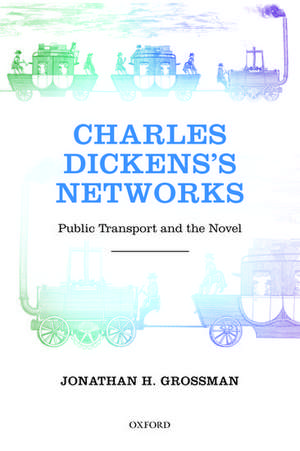
Charles Dickens's Networks: Public Transport and the Novel
Autor Jonathan H. Grossmanen Limba Engleză Paperback – 3 oct 2013
Preț: 265.79 lei
Preț vechi: 304.73 lei
-13%
Puncte Express: 399
Carte tipărită la comandă
Livrare economică 27 noiembrie-02 decembrie
Livrare prin curier în România Termenul estimat este afișat lângă disponibilitate.
Transport gratuit de la 400.00 lei Plată online sau ramburs, în funcție de opțiunile comenzii.
Retur gratuit în 14 zile Comandă securizată și suport în română.
Specificații
ISBN-13: 9780199682164
ISBN-10: 019968216X
Pagini: 272
Ilustrații: 17 black-and-white halftones and 3 maps
Dimensiuni: 156 x 234 x 16 mm
Greutate: 0.39 kg
Editura: Oxford University Press
Colecția OUP Oxford
Locul publicării:Oxford, United Kingdom
ISBN-10: 019968216X
Pagini: 272
Ilustrații: 17 black-and-white halftones and 3 maps
Dimensiuni: 156 x 234 x 16 mm
Greutate: 0.39 kg
Editura: Oxford University Press
Colecția OUP Oxford
Locul publicării:Oxford, United Kingdom
V-ar putea interesa
-
 -31%Preț: 1089.86 lei1573.21 lei
 -
 Browning's HatredsDaniel Karlin-33%Preț: 661.33 lei981.93 lei
 -
 Hardy's Fables of Integrity: Woman, Body, TextMarjorie Garson-22%Preț: 302.62 lei388.97 lei
 -
 Landor's Cleanness: A Study of Walter Savage LandorAdam Roberts-31%Preț: 769.92 lei1121.20 lei
 -
 -13%Preț: 304.17 lei350.40 lei
 -
 -28%Preț: 418.60 lei584.64 lei
 -
 Confessions of an English Opium-Eater and Other WritingsThomas De Quincey-17%Preț: 54.40 lei65.76 lei
 -
 -20%Preț: 393.82 lei494.96 lei
 -
 The Masculine Middlebrow, 1880-1950K. MacdonaldPreț: 403.68 lei
 -
 Preț: 392.97 lei
 -
 Preț: 407.47 lei
 -
 Reading Jane AustenM. ScheuermannPreț: 396.05 lei
 -
 Writing Women of the Fin de SiècleAdrienne E GavinPreț: 403.61 lei
 -
 The Cambridge Introduction to British Romantic PoetryMichael FerberPreț: 240.13 lei
Recenzii
a fine book about a series of equally fantastic techno-imaginary developments in Britain beginning in the 1820s ... I admire the disciplined focus Grossman demonstrates in his emphasis on the novel, and in particular on the novel as a precision tool wielded by Dickens
Grossman offers new and thought-provoking ways of thinking about each of the three novels that he considers.
What stands out about Charles Dickensâs Networks is the clever and convincing manner in which historical and theoretical insights concerning the Victorian transport system are used to illuminate particular episodes, generic features, and textual strategies from Dickens's fiction ... in developing such a compelling and nuanced account of the way in which the public transport revolution both impacted upon and was mediated by Dickens's fiction, this study opens up spatio-temporal dimensions of Victorian society and culture in a manner that deserves and will reward further work.
Grossman offers new and thought-provoking ways of thinking about each of the three novels that he considers.
What stands out about Charles Dickensâs Networks is the clever and convincing manner in which historical and theoretical insights concerning the Victorian transport system are used to illuminate particular episodes, generic features, and textual strategies from Dickens's fiction ... in developing such a compelling and nuanced account of the way in which the public transport revolution both impacted upon and was mediated by Dickens's fiction, this study opens up spatio-temporal dimensions of Victorian society and culture in a manner that deserves and will reward further work.
Notă biografică
Jonathan H. Grossman is Associate Professor of English at UCLA. He is also the author of The Art of Alibi: English Law Courts and the Novel (2002).