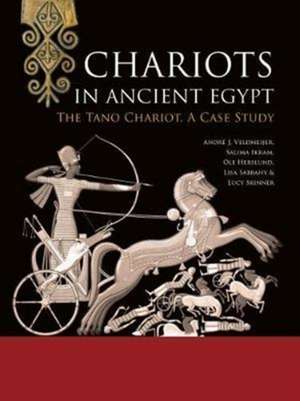
Chariots in Ancient Egypt
Autor André J. Veldmeijer, Salima Ikramen Limba Engleză Paperback – 29 mai 2018
Analiza tehnologică a fragmentelor de piele ce compun așa-numitul „Car Tano” reprezintă punctul central al acestei lucrări monumentale, oferind informații cruciale despre un element care lipsea din mormintele regale: învelișul original din piele al vehiculelor. Deși mormântul lui Tutankhamun a oferit șase care de luptă, niciunul nu și-a păstrat componentele organice exterioare. Chariots in Ancient Egypt recuperează istoria unui set de peste 60 de fragmente de piele decorată, „uitate” în depozitele Muzeului din Cairo din 1932, demonstrând cum aceste obiecte au revoluționat nu doar tacticile de război după 1600 î.Hr., ci și iconografia puterii faraonice.
Ne-a atras atenția rigoarea cu care André J. Veldmeijer și Salima Ikram documentează tehnicile de aplicație în culori roșu, verde și bej, oferind paralele cu piese nepublicate anterior din colecțiile Metropolitan Museum și Berlin. Volumul nu se limitează la descrierea materială; el integrează texte hieroglifice și analize de laborator pentru a plasa carul în contextul propagandei regale și al ceremoniilor religioase. Această lucrare este o alternativă tehnică la Bronze Age War Chariots pentru cursurile de arheologie militară, având avantajul unei abordări axate pe arheologia materialelor organice și pe reconstrucția tehnologică precisă, spre deosebire de lucrările care se concentrează strict pe strategie.
Putem afirma că volumul consolidează direcția de cercetare a autorului, vizibilă și în Let a cow-skin be brought, unde analiza pielăriei devine un instrument de descifrare a vieții cotidiene egiptene. Structura este una academică, sprijinită de o bogată ilustrație fotografică și desene tehnice, fiind esențială pentru înțelegerea modului în care ingineria și estetica s-au contopit în Egiptul Antic.
Preț: 961.46 lei
Preț vechi: 1172.52 lei
-18%
Carte disponibilă
Livrare economică 10-24 noiembrie
Livrare express 24-30 octombrie pentru 76.56 lei
Specificații
ISBN-10: 9088904669
Pagini: 590
Dimensiuni: 210 x 280 x 38 mm
Greutate: 1.82 kg
Editura: Sidestone Press
V-ar putea interesa
-
 Solon - Begruender Der Demokratie?Isabella Tsigarida-23%Preț: 485.59 lei630.64 lei
 -
 -18%Preț: 635.34 lei774.80 lei
 -
 Tutankhamun's Footwear: Studies of Ancient Egyptian FootwearAndre J. Veldmeijer-15%Preț: 484.12 lei569.55 lei
 -
 Leatherwork from Qasr Ibrim (Egypt). Part I: Footwear from the Ottoman PeriodAndre J. Veldmeijer-18%Preț: 769.59 lei938.52 lei
De ce să citești această carte
Această carte este indispensabilă egiptologilor și pasionaților de istorie militară antică, oferind prima documentare completă a fragmentelor de piele ce îmbrăcau carele de luptă. Cititorul câștigă o perspectivă unică asupra meșteșugului pielăriei și a modului în care elitele egiptene își afișau statutul. Este o resursă rară care completează lacunele lăsate de descoperirile din mormântul lui Tutankhamun prin studierea 'Carului Tano'.
Despre autor
André J. Veldmeijer este un specialist recunoscut în arheologia materialelor organice, fiind coordonatorul proiectelor Ancient Egyptian Leatherwork (AELP) și Footwear Project (AEFP). Expertiza sa se concentrează pe tehnologia prelucrării pielii și a încălțămintei în Egiptul Antic, publicând numeroase cataloage de referință precum Tutankhamun's Footwear. Salima Ikram este profesor de egiptologie la Universitatea Americană din Cairo, renumită pentru contribuțiile sale în arheozoologie și practicile de mumificare, colaborând cu Veldmeijer pentru a oferi o viziune multidisciplinară asupra artefactelor analizate.
Descriere scurtă
Notă biografică
Descriere
Since long, chariots in ancient Egypt are only known from depictions and the wooden remains from six of those vehicles from the tomb of Tutankhamun, but the present work presents for the first time a unique, complete leather casing and harnessing of a New Kingdom chariot in the collection of the Egyptian Museum (Cairo).