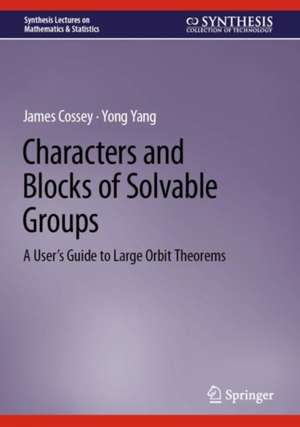
Characters and Blocks of Solvable Groups: Synthesis Lectures on Mathematics & Statistics
Autor James Cossey, Yong Yangen Limba Engleză Hardback – 13 apr 2024
Observăm în volumul Characters and Blocks of Solvable Groups o sinteză actualizată a cercetărilor din ultimele decenii în teoria reprezentării grupurilor finite rezolvabile. Spre deosebire de lucrările fundamentale care pun accent pe bazele algebrei, James Cossey și Yong Yang se concentrează pe o nișă specifică și extrem de fertilă: teoremele de tip „large orbit” (orbită mare) și capacitatea acestora de a servi drept punte între teoria grupurilor și algebra liniară.
Această ediție din 2024 aduce la zi literatura de specialitate, oferind o perspectivă mai tehnică și mai aplicată asupra unor probleme nerezolvate anterior. Dacă Representations of Solvable Groups de Olaf Manz se concentra pe module peste corpuri finite și aplicații în studiul conjecturilor Alperin-McKay, lucrarea de față adoptă o abordare mai orientată spre rezultatele moderne obținute prin studiul orbitelor, fiind un instrument de lucru esențial pentru cercetătorii care urmăresc progresele recente în domeniu.
Structura cărții este riguros logică, începând cu materialul de bază necesar pentru a înțelege grupurile liniare rezolvabile și lema de permutare a lui Gluck. Ulterior, autorii ne ghidează prin demonstrații complexe legate de conjectura lui Gluck și celebra conjectură ρ-σ a lui Huppert. Remarcăm includerea a două capitole despre grafurile Brauer, urmate de aplicații practice ce vizează clasele de conjugare și zerourile caracterelor. Notăm cu interes modul în care autorii reușesc să transforme un subiect abstract într-un parcurs demonstrativ clar, evidențiind modul în care teoremele de orbită pot fi utilizate pentru a debloca noi proprietăți structurale ale grupurilor rezolvabile.
Din seria Synthesis Lectures on Mathematics & Statistics
-
 Preț: 335.28 lei
 -
 Preț: 179.36 lei
 - 15%
 Preț: 389.57 lei
 -
 Preț: 311.08 lei
 -
 Preț: 349.73 lei
 - 15%
 Preț: 388.76 lei
 -
 Preț: 407.69 lei
 -
 Preț: 210.35 lei
 -
 Preț: 313.19 lei
 -
 Preț: 315.28 lei
 -
 Preț: 411.12 lei
 -
 Preț: 406.34 lei
 - 15%
 Preț: 427.18 lei
 -
 Preț: 296.40 lei
 -
 Preț: 404.48 lei
 -
 Preț: 313.31 lei
 -
 Preț: 294.06 lei
 -
 Preț: 318.47 lei
 -
 Preț: 346.79 lei
 -
 Preț: 313.41 lei
 - 15%
 Preț: 566.78 lei
 -
 Preț: 319.82 lei
 - 15%
 Preț: 530.40 lei
 -
 Preț: 311.36 lei
 -
 Preț: 255.81 lei
 -
 Preț: 259.66 lei
 -
 Preț: 399.82 lei
 -
 Preț: 260.81 lei
 -
 Preț: 438.15 lei
 -
 Preț: 199.08 lei
 -
 Preț: 180.19 lei
 -
 Preț: 471.85 lei
 -
 Preț: 261.99 lei
 -
 Preț: 436.47 lei
 -
 Preț: 295.24 lei
 -
 Preț: 369.85 lei
 -
 Preț: 251.71 lei
 -
 Preț: 346.49 lei
 -
 Preț: 439.83 lei
 -
 Preț: 152.59 lei
 -
 Preț: 370.01 lei
 -
 Preț: 178.43 lei
 -
 Preț: 470.91 lei
 -
 Preț: 275.28 lei
 -
 Preț: 375.40 lei
 -
 Preț: 322.97 lei
 -
 Preț: 198.39 lei
 -
 Preț: 319.89 lei
Preț: 313.19 lei
Carte disponibilă
Livrare economică 26 mai-09 iunie
Specificații
ISBN-10: 3031507053
Pagini: 172
Ilustrații: IX, 159 p. 1 illus.
Dimensiuni: 173 x 246 x 16 mm
Greutate: 0.48 kg
Ediția:2024
Editura: Springer
Colecția Synthesis Lectures on Mathematics & Statistics
Seria Synthesis Lectures on Mathematics & Statistics
Locul publicării:Cham, Switzerland
De ce să citești această carte
Această lucrare este indispensabilă cercetătorilor și studenților avansați în matematică interesați de algebra abstractă. Cititorul câștigă o înțelegere profundă a teoremelor de orbită mare, un instrument puternic în teoria reprezentării. Este o recomandare solidă pentru cei care doresc să stăpânească tehnicile moderne necesare pentru a aborda conjecturi celebre precum cele ale lui Gluck sau Huppert, oferind o punte între teoria clasică și cercetarea contemporană.
Despre autor
James Cossey și Yong Yang sunt matematicieni recunoscuți pentru contribuțiile lor în domeniul algebrei, specializați în teoria caracterelor și reprezentarea grupurilor finite. James Cossey a publicat extensiv despre structura grupurilor rezolvabile, în timp ce Yong Yang este cunoscut pentru cercetările sale privind acțiunile grupurilor și lungimea orbitelor. Expertiza lor combinată în acest volum publicat de Springer oferă o autoritate academică rară, transformând teme complexe de cercetare în resurse accesibile pentru comunitatea matematică internațională.
Cuprins
Notă biografică
Textul de pe ultima copertă
- Discusses recent developments in the representation theory of finite solvable groups
- Provides an extensive survey of the current state of the large-orbit theorems, providing a broad overview of the topic
- Includes proofs that demonstrate how these theorems can be applied to prove new results about solvable groups
Descriere
This book highlights recent developments in the representation theory of finite solvable groups, which seeks to connect group theory to linear algebra in ways that allow for better study of the groups in question.