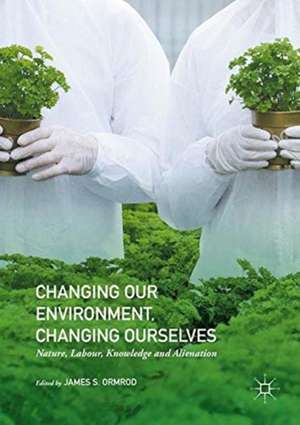
Changing our Environment, Changing Ourselves
Editat de James S. Ormroden Limba Engleză Paperback – 21 apr 2021
Preț: 375.61 lei
Puncte Express: 563
Carte tipărită la comandă
Livrare economică 01-15 decembrie
Livrare prin curier în România Termenul estimat este afișat lângă disponibilitate.
Transport gratuit de la 400.00 lei Plată online sau ramburs, în funcție de opțiunile comenzii.
Retur gratuit în 14 zile Comandă securizată și suport în română.
Specificații
ISBN-13: 9781349848959
ISBN-10: 1349848956
Pagini: 336
Ilustrații: XVII, 315 p. 4 illus., 2 illus. in color.
Dimensiuni: 148 x 210 x 19 mm
Greutate: 0.44 kg
Ediția:1st ed. 2016
Editura: Palgrave MacMillan
Locul publicării:London, United Kingdom
ISBN-10: 1349848956
Pagini: 336
Ilustrații: XVII, 315 p. 4 illus., 2 illus. in color.
Dimensiuni: 148 x 210 x 19 mm
Greutate: 0.44 kg
Ediția:1st ed. 2016
Editura: Palgrave MacMillan
Locul publicării:London, United Kingdom
V-ar putea interesa
-
 Green Men & White SwansJacqueline SimpsonPreț: 108.87 lei
 -
 Case Studies and Causal InferenceI. Rohlfing-18%Preț: 812.80 lei991.22 lei
 -
 Preț: 399.29 lei
 -
 Engineering SocietyKerstin BrückwehPreț: 415.38 lei
 -
 Recognition Theory as Social ResearchShane O'NeillPreț: 406.28 lei
 -
 Clumsy Solutions for a Complex WorldM. VerweijPreț: 399.72 lei
 -
 -15%Preț: 719.68 lei846.69 lei
 -
 Macionis, J: SociologyKen Plummer-13%Preț: 470.71 lei541.04 lei
 -
 Preț: 414.50 lei
 -
 Preț: 285.74 lei
 -
 OligarchyJeffrey A. WintersPreț: 210.03 lei
 -
 Preț: 270.88 lei
 -
 Performance and PowerJeffrey C AlexanderPreț: 203.06 lei
 -
 Sociology for DummiesJay GablerPreț: 139.50 lei
 -
 Preț: 478.59 lei
 -
 Language Myths, Mysteries and MagicK. StollznowPreț: 434.51 lei
 -
 American GraceRobert D PutnamPreț: 166.21 lei
 -
 The Initiate 2David J. WingfieldPreț: 143.19 lei
Cuprins
- Introduction: Changing our environment, changing ourselves.- PART I: THE WORK OF PETER DICKENS.- 1. Peter Dickens: Late capitalism, nature and mental life.- 2. Defragmenting nature: Themes in Peter Dickens’s work.- PART II: PHILOSOPHICAL AND THEORETICAL DEBATES.- 3. Environmental alienation.- 4. Marx’s universal metabolism of nature and the Frankfurt School: Dialectical contradictions and critical syntheses.- PART III: EMERGING ISSUES.- 5. Metabolic rift theory and the crisis of our foodways.- 6. Satellite farming, food and human wellbeing.- 7. Computers and the alienation of thinking: From Deep Blue to the Googlemobile.- 8. Society, nature and experience: Jouissance on the margins.
Textul de pe ultima copertă
In this book, a celebration of the work of the sociologist Peter Dickens serves as the catalyst for exploring the relationship between human ‘internal nature’ (our health and psychological well-being) and ‘external nature’ (the environment on which we depend and which we collectively transform). Across contributions from Ted Benton, James Ormrod, Kate Soper, John Bellamy Foster and Brett Clark, Graham Sharp, James Addicott, Kathryn Dean and Peter Dickens himself, the book draws attention to alienation associated with the promotion of different knowledges in late capitalist production. But it also highlights the possibilities for generating less alienated relations with our environment in the future. As well as discussing the philosophical and theoretical issues involved, the book contains contemporary case studies of ultra-processed food, satellite farming, computerised thinking and dark tourism.