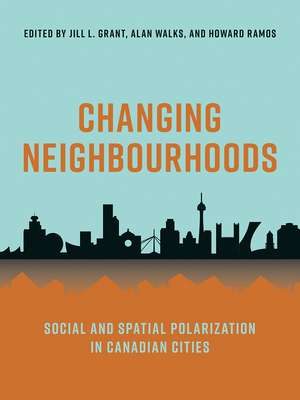
Changing Neighbourhoods: Social and Spatial Polarization in Canadian Cities
Editat de Jill L. Granten Limba Engleză Hardback – 15 oct 2020
Publicată sub egida University of British Columbia Press, această lucrare reprezintă o analiză riguroasă a transformărilor urbane canadiene din ultimele patru decenii. Ne-a atras atenția structura sa fundamentată pe datele colectate de Neighbourhood Change Research Partnership, care oferă o perspectivă comparativă unică asupra a șapte metropole majore: Toronto, Montreal, Vancouver, Calgary, Winnipeg, Hamilton și Halifax. Volumul nu se limitează la o descriere statistică, ci investighează modul în care inegalitatea economică și polarizarea socio-spațială au redefinit accesul la locuire și calitatea vieții începând cu anii 1980.
Primele trei capitole stabilesc cadrul teoretic și metodologic, abordând dificultățile cercetării dinamicii cartierelor. În miezul cărții, autorii utilizează cartografierea veniturilor medii pentru a expune factorii sociali, economici și culturali care au condus la segregare. Apreciem în mod deosebit capitolele finale, care transformă datele brute în recomandări de politici publice și reflecții teoretice esențiale pentru viitorul urbanismului.
Changing Neighbourhoods reprezintă o alternativă localizată și empirică la Urban Segregation and the Welfare State pentru cursurile de planificare urbană și geografie socială. În timp ce volumul lui Sako Musterd oferă o privire globală asupra segregării, lucrarea editată de Jill L. Grant aduce avantajul unei metodologii unitare aplicate sistemului urban canadian, oferind o profunzime a detaliului greu de egalat în studiile multinaționale. Tonul este unul academic, precis, punând accent pe urgența unor răspunsuri politice concertate în fața diversificării populației urbane.
Preț: 563.62 lei
Carte disponibilă
Livrare economică 09-23 noiembrie
Livrare express 24-30 octombrie pentru 62.19 lei
Specificații
ISBN-10: 0774862025
Pagini: 352
Dimensiuni: 191 x 254 x 25 mm
Greutate: 0.93 kg
Editura: University of British Columbia Press
Colecția University of British Columbia Press
V-ar putea interesa
-
 Left BehindPaul CollierPreț: 93.10 lei
 -
 Great American City: Chicago and the Enduring Neighborhood EffectRobert J. SampsonPreț: 187.04 lei
 -
 Preț: 278.33 lei
 -
 The Death and Life of GentrificationJaponica Brown-SaracinoPreț: 175.59 lei
 -
 In Their Place: The Imagined Geographies of PovertyStephen CrossleyPreț: 155.28 lei
 -
 Preț: 323.41 lei
 -
 Preț: 413.31 lei
 -
 Insurgent Urbanisms in the AmericasKristine StiphanyPreț: 383.51 lei
 -
 -18%Preț: 1109.25 lei1352.73 lei
 -
 Welcome to the NeighbourhoodJane FallonPreț: 73.28 lei
 -
 EqualityThomas PikettyPreț: 84.22 lei
 -
 Messy CitiesZahra EbrahimPreț: 129.97 lei
 -
 The New Urban CrisisRichard Florida-5%Preț: 90.10 lei94.41 lei
 -
 The Homegrown CityMatias EchanovePreț: 152.61 lei
 -
 Making EqualGraeme AthertonPreț: 162.13 lei
 -
 Nature, Culture, and InequalityThomas PikettyPreț: 93.66 lei
 -
 Dual Cities: Social Housing in London & New YorkKarakusevic PaulPreț: 406.22 lei
 -
 Preț: 410.18 lei
 -
 Urban Inequality and Segregation in Europe and ChinaGwilym PrycePreț: 203.66 lei
 -
 Suburbia Reconsidered, Volume 3Pavlína Flaj¿arová-24%Preț: 827.29 lei1088.54 lei
De ce să citești această carte
Această carte este indispensabilă pentru urbaniști, sociologi și decidenți politici interesați de modul în care inegalitatea economică modelează orașele. Cititorul câștigă o înțelegere bazată pe date concrete a modului în care cartierele se transformă din spații ale diversității în enclave ale bogăției sau sărăciei. Este un instrument esențial pentru a înțelege dinamica urbană canadiană și pentru a fundamenta strategii de planificare mai echitabile.
Despre autor
Jill L. Grant este Profesor Emerit la School of Planning din cadrul Universității Dalhousie și o figură centrală în cercetarea urbanismului canadian. Expertiza sa acoperă planificarea comunitară, designul urban și dimensiunile sociale ale locuirii. În calitate de editor al acestui volum, ea coordonează eforturile Neighbourhood Change Research Partnership, consolidând o carieră dedicată înțelegerii modului în care formele urbane și politicile de planificare influențează interacțiunile umane și echitatea socială în marile orașe.
Descriere scurtă
This book examines the dimensions and impacts of increased economic inequality and urban socio-spatial polarization since the 1980s. Based on the work of the Neighbourhood Change Research Partnership, an innovative national comparative study of seven cities (Toronto, Montreal, Vancouver, Calgary, Winnipeg, Hamilton, and Halifax), the authors reveal the dynamics of neighbourhood change across the Canadian urban system. By mapping average income trends across neighbourhoods, they show the kinds of factors – social, economic, and cultural – that influenced residential options and redistributed concentrations of poverty and affluence. While the heart of the book lies in the project’s findings from each city, other chapter provide important context. The first three chapters discuss the trends, theories, and methodological puzzles that motivated the research and guided its development. The final two chapters offer reflections on lessons learned from the research and the implications for theory and practice. Taken together, they offer important understandings of the depth and the breadth of the problem at hand and signal the urgency for concerted policy responses in the decades to come.