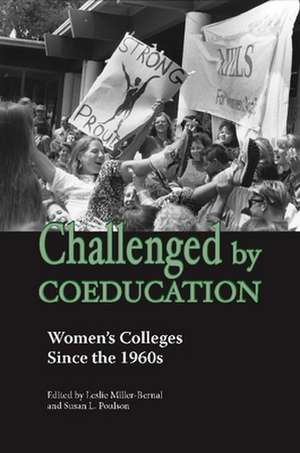
Challenged by Coeducation: Women's Colleges Since the 1960s
Editat de Leslie Miller-Bernal, Susan L. Poulsonen Limba Engleză Paperback – 22 ian 2007
Challenged by Coeducation details the responses of women's colleges to this latest wave of coeducation. Case studies written expressly for this volume include many types of women's colleges-Catholic and secular; Seven Sisters and less prestigious; private and state; liberal arts and more applied; northern, southern, and western; urban and rural; independent and coordinated with a coeducational institution. They demonstrate the principal ways women's colleges have adapted to the new coeducational era: some have been taken over or closed, but most have changed by admitting men and thereby becoming coeducational, or by offering new programs to different populations. Some women's colleges, mostly those that are in cities, connected to other colleges, and prestigious with a high endowment, still enjoy success.
Despite their dramatic drop in numbers, from 250 to fewer than 60 today, women's colleges are still important, editors Miller-Bernal and Poulson argue. With their commitment to enhancing women's lives, women's colleges and formerly women's colleges can serve as models of egalitarian coeducation.
| Toate formatele și edițiile | Preț | Express |
|---|---|---|
| Paperback (1) | 310.94 lei 6-8 săpt. | |
| Vanderbilt University Press – 22 ian 2007 | 310.94 lei 6-8 săpt. | |
| Hardback (1) | 575.19 lei 6-8 săpt. | |
| Vanderbilt University Press – 22 ian 2007 | 575.19 lei 6-8 săpt. |
Preț: 310.94 lei
Puncte Express: 466
Preț estimativ în valută:
54.100€ • 64.29$ • 47.81£
54.100€ • 64.29$ • 47.81£
Carte tipărită la comandă
Livrare economică 07-21 martie
Specificații
ISBN-13: 9780826515438
ISBN-10: 0826515436
Pagini: 392
Dimensiuni: 152 x 229 x 29 mm
Greutate: 0.68 kg
Editura: Vanderbilt University Press
Colecția Vanderbilt University Press
ISBN-10: 0826515436
Pagini: 392
Dimensiuni: 152 x 229 x 29 mm
Greutate: 0.68 kg
Editura: Vanderbilt University Press
Colecția Vanderbilt University Press
V-ar putea interesa
-
 GeishaLiza Dalby-38%Preț: 72.57 lei116.54 lei
 -
 Autobiography Of A GeishaSayo MasudaPreț: 108.98 lei
 -
 The Woman Reader 1837-1914Kate Flint-14%Preț: 363.65 lei423.79 lei
 -
 -24%Preț: 378.97 lei500.42 lei
 -
 Women's Fiction and the Great WarSuzanne Raitt-36%Preț: 270.07 lei421.58 lei
 -
 English Feminism, 1780-1980Barbara Caine-24%Preț: 368.20 lei483.89 lei
 -
 -31%Preț: 510.09 lei743.70 lei
 -
 -29%Preț: 654.91 lei917.46 lei
 -
 -60%Preț: 241.60 lei596.61 lei
 -
 The Impact of Women in CongressDebra L. Dodson-9%Preț: 276.15 lei304.56 lei
 -
 Woman Defamed and Woman Defended: An Anthology of Medieval TextsAlcuin Blamires-11%Preț: 362.10 lei406.86 lei
 -
 Women in Late Antiquity: Pagan and Christian Life-stylesGillian Clark-11%Preț: 432.42 lei485.87 lei
 -
 Gender and Human RightsKaren Knop-11%Preț: 385.87 lei433.55 lei
 -
 Women at Work: An Economic PerspectiveTito Boeri-24%Preț: 342.76 lei448.45 lei
 -
 Women Who Run with the WolvesClarissa Pinkola EstésPreț: 61.95 lei
 -
 Preț: 102.22 lei
 -
 A Suitable Job for a WomanVal McDermidPreț: 104.76 lei
Notă biografică
Leslie Miller-Bernal, Professor of Sociology at Wells College, is the author of Separate by Degree: Women Students' Experiences in Women's and Coeducational Colleges and co-editor of Going Coed: Women's Experiences in Formerly Men's Colleges and Universities, 1950-2000 (Vanderbilt University Press). .
Susan L. Poulson is Professor of History at the University of Scranton. Together with Leslie Miller-Bernal, she co-edited Going Coed: Women's Experiences in Formerly Men's Colleges and Universities, 1950-2000 (Vanderbilt University Press).
Susan L. Poulson is Professor of History at the University of Scranton. Together with Leslie Miller-Bernal, she co-edited Going Coed: Women's Experiences in Formerly Men's Colleges and Universities, 1950-2000 (Vanderbilt University Press).
Recenzii
Leslie Miller-Bernal and Susan Poulson offer a new perspective on the familiar topic of coeducation and women's colleges.
--Catholic Historical Review
A fair, balanced account of the circumstances surrounding coeducation--both its benefits and its limitations.
--Choice
...comprehensive, accessible, and offers valuable information for those interested in gender equality in higher education.
--Contemporary Sociology
--Catholic Historical Review
A fair, balanced account of the circumstances surrounding coeducation--both its benefits and its limitations.
--Choice
...comprehensive, accessible, and offers valuable information for those interested in gender equality in higher education.
--Contemporary Sociology