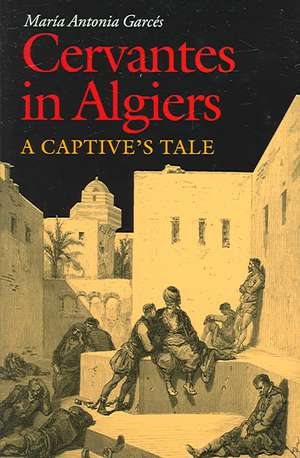
Cervantes in Algiers: A Captive's Tale
Autor Maria Antonia Garcesen Limba Engleză Paperback – mar 2005
The idea that survivors of captivity need to repeat their story in order to survive (an insight invoked from Coleridge to Primo Levi to Dori Laub) explains not only Cervantes's storytelling but also the book that theorizes it so compellingly. As a former captive herself (a hostage of Colombian guerrillas), the author reads and listens to Cervantes with another ear.
| Toate formatele și edițiile | Preț | Express |
|---|---|---|
| Paperback (1) | 308.74 lei 6-8 săpt. | |
| Vanderbilt University Press – mar 2005 | 308.74 lei 6-8 săpt. | |
| Hardback (1) | 464.89 lei 6-8 săpt. | |
| Vanderbilt University Press – 25 sep 2002 | 464.89 lei 6-8 săpt. |
Preț: 308.74 lei
Puncte Express: 463
Preț estimativ în valută:
54.65€ • 63.71$ • 47.34£
54.65€ • 63.71$ • 47.34£
Carte tipărită la comandă
Livrare economică 27 februarie-13 martie
Preluare comenzi: 021 569.72.76
Specificații
ISBN-13: 9780826514707
ISBN-10: 0826514707
Pagini: 368
Dimensiuni: 152 x 229 x 25 mm
Greutate: 0.63 kg
Ediția:Revised
Editura: Vanderbilt University Press
Colecția Vanderbilt University Press
ISBN-10: 0826514707
Pagini: 368
Dimensiuni: 152 x 229 x 25 mm
Greutate: 0.63 kg
Ediția:Revised
Editura: Vanderbilt University Press
Colecția Vanderbilt University Press
V-ar putea interesa
-
 One Flesh: Paradisal Marriage and Sexual Relations in the Age of MiltonJames Grantham Turner-34%Preț: 571.67 lei862.21 lei
 -
 -37%Preț: 645.62 lei1027.89 lei
 -
 -28%Preț: 331.87 lei458.20 lei
 -
 The Literary Culture of the Reformation: Grammar and GraceBrian Cummings-11%Preț: 408.96 lei459.51 lei
 -
 -20%Preț: 337.83 lei422.94 lei
 -
 Shakespeare in PartsSimon Palfrey-13%Preț: 273.60 lei312.81 lei
 -
 -14%Preț: 362.84 lei423.35 lei
 -
 -15%Preț: 678.24 lei797.93 lei
 -
 Middleton and Rowley: The ChangelingJay O'BerskiPreț: 147.54 lei
 -
 Preț: 376.75 lei
 -
 The Merry Wives of WindsorProf. Eric Rasmussen-13%Preț: 63.15 lei72.27 lei
 -
 Teaching the Early Modern PeriodD. ConroyPreț: 371.20 lei
 -
 Shakespeare's SonnetsProf. Eric Rasmussen-29%Preț: 61.22 lei86.59 lei
 -
 Preț: 368.23 lei
 -
 The Cambridge Shakespeare GuideEmma SmithPreț: 112.35 lei
 -
 An Eighteenth Century Gentlemen and Other EssaysS. C. RobertsPreț: 265.05 lei
 -
 Preț: 325.34 lei
 -
 The Solitudes of Don Luis De Góngora: A Text with Verse TranslationDon Luis de GongoraPreț: 285.23 lei
 -
 Preț: 325.14 lei
 -
 Preț: 319.59 lei
 -
 An Apologie for Poetrie by Sir Philip SidneyEvelyn S. ShuckburghPreț: 286.32 lei
 -
 The Life of Sir Philip SidneyMalcolm William WallacePreț: 393.13 lei
 -
 La Venganza De TamarTirso De MolinaPreț: 308.19 lei
 -
 Preț: 294.64 lei
 -
 Preț: 196.45 lei
 -
 Preț: 342.85 lei
 -
 Reading Shakespeare's SonnetsDon PatersonPreț: 117.24 lei
 -
 Tis Pity She's A Whore: A critical guideProfessor Lisa Hopkins-16%Preț: 222.42 lei264.42 lei
Notă biografică
Maria Antonia Garces, a former captive herself (a hostage of Colombian guerrillas), is associate professor of Hispanic studies, Cornell University.
Recenzii
Maria Antonia Garces provides new and fascinating interpretations of Cervantes' texts . . . [Her] book is grounded on the link between trauma and creativity . . . The commingling of history, biography, and trauma studies and, most importantly, the vivid narrative of an Algiers that Cervantes constantly recalls, make of this an exciting and fascinating read. This is an important book that provides new and compelling insights into Cervantes' Algiers.
--Renaissance Quarterly
[Highly recommended] not because it gives a personal picture of prison life . . . or because it bolsters a new theory of trauma criticism . . . [but] because it accomplishes something that is greatly needed among Hispanists, which is to say that it gets out of the fiction into the real world in which it was produced.
--BHR
The significance of this book is enormous, as it is the first to chronicle Cervantes's five-year captivity in Algiers as both a traumatic and creative event [. . .] Garces's book will open up new avenues not only for rethinking the connections between trauma and captivity, but also for questioning the complex relations between Christian Spain and Islam in early modern times.
--Diana de Armas Wilson
--Renaissance Quarterly
[Highly recommended] not because it gives a personal picture of prison life . . . or because it bolsters a new theory of trauma criticism . . . [but] because it accomplishes something that is greatly needed among Hispanists, which is to say that it gets out of the fiction into the real world in which it was produced.
--BHR
The significance of this book is enormous, as it is the first to chronicle Cervantes's five-year captivity in Algiers as both a traumatic and creative event [. . .] Garces's book will open up new avenues not only for rethinking the connections between trauma and captivity, but also for questioning the complex relations between Christian Spain and Islam in early modern times.
--Diana de Armas Wilson