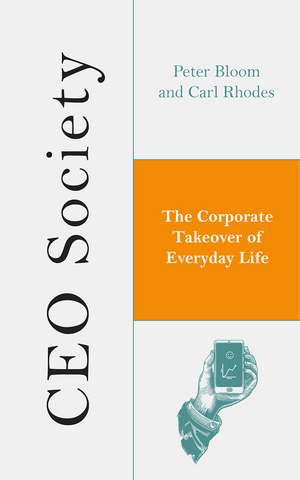
CEO Society: The Corporate Takeover of Everyday Life
Autor Professor Peter Bloom, Carl Rhodesen Limba Engleză Paperback – 15 apr 2018
Descoperim în CEO Society o analiză critică a modului în care logica eficienței corporatiste a depășit granițele companiilor, devenind un model de conduită pentru întreaga societate. Aplicabilitatea practică a acestui volum rezidă în capacitatea sa de a decripta de ce, în ciuda eșecurilor economice recente, figura liderului de tip CEO — exemplificată prin Steve Jobs sau Mark Zuckerberg — rămâne un reper cultural dominant. Remarcăm o structură riguroasă care ghidează cititorul de la procesul de idolatrizare a executivului, în primele capitole, către analize complexe despre „politicianul-CEO” și transformarea individului obișnuit într-un competitor pe o piață a existenței gestionată după principii de business.
Această lucrare ocupă o nișă similară cu Hail to the CEO de James Hoopes, însă CEO Society propune o abordare mai sistemică și mai orientată către sociologia politică, nu doar către etica managerială. Dacă Hail to the CEO se concentrează pe pericolele cultului moralității în leadership, Professor Peter Bloom și Carl Rhodes extind discuția spre modul în care cetățenii înșiși încep să imite calitățile executivilor în căutarea succesului personal. În contextul operei autorilor, volumul rafinează temele explorate de Professor Peter Bloom în lucrări precum „The Ethics of Neoliberalism”, trecând de la analiza moralității capitalismului la impactul său direct asupra vieții cotidiene. Progresia narativă, de la promisiunea „salvării” prin management până la costul ridicat al acestei mentalități asupra democrației, oferă o perspectivă lucidă asupra presiunilor sociale contemporane.
Preț: 130.60 lei
Preț vechi: 164.61 lei
-21%
Carte disponibilă
Livrare economică 07-21 noiembrie
Livrare express 24-30 octombrie pentru 58.68 lei
Specificații
ISBN-10: 1786990725
Pagini: 288
Dimensiuni: 134 x 214 x 24 mm
Greutate: 0.32 kg
Ediția:1
Editura: Bloomsbury Publishing
Colecția Zed Books
Locul publicării:London, United Kingdom
De ce să citești această carte
Recomandăm această carte studenților și profesioniștilor din științe politice și sociologie care doresc să înțeleagă mecanismele din spatele succesului liderilor populiști cu profil de om de afaceri. Cititorul câștigă un instrument critic de analiză a presiunilor de auto-optimizare și o înțelegere profundă a modului în care interesele corporatiste redefinesc democrația modernă. Este o lectură esențială pentru a distinge între managementul eficient și guvernarea democratică.
Descriere
But why, in the wake of the failings exposed by the 2008 financial crisis, does the corporate ideal continue to exert such a grip on popular attitudes? In this insightful new book, Bloom and Rhodes examine the rise of the CEO society, and how it has started to transform governments, culture and the economy. This influence, they argue, holds troubling implications for the future of democracy - as evidenced by the disturbing political rise of Donald Trump in the US - and for our society as a whole.
Cuprins
1. Welcome to the CEO Society
2. The Idolisation of the CEO
3. Competing in the Executive Economy
4. The CEO Politician
5. The CEO as a Model for Living
6. The Generous CEO?
7. The Bad Faith of CEO Salvation
Afterword: The High Cost of the CEO Society
Recenzii
When the answer to any problem is sending a CEO to the rescue, we are in deep trouble. This smart and insightful book takes a look at the increasing veneration of CEOs, and the damage it is doing to our society.
In spite of the thorough and still growing critique of the leadership cult, CEOs proliferate in both private and public sectors. Let us hope that Bloom and Rhodes' book will serve as an antidote.
Essential reading for anyone wanting to understand the contemporary fetishisation of corporate leadership. Rhodes and Bloom trace the rise of the cult of the CEO, mounting a strong defence of democracy in the face of this celebratory authoritarianism.
This unique book sheds light on one of the most tragic paradoxes of contemporary life: Why do we celebrate neoliberalism, through today's "cult of the CEO"? Bloom and Rhodes explain our deep-seated attachments to ideologies that are not only flawed but also dangerous.
Many of today's CEOs purport to serve the public good. They are wealth takers re-branded as wealth creators. This book illuminates the dangers of CEO worship in an age of entrenched austerity.
In a CEO society, only winners are allowed. In this timely and passionate book, Bloom and Rhodes identify what is at stake as corporate leadership replaces all other models for success. It delivers solace and motivation for anyone who believes that equity and justice should matter in governance.
A fascinating look at how the near deification of corporate executives has corroded culture across the globe, with dire implications for democracy. This is a wake-up call to rethink our values before it is too late to save hard-won and irreplaceable public institutions.
Bloom and Rhodes skilfully follow the ideology of the CEO into every corner of our society, revealing its sources, its impacts, and the resistance it is generating. Highly recommended for anyone concerned with contemporary capitalism.