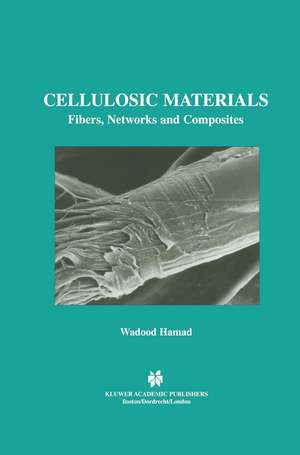
Cellulosic Materials: Fibers, Networks and Composites
Autor Wadood Y. Hamaden Limba Engleză Paperback – 13 mar 2014
The book is structured in five chapters which provide a sequential treatment of the running theme: deformation mechanics and the physical, morphological and mechanical characterization of native cellulose fibers networks and composites.
The heart of the book is Chapter 3, Damage Accumulation in Fibers, which treats the experimental methodology for fatigue testing of single fibers and the engendered results. In-depth examinations of the morphology, structure and chemical composition of native cellulose fibers, and the mechanics of deformation in these natural composite fibers are proffered in Chapters 1 and 2, respectively.
The fourth chapter, Fractal Simulation of Crack Propagation, presents a fractal-based approach to modeling damage accumulation in materials. Fractals lend themselves well to modeling such randomly-oriented phenomena as crack propagation and fracture.
The last chapter, Fibrous Structures: Networks and Composites, comprises analytical approaches for handling networks and composites.
Preț: 906.80 lei
Preț vechi: 1105.86 lei
-18%
Puncte Express: 1360
Carte tipărită la comandă
Livrare economică 30 noiembrie-14 decembrie
Livrare prin curier în România Termenul estimat este afișat lângă disponibilitate.
Transport gratuit pentru acest produs Plată online sau ramburs, în funcție de opțiunile comenzii.
Retur gratuit în 14 zile Comandă securizată și suport în română.
Specificații
ISBN-13: 9781461352570
ISBN-10: 1461352576
Pagini: 272
Ilustrații: XXVIII, 239 p.
Dimensiuni: 155 x 235 x 14 mm
Greutate: 0.39 kg
Ediția:Softcover reprint of the original 1st ed. 2002
Editura: Springer Us
Colecția Springer
Locul publicării:New York, NY, United States
ISBN-10: 1461352576
Pagini: 272
Ilustrații: XXVIII, 239 p.
Dimensiuni: 155 x 235 x 14 mm
Greutate: 0.39 kg
Ediția:Softcover reprint of the original 1st ed. 2002
Editura: Springer Us
Colecția Springer
Locul publicării:New York, NY, United States
V-ar putea interesa
-
 -18%Preț: 988.90 lei1205.97 lei
 -
 The Inorganic Chemistry of MaterialsPaul J. van der Put-18%Preț: 992.24 lei1210.04 lei
 -
 Small Particles TechnologyDale A. Brandreth-18%Preț: 993.52 lei1211.61 lei
 -
 -18%Preț: 1290.49 lei1573.77 lei
 -
 -18%Preț: 1375.91 lei1677.94 lei
 -
 -18%Preț: 1002.44 lei1222.49 lei
 -
 -18%Preț: 1273.21 lei1552.70 lei
 -
 -18%Preț: 1868.62 lei2278.81 lei
 -
 Handbook Of Fillers For PlasticsJ. V. Mileski-18%Preț: 2058.97 lei2510.94 lei
 -
 Residual StressSchajer-9%Preț: 965.33 lei1060.80 lei
 -
 Cellulose NanocrystalsWadood Y Hamad-23%Preț: 780.46 lei1013.59 lei
 -
 -15%Preț: 666.00 lei783.53 lei
 -
 Metal Matrix Composites in IndustryAlexander Evans-18%Preț: 964.46 lei1176.17 lei
 -
 Collected Papers of R.S. RivlinGrigory I. Barenblatt-24%Preț: 1172.90 lei1543.29 lei
 -
 Scanning Electron Microscopy and X-Ray MicroanalysisJoseph Goldstein-15%Preț: 749.29 lei881.52 lei
 -
 Large Plastic Deformation of Crystalline AggregatesCristian Teodosiu-15%Preț: 646.40 lei760.47 lei
 -
 Small-Angle Scattering from Confined and Interfacial FluidsYuri B. Melnichenko-15%Preț: 674.07 lei793.03 lei
 -
 Quality of Machined Wood SurfacesEtele Csanády-15%Preț: 668.10 lei785.99 lei
 -
 -15%Preț: 676.61 lei796.01 lei
 -
 -15%Preț: 664.46 lei781.72 lei
 -
 Controlled Atmosphere Transmission Electron MicroscopyThomas Willum Hansen-15%Preț: 672.01 lei790.60 lei
 -
 Characterization of Metals and AlloysRamiro Pérez Campos-18%Preț: 752.06 lei917.14 lei
 -
 Measurement, Testing and Sensor TechnologyHorst Czichos-19%Preț: 545.38 lei673.30 lei
 -
 THz Technology Applied to Cultural Heritage in PracticeKaori Fukunaga-20%Preț: 634.53 lei793.16 lei
 -
 Analytical Transmission Electron MicroscopyJürgen ThomasPreț: 413.59 lei
 -
 -15%Preț: 659.78 lei776.21 lei
Public țintă
ResearchDescriere
The objectives of this book are twofold: 1. To provide a thorough examination of the materials science of cellulosic fibers with emphasis on the characterization of structure-property relations, and 2. To advance knowledge of how to best analyze cellulosic fibrous networks and composites, and, ultimately, engineer "novel" cellulose-based systems of superior performance and functionality. The design of new materials through the study of living systems, or bio-imitation, is burgeoning to become an established field, generally referred to as biomimetics. The latter, as with materials science, in general, prominently features multi-disciplinarity where new developments in mathematics, physics, chemistry and engineering continue to inspire novel areas of research and development.
The book is structured in five chapters which provide a sequential treatment of the running theme: deformation mechanics and the physical, morphological and mechanical characterization of native cellulose fibers networks and composites.
The heart of the book is Chapter 3, Damage Accumulation in Fibers, which treats the experimental methodology for fatigue testing of single fibers and the engendered results. In-depth examinations of the morphology, structure and chemical composition of native cellulose fibers, and the mechanics of deformation in these natural composite fibers are proffered in Chapters 1 and 2, respectively.
The fourth chapter, Fractal Simulation of Crack Propagation, presents a fractal-based approach to modeling damage accumulation in materials. Fractals lend themselves well to modeling such randomly-oriented phenomena as crack propagation and fracture.
The last chapter, Fibrous Structures: Networks and Composites, comprises analytical approaches for handling networks and composites.
The book is structured in five chapters which provide a sequential treatment of the running theme: deformation mechanics and the physical, morphological and mechanical characterization of native cellulose fibers networks and composites.
The heart of the book is Chapter 3, Damage Accumulation in Fibers, which treats the experimental methodology for fatigue testing of single fibers and the engendered results. In-depth examinations of the morphology, structure and chemical composition of native cellulose fibers, and the mechanics of deformation in these natural composite fibers are proffered in Chapters 1 and 2, respectively.
The fourth chapter, Fractal Simulation of Crack Propagation, presents a fractal-based approach to modeling damage accumulation in materials. Fractals lend themselves well to modeling such randomly-oriented phenomena as crack propagation and fracture.
The last chapter, Fibrous Structures: Networks and Composites, comprises analytical approaches for handling networks and composites.
Cuprins
Part I The Challenge of nanotechnology.- The Radical Vision of Nanotechnology - An Introduction.- Our Nanotechnological Future: What Should we Worry About.- Part 2 Self-Assembly and Biomimetics in Cellulosics.- Why Cellulose.- Cell Wall Nanostructure.- Nanostructure Characterization and Properties.- Nanocrystalline Cellulose Extraction.- Optical Properties of Chiral Nematic (Cellulosic) Liquid Crystals.- Part 3 Development of Functional Bionanomaterials.- The Reinforcement Potential of Cellulose Nanofibrils.- Nano-Reinforced Cellulose Systems: Nanocomposites and Biopolymers.- Applications of Cellulose Nanomaterials.- Health, Safety and Economic Issues