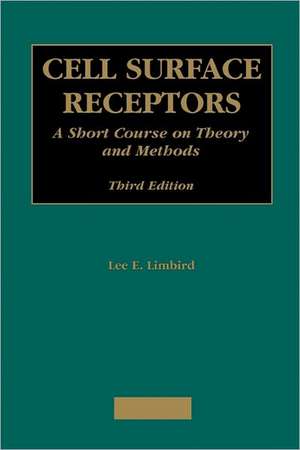
Cell Surface Receptors
Autor Lee E. Limbirden Limba Engleză Paperback – 29 oct 2010
Preț: 1060.27 lei
Preț vechi: 1116.07 lei
-5%
Puncte Express: 1590
Carte tipărită la comandă
Livrare economică 20 noiembrie-04 decembrie
Livrare prin curier în România Termenul estimat este afișat lângă disponibilitate.
Transport gratuit pentru acest produs Plată online sau ramburs, în funcție de opțiunile comenzii.
Retur gratuit în 14 zile Comandă securizată și suport în română.
Specificații
ISBN-13: 9781441935717
ISBN-10: 1441935711
Pagini: 232
Ilustrații: XII, 220 p. 34 illus.
Dimensiuni: 155 x 235 x 13 mm
Greutate: 0.36 kg
Ediția:Third Edition 2005
Editura: Springer
Locul publicării:New York, NY, United States
ISBN-10: 1441935711
Pagini: 232
Ilustrații: XII, 220 p. 34 illus.
Dimensiuni: 155 x 235 x 13 mm
Greutate: 0.36 kg
Ediția:Third Edition 2005
Editura: Springer
Locul publicării:New York, NY, United States
V-ar putea interesa
-
 USMLE Road Map Pharmacology, Second EditionBertram Katzung-34%Preț: 273.89 lei416.21 lei
 -
 Clinical TrialsPocock-5%Preț: 659.88 lei694.62 lei
 -
 Pharmacy OSCEs and Competency-Based AssessmentsSharon Haughey-5%Preț: 188.39 lei198.30 lei
 -
 -23%Preț: 1703.48 lei2226.30 lei
 -
 Recent Developments in Beta-Blockers ResearchYousef Shahin-23%Preț: 1043.34 lei1362.36 lei
 -
 -23%Preț: 2161.29 lei2822.21 lei
 -
 -23%Preț: 1596.93 lei2080.11 lei
 -
 Advances in Oxytocin ResearchEvan Anderson-23%Preț: 756.13 lei988.12 lei
Public țintă
ResearchCuprins
Introduction to Receptor Theory - Origin of the Receptor Concept - Occupancy Theory -Relationship Between Occupancy and Response - Concept of Spare Receptors - Operational Models of Pharmacological Agonism - Rate Theory - Allosteric Theory - Beyond Two-State Receptor Theory – Summary.- Characterization of Receptors Based on Receptor-Mediated Responses - Characterization of Receptor Specificity - Determining Equilibrium Dissociation Constants (Kd Values) for Receptor-Ligand Interactions Based on Measurements of Receptor-Mediated Response - Pharmacologic Resultant Analysis – Summary.- Identification of Receptors Using Direct Radioligand Binding Techniques – Methods - Data Generation - Criteria Expected for Binding of *D to the Physiologically Relevant Receptor, R - Determination of Rate Constants for Radioligand Association and Dissociation – Summary.- Complex Binding Phenomena - Mathematical Descriptions of Complex Binding Phenomena 124 - Non-Linear Regression Analysis of Complex Binding Phenomena - Independent Receptor Subtypes - Affinity States of a Single Receptor Population – Summary.- The Preparation and Study of Detergent-Solubilized Receptors - General Properties of Biological Membranes and Detergent Micelles - Choice of a Biological Detergent - Solubilizing Receptors from Biological Membranes - Methods for Analysis of Detergent-Solubilized Receptors – Summary.- Quantifying Cell Surface Receptor Binding and Turnover in Intact Cells - Discriminating Between Cell Surface Versus Intracellular Receptor-Ligand Complexes - Biochemical Evidence Consistent with Recycling of Cell Surface Receptors - Assessment of Rate Constants for Receptor Turnover Using a Steady State Mathematical Analysis of Intact Cell Radioligand Binding Data - The Heavy Amino Acid Density-Shift Technique for Quantitating Receptor Synthesis and Turnover – Summary.- Index.
Textul de pe ultima copertă
Cell Surface Receptors: A Short Course on Theory and Methods, 3rd Edition, links theoretical insights into drug-receptor interactions described in mathematical models with the experimental strategies to characterize the biological receptor of interest. The study of receptors has changed considerably over the period of the publication of the three editions of this book. The cloning of several genomes makes it unlikely that preparations of receptors now or in the future will arise from their purification as trace proteins from native tissues, but rather from a myriad of molecular approaches. Nonetheless, understanding the molecular mechanisms and ultimately the in vivo biology of these receptors means that investigators will engage in molecular, cellular and ultimate in vivo strategies. It should be of value to investigators who want to identify, characterize and understand the biology of a receptor of interest.
This book is primarily targeted to researchers and graduate students in the fields of molecular pharmacology, receptors, receptor biology, and signal transduction. These courses are variously found in pharmacology, molecular and cell biology, biochemistry and neuroscience. Researchers in the pharmaceutical industry working on bringing new drugs to market will also find this book useful.
This book is primarily targeted to researchers and graduate students in the fields of molecular pharmacology, receptors, receptor biology, and signal transduction. These courses are variously found in pharmacology, molecular and cell biology, biochemistry and neuroscience. Researchers in the pharmaceutical industry working on bringing new drugs to market will also find this book useful.
Caracteristici
The advantage of this book is that it is a primer, and it is based upon the first three laws of thermodynamics.
The material is presented in a logical sequence that allows the researcher or student to understand methods and principles of cell surface receptors in a brief, focused manner
Includes supplementary material: sn.pub/extras
The material is presented in a logical sequence that allows the researcher or student to understand methods and principles of cell surface receptors in a brief, focused manner
Includes supplementary material: sn.pub/extras