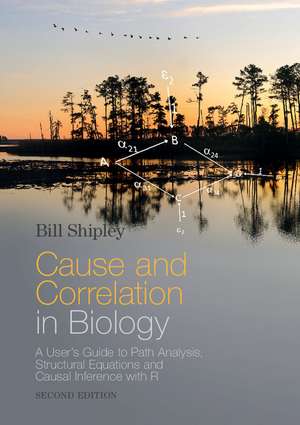
Cause and Correlation in Biology: A User's Guide to Path Analysis, Structural Equations and Causal Inference with R
Autor Bill Shipleyen Limba Engleză Paperback – 17 apr 2016
Notăm cu interes acest manual metodologic, ajuns la a doua ediție, care funcționează ca un ghid aplicat pentru cercetătorii din științele naturii. Cause and Correlation in Biology se adresează unei probleme fundamentale în ecologie și biologie: stabilirea relațiilor de cauzalitate atunci când experimentele controlate nu sunt posibile din motive etice sau logistice. Autorul reușește să demistifice utilizarea ecuațiilor structurale (SEM) și a analizei de drum (path analysis), oferind soluții concrete pentru testarea ipotezelor cauzale prin intermediul datelor observaționale.
Remarcăm actualizarea substanțială a acestei ediții, care integrează acum limbajul R ca instrument principal de lucru. Structura cărții acoperă teme avansate, de la modelele multilevel și constrângerile filogenetice, până la gestionarea valorilor lipsă, totul fiind prezentat într-un limbaj accesibil, cu un minimum de terminologie matematică aridă. Față de volumul Structural Equation Modeling de Bruce H. Pugesek, care pune un accent mai mare pe fundamentarea teoretică și istoria SEM, lucrarea lui Bill Shipley este mult mai orientată către procesul de implementare și rezolvarea problemelor practice întâlnite în teren. De asemenea, dacă Foundational and Applied Statistics for Biologists Using R oferă o privire de ansamblu asupra statisticii generale, Shipley se specializează strict pe inferența cauzală multivariată.
Reținem că această lucrare continuă preocuparea autorului pentru structurile complexe, observată și în cealaltă lucrare a sa, From Plant Traits to Vegetation Structure. În timp ce volumul anterior aplica modele matematice pentru a prezice abundența speciilor, Cause and Correlation in Biology oferă cadrul statistic necesar pentru a înțelege „de ce” apar anumite tipare în natură. Este un instrument esențial pentru tranziția de la simpla corelație la înțelegerea mecanismelor cauzale.
Preț: 452.87 lei
Carte tipărită la comandă
Livrare economică 08-22 iunie
Specificații
ISBN-10: 1107442591
Pagini: 314
Ilustrații: 113 b/w illus. 22 tables
Dimensiuni: 173 x 246 x 15 mm
Greutate: 0.63 kg
Ediția:2Revizuită
Editura: Cambridge University Press
Colecția Cambridge University Press
Locul publicării:New York, United States
V-ar putea interesa
-
 -18%Preț: 1193.84 lei1455.90 lei
 -
 Diagnosing and Changing Organizational CultureKim S. CameronPreț: 391.20 lei
 -
 KGB Lexicon: The Soviet Intelligence Officers HandbookVasili Mitrokhin-15%Preț: 424.92 lei499.90 lei
 -
 Preț: 146.78 lei
 -
 The Decision to AttackAaron Franklin BrantlyPreț: 402.60 lei
 -
 -18%Preț: 850.15 lei1036.77 lei
 -
 -18%Preț: 1342.47 lei1637.15 lei
 -
 The Routledge Handbook of European SecuritySven Biscop-15%Preț: 426.81 lei502.12 lei
 -
 Preț: 439.14 lei
 -
 The Interpersonal Communication Book, Global EditionJoseph DevitoPreț: 86.47 lei
 -
 Competition, Cooperation, Research and DevelopmentJoanna A Poyago-Theotoky-15%Preț: 613.00 lei721.18 lei
 -
 Discourse Theory in European PoliticsD. Howarth-15%Preț: 560.09 lei658.93 lei
 -
 The Human SkillsFrank StopaPreț: 143.86 lei
 -
 Preț: 107.97 lei
 -
 Human IntelligenceRobert D. SteelePreț: 142.88 lei
 -
 The Cold War Spy Pocket ManualPhilip ParkerPreț: 70.07 lei
 -
 Preț: 225.41 lei
 -
 Information Sharing in Military OperationsIrina Goldenberg-18%Preț: 708.64 lei864.19 lei
 -
 CooperationR. Tuomela-18%Preț: 1323.15 lei1613.61 lei
De ce să citești această carte
Recomandăm această carte oricărui biolog sau ecolog care lucrează cu seturi de date complexe și dorește să depășească stadiul descrierii corelațiilor. Cititorul câștigă o metodologie clară pentru a testa ipoteze cauzale folosind R, beneficiind de explicații vizuale prin cele peste 100 de ilustrații. Este resursa ideală pentru a învăța cum să construiești modele statistice riguroase care să reflecte realitatea biologică, fără a te pierde în formalism matematic excesiv.
Despre autor
Bill Shipley este un cercetător recunoscut, cu un doctorat în ecologia plantelor obținut la Universitatea din Ottawa în 1987. În prezent, este profesor de ecologie și statistică la Universitatea din Sherbrooke, Canada. Cu o carieră academică solidă, acesta a publicat peste 70 de articole științifice evaluate de colegi (peer-reviewed), specializându-se în intersecția dintre ecologie și metodele statistice avansate. Expertiza sa în utilizarea modelelor matematice pentru a explica structura vegetației și trăsăturile plantelor se reflectă în abordarea didactică și aplicată a cărților sale publicate la Cambridge University Press.
Descriere scurtă
Cuprins
Recenzii
Review of previous edition: 'Addressing students and practising biologists, Shipley does a terrific job of making mathematical ideas accessible … Cause and Correlation in Biology is a nontechnical and honest introduction to statistical methods for testing causal hypotheses.' Johan Paulsson, Nature Cell Biology
Review of previous edition: 'I highly recommend the book for those interested in multivariate approaches to biology.' Annals of Botany
'Bill Shipley has done an excellent job in tackling the fundamental issue of testing causality in biology and making it accessible to any biology student or scholar. This book is about statistics, but the storytelling is for biologists. When the first edition for this book came out, in 2000, path analyses were not a common tool for biologists. Although the first edition convinced us to use structural equation modelling, this second edition supplies the essential toolbox. This book is the best route to take if you want to master structural equation modelling in biology, and the very good news is that this second edition not only provides updates and extensions, it also offers R codes to run your analyses.' Anne Charmantier, Centre d'Écologie Fonctionnelle et Évolutive (CEFE), Montpellier
'For a long time biologists have inferred causation only from carefully designed experiments. Shipley's book broadens horizons by showing how to use observational data to infer whether a causal model is plausible, and to estimate the variation in response due to competing causes.' David Warton, University of New South Wales, Sydney