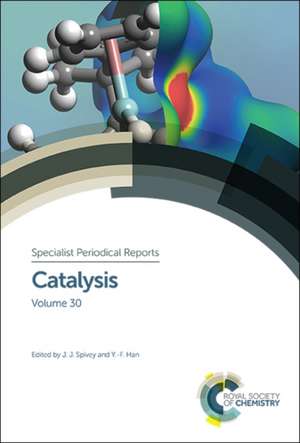
Catalysis
en Hardback – 7 mai 2018
Preț: 2301.11 lei
Preț vechi: 3152.20 lei
-27%
Puncte Express: 3452
Carte tipărită la comandă
Livrare economică 29 iulie-12 august
Livrare prin curier în România Termenul estimat este afișat lângă disponibilitate.
Transport gratuit pentru acest produs Plată online sau ramburs, în funcție de opțiunile comenzii.
Retur gratuit în 14 zile Comandă securizată și suport în română.
Specificații
ISBN-13: 9781788011518
ISBN-10: 1788011511
Pagini: 222
Dimensiuni: 156 x 234 mm
Greutate: 0.5 kg
Editura: Royal Society Of Chemistry
ISBN-10: 1788011511
Pagini: 222
Dimensiuni: 156 x 234 mm
Greutate: 0.5 kg
Editura: Royal Society Of Chemistry
V-ar putea interesa
-
 Preț: 55.98 lei
 -
 Preț: 56.05 lei
 -
 A Dictionary of Environment and ConservationMichael Allaby-20%Preț: 101.81 lei127.66 lei
 -
 PolyampholytesSarkyt E. Kudaibergenov-15%Preț: 625.12 lei735.43 lei
 -
 Fundamentals of Molecular CatalysisHideo Kurosawa-27%Preț: 1369.24 lei1875.67 lei
 -
 -18%Preț: 1177.32 lei1435.76 lei
 -
 -18%Preț: 1176.42 lei1434.66 lei
 -
 -18%Preț: 1819.99 lei2219.50 lei
 -
 Multifunctional Mesoporous Inorganic SolidsCésar A.C. Sequeira-18%Preț: 1186.11 lei1446.49 lei
 -
 -18%Preț: 1185.07 lei1445.21 lei
 -
 Soft Mechanochemical SynthesisG. V. Avvakumov-15%Preț: 620.95 lei730.52 lei
 -
 Homogeneous Catalysis: Understanding the ArtPiet W.N.M. van Leeuwen-18%Preț: 1175.79 lei1433.89 lei
 -
 The Maxims of General PattonGary BloomfieldPreț: 68.08 lei
 -
 In situ NMR Methods in CatalysisJoachim Bargon-18%Preț: 911.05 lei1111.04 lei
Descriere
Catalysts
are
required
for
a
variety
of
applications
and
this
volume
looks
at
modern
approaches
to
catalysis
and
critically
reviews
the
extensive
literature
on
areas
such
as
catalysts
derived
from
waste
materials
and
a
new
tool
to
explore
catalytic
reaction
mechanisms
-
the
catalytic
shock
tube.
Cuprins
Preface; Key catalyst types for the efficient refining of Fischer–Tropsch syncrude: alumina and phosphoric acid; Recent developments and achievements in partial oxidation of methane with and without addition of steam; Precious metal catalysts for deep hydrodesulfurization; Catalytic reactions studied by angle-resolved product desorption; Quantification of cluster size effect (structure sensitivity) in heterogeneous catalysis; Photocatalysis in green chemistry and destruction of very toxic compounds; Hierarchical zeolites: materials with improved accessibility and enhanced catalytic activity; Catalysis involved in dimethylether production and as an intermediate in the generation of hydrocarbons via Fischer-Tropsch synthesis and MTG process; Selective oxidation catalysis on rhenium-oxide catalysts
Notă biografică
Professor Spivey is the McLaurin Shivers Professor of Chemical Engineering at Louisiana State University and Director of the DOE Energy Frontier Research Center at LSU. Professor Spivey's research interests include the application of the principles of heterogeneous catalysis to catalytic combustion, control of sulfur and nitrogen oxides from combustion processes, acid/base catalysis (e.g., for condensation reactions), hydrocarbon synthesis, and the study of catalyst deactivation.
Textul de pe ultima copertă
The current volume of this series focuses on a number of different areas of our discipline. As in past volumes, the number of chapters related to energy and fuel conversion continue to reflect the importance of these areas to researchers and funding agencies. Chapters presented here also deal with material synthesis (e.g., zeolites) and fundamental catalyst properties (e.g., cluster size effects). First, Arno de Klerk (U. Alberta, Canada) reviews two types of acid catalysts for upgrading of Fischer–Tropsch syncrude. Roberto Lanza, Jorge Velasco and Sven Järås (KTH, Stockholm) examine recent literature on partial oxidation of methane and the effect of steam this reaction. John Kuhn (U. South Florida, USA) reports on noble metal catalysts for deep hydrodesulfurization. Tatsuo Matsushima (Hokkaido Univ., Japan) and Kosuke Shobatake (Nagoya Univ., Japan) show how a technique known as angle-resolved product desorption can be used as a direct approach to probe the active sites responsible for product formation or active intermediates. Dmitry Murzin (Abo Akademi Univ., Finland) and Valentin Parmon (Boreskov Institute., Russia) review the subject of metal cluster size effects in heterogeneous catalysis. Vasile Parvelscu (U. Bucharest, Romania) and Hermenegildo Garcia (U. Politecnica de Valencia, Spain) discuss developments in the widely studied area of photocatalysis, especially for destruction of toxic compounds. D. P. Serrano and J. M. Escola (U. Rey Juan Carlos, Spain), along with J. Aguado (IMDEA Energy Institute, Spain) review a class of materials known as hierarchical zeolites. Eduardo Sousa-Aguiar (Federal University of Rio de Janeiro, Brazil) and Lucia Appel (National Technology Institute, Brazil) examine recent studies on the catalytic reactions leading to dimethyl ether (DME), and its use as a fuel additive, among others. Finally, Mizuki Tada (Institute for Molecular Science, Japan) discusses selective oxidation on rhenium-based catalysts. This chapter reviews attempts to minimize sublimation (e.g., with Sb or NH3), and highlights reactions such as selective oxidation and ammoxidation of isobutylene.