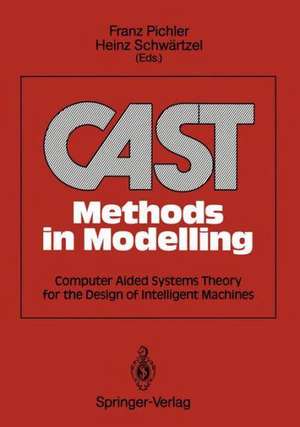
CAST Methods in Modelling
Autor Franz Pichler, Heinz Schwärtzelen Limba Engleză Paperback – 12 feb 2012
Preț: 657.19 lei
Preț vechi: 821.48 lei
-20%
Puncte Express: 986
Carte tipărită la comandă
Livrare economică 07-21 decembrie
Livrare prin curier în România Termenul estimat este afișat lângă disponibilitate.
Transport gratuit pentru acest produs Plată online sau ramburs, în funcție de opțiunile comenzii.
Retur gratuit în 14 zile Comandă securizată și suport în română.
Specificații
ISBN-13: 9783642956829
ISBN-10: 3642956823
Pagini: 392
Ilustrații: XIV, 376 p.
Dimensiuni: 170 x 242 x 22 mm
Greutate: 0.67 kg
Ediția:Softcover reprint of the original 1st ed. 1992
Editura: Springer
Locul publicării:Berlin, Heidelberg, Germany
ISBN-10: 3642956823
Pagini: 392
Ilustrații: XIV, 376 p.
Dimensiuni: 170 x 242 x 22 mm
Greutate: 0.67 kg
Ediția:Softcover reprint of the original 1st ed. 1992
Editura: Springer
Locul publicării:Berlin, Heidelberg, Germany
V-ar putea interesa
-
 -23%Preț: 395.42 lei516.41 lei
 -
 Designer Drafting and Visualizing for the Entertainment WorldPatricia Woodbridge-8%Preț: 521.53 lei566.89 lei
 -
 -20%Preț: 410.94 lei513.69 lei
 -
 Computational Intelligence in Design and ManufacturingAndrew Kusiak-14%Preț: 931.37 lei1082.98 lei
 -
 Notes on the Synthesis of FormChristopher AlexanderPreț: 235.55 lei
 -
 MechatronicsW. Bolton-11%Preț: 667.57 lei750.07 lei
 -
 Modern Systems Analysis and Design, Global EditionJoseph Valacich-8%Preț: 606.91 lei659.70 lei
 -
 Foundations of Analog and Digital Electronic CircuitsAnant Agarwal-27%Preț: 551.94 lei754.30 lei
 -
 Drawing for Product DesignersKevin Henry-29%Preț: 165.85 lei233.29 lei
 -
 Statistics for ScientistsUmberto Michelucci-20%Preț: 279.62 lei349.53 lei
 -
 Components Operationally: Reversibility and System EngineeringClaudio Antares Mezzina-20%Preț: 389.32 lei486.66 lei
 -
 -20%Preț: 391.26 lei489.08 lei
 -
 Advanced Control Methods for Industrial ProcessesPablo A. López-Pérez-23%Preț: 701.54 lei911.09 lei
 -
 Modeling Complex Processes Through Nature-Analogous MethodsChristina Klüver-15%Preț: 511.58 lei601.85 lei
 -
 Machine Knitter's ReferenceBeleke Den HartogPreț: 185.45 lei
 -
 AAD Algorithms-Aided DesignArturo TedeschiPreț: 356.48 lei
 -
 -23%Preț: 648.30 lei840.50 lei
Public țintă
ResearchCuprins
1 Introduction.- 1.1 Problem-Solving by Models.- 1.2 Systems Theory Instrumented Modelling.- 1.3 CAST — Computer Aided Systems Theory.- 1.4 CAST Methods in Modelling: An Overview.- References — Chapter 1.- 2 Cast Method Bank Systems.- 2.1 CAST Method Bank System Design.- 2.2 CAST.FSM — Finite State Machine Method Bank System.- 2.3 CAST.FOURIER — Method Bank for Generalized Spectral Techniques.- 2.4 CAST.LISAS — Simulation Tool for Regular Networks of Finite State Machines.- 2.5 CAST.PN — An Editor and Simulation Tool for Petri Nets.- 2.6 CAST Applications.- References — Chapter 2.- 3 Modelling and Simulation.- 3.1 Introduction.- 3.2 System Specification Formalisms.- 3.3 Abstract Simulator Concepts.- 3.4 Implementations of Modelling and Simulation Environments.- 3.5 Multifacetted Modelling.- 3.6 Towards Variable Structure Modelling and Simulation.- References — Chapter 3.- 4 Machine Vision.- 4.1 Introduction.- 4.2 CAST and Machine Vision.- 4.3 Modelling Objects for Visual Recognition.- 4.4 Spontaneous Recognition of Structured Objects.- 4.5 An Integrated Development Tool for Machine Vision.- References — Chapter 4.- 5 Implementation Issues.- 5.1 Software Development for CAST.- 5.2 Building Class Hierarchies.- 5.3 Browsers for CAST Tools.- 5.4 Implementing Data Persistency in LISP.- 5.5 Direct Embedding of Procedural Code in LISP.- References — Chapter 5.- Appendix: CAST.FSM User’s Guide.- A.1 CAST.FSM Background.- A.2 System Requirements.- A.2.1 Hardware.- A.2.2 Software.- A.3 CAST.FSM Installation.- A.4 Starting a CAST Session and Browsing.- A.4.1 The CAST Class Browser.- A.4.2 The CAST Instance Browser.- A.4.3 Defining a System.- A.4.4 Petri Nets Make the Difference.- A.5 Table Editing.- A.6 Analysis Operations.- A.6.1 I/O-Experiment.- A.6.2Lattice.- A.6.3 Others.- A.7 Synthesis, System Transformations and the Realization Tree.- A.8 Living with a Prototype: Errors and Breaks.- A.8.1 Beginners and casual CAST.FSM Users.- A.8.2 Power Users.- A.9 Saving Realizations on Files.- References — Appendix.