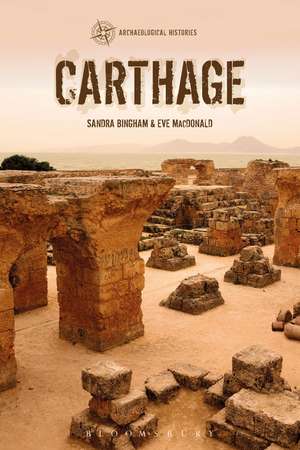
Carthage: Archaeological Histories
Autor Dr Sandra Bingham, Dr Eve MacDonalden Limba Engleză Paperback – 11 iul 2024
In the 17th and 18th centuries, when European explorers first arrived, searching for the site of Carthage, they were amazed that almost nothing of its former glory remained and lamented its loss. The gradual and sometimes controversial exploration of Carthage has, over the last two centuries, brought the story of this renowned ancient city back into the public imagination. From the first discovery of Punic artifacts to the plunder of the site for the enrichment of European museums, the book follows the many personalities whose interests and diligence led to the establishment of scientific archaeological excavations and the re-emergence of Carthage from the ruins.




Preț: 148.16 lei
Preț vechi: 171.97 lei
-14%
Puncte Express: 222
Carte tipărită la comandă
Livrare economică 08-22 decembrie
Livrare express 31 octombrie-06 noiembrie pentru 46.08 lei
Livrare prin curier în România Termenul estimat este afișat lângă disponibilitate.
Transport gratuit de la 400.00 lei Plată online sau ramburs, în funcție de opțiunile comenzii.
Retur gratuit în 14 zile Comandă securizată și suport în română.
Specificații
ISBN-13: 9781472522764
ISBN-10: 1472522761
Pagini: 176
Ilustrații: 38 bw illus
Dimensiuni: 156 x 234 x 10 mm
Greutate: 0.26 kg
Editura: Bloomsbury Publishing
Colecția Bloomsbury Academic
Seria Archaeological Histories
Locul publicării:London, United Kingdom
ISBN-10: 1472522761
Pagini: 176
Ilustrații: 38 bw illus
Dimensiuni: 156 x 234 x 10 mm
Greutate: 0.26 kg
Editura: Bloomsbury Publishing
Colecția Bloomsbury Academic
Seria Archaeological Histories
Locul publicării:London, United Kingdom
Cuprins
List of Illustrations
List of Maps
Acknowledgements
Introduction
Chapter 1: From Carthage to Rome: A Brief Overview
Chapter 2: From Carthage to Tunis: A New Focus
Chapter 3: The Europeans
Chapter 4: Rivals in the Field
Chapter 5: The French Collector
Chapter 6: The Excavating Priest
Chapter 7: The Tophet, Carthage and the Early Twentieth Century
Chapter 8: Independence, UNESCO and the Twenty-First Century
Epilogue
Notes
Bibliography
Index
List of Maps
Acknowledgements
Introduction
Chapter 1: From Carthage to Rome: A Brief Overview
Chapter 2: From Carthage to Tunis: A New Focus
Chapter 3: The Europeans
Chapter 4: Rivals in the Field
Chapter 5: The French Collector
Chapter 6: The Excavating Priest
Chapter 7: The Tophet, Carthage and the Early Twentieth Century
Chapter 8: Independence, UNESCO and the Twenty-First Century
Epilogue
Notes
Bibliography
Index
Recenzii
Carthage is an innovative and fascinating cultural history. Besides outlining the Punic, Roman and Christian city and its monuments, this book includes studies on the history of mentalities and archaeological fieldwork at Carthage from the 17th century to recent times.
This book is an excellent introduction to the history of archaeology at the site of Carthage. It will be extremely useful for students and people who are interested in Carthage and Roman North Africa, and students working on the history of the discipline of archaeology.
Recommended [for] graduate students and faculty.
Sandra Bingham and Eve MacDonald have filled a substantial gap in English-speaking scholarship by producing an account of the history and archaeology of Carthage from antiquity to our own time . It gives a crisp and reliable account of the historical trajectory of a major site in the Southern Mediterranean, showing what a productive vantage point it is for wider themes in the history of the Mediterranean, most notably, on the transmission of knowledge and the dynamics of cultural change.
This book is an excellent introduction to the history of archaeology at the site of Carthage. It will be extremely useful for students and people who are interested in Carthage and Roman North Africa, and students working on the history of the discipline of archaeology.
Recommended [for] graduate students and faculty.
Sandra Bingham and Eve MacDonald have filled a substantial gap in English-speaking scholarship by producing an account of the history and archaeology of Carthage from antiquity to our own time . It gives a crisp and reliable account of the historical trajectory of a major site in the Southern Mediterranean, showing what a productive vantage point it is for wider themes in the history of the Mediterranean, most notably, on the transmission of knowledge and the dynamics of cultural change.