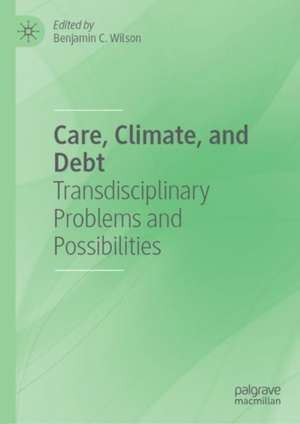
Care, Climate, and Debt: Global Institute for Sustainable Prosperity
Editat de Benjamin C. Wilsonen Limba Engleză Hardback – 23 aug 2022



Preț: 701.98 lei
Preț vechi: 856.07 lei
-18%
Puncte Express: 1053
Carte tipărită la comandă
Livrare economică 21 noiembrie-05 decembrie
Livrare prin curier în România Termenul estimat este afișat lângă disponibilitate.
Transport gratuit pentru acest produs Plată online sau ramburs, în funcție de opțiunile comenzii.
Retur gratuit în 14 zile Comandă securizată și suport în română.
Specificații
ISBN-13: 9783030963545
ISBN-10: 3030963543
Pagini: 248
Ilustrații: XII, 234 p. 24 illus., 23 illus. in color.
Dimensiuni: 153 x 216 x 19 mm
Greutate: 0.44 kg
Ediția:1st ed. 2022
Editura: Springer
Colecția Global Institute for Sustainable Prosperity
Seria Global Institute for Sustainable Prosperity
Locul publicării:Cham, Switzerland
ISBN-10: 3030963543
Pagini: 248
Ilustrații: XII, 234 p. 24 illus., 23 illus. in color.
Dimensiuni: 153 x 216 x 19 mm
Greutate: 0.44 kg
Ediția:1st ed. 2022
Editura: Springer
Colecția Global Institute for Sustainable Prosperity
Seria Global Institute for Sustainable Prosperity
Locul publicării:Cham, Switzerland
Cuprins
Introduction.- Criminal Justice: Race and Resistance.- Chapter 1. Indebted by Proxy: How Women Are Faring Under the Carceral State.- Chapter 2. Black August: A Black Radical Tradition.- Ecological Debt, Education, and the Art of Communication.- Chapter 3. Ecological Debt and the Holistic Value of Nature.- Chapter 4. Our Carbon Debt: A Curriculum for Interdisciplinary Education on Climate Change.- Chapter 5. An Effort to Integrate Social and Environmental Awareness into Graphic Design Education.- Micro and Macro Consequences of Debt and the Possibility of Forgiveness.- Chapter 6. Can Household Debt Cause a Financial Crisis?.- Chapter 7. Squid Game and Student Debt Resistance: A Politics of Self-Care, Creativity, and Collective Action in the Neoliberal University.- Chapter 8. How Are You Going to Pay for it? The Macroeconomic Benefits of Student Debt Cancellation.- The Aesthetics and Potential of Alternative Monetary Design.- Chapter 9. ‘Solidarity is a Force Stronger than Gravity’: Money, Aesthetics & the Abstractness of Care.- Chapter 10. Water, Money, and the Job Guarantee.- Chapter 11. The Uni Currency Project: Democratic Finance for Public Higher Education After COVID-19.
Textul de pe ultima copertă
This volume spans economics, history, sociology, law, graphic design, religion, environmental science, politics and more to offer a transdisciplinary examination of debt. From this perspective, many of our most pressing social and environmental crises are explored to raise critical questions about debt’s problems and possibilities. Who do we owe? Where are the offsetting credits? Why do such persistent deficits in care permeate so much of our lives? Can we imagine new approaches to balance sheets, measures of value, and justice to reconcile these deficits? Often regarded as a constraint on our ability to meet the challenges of our day, this volume reimagines debt as a social construct capable of empowering people to organize and produce sustainable prosperity for all. This text is ideal for provoking classroom discussions that not only point out the gravity of the crises we face in the twenty-first century, but also seeks to set readers’ minds free to create innovative solutions.
Benjamin C. Wilson is an associate professor of political economy at the State University of New York College at Cortland and a Research Scholar for the Global Institute for Sustainable Prosperity. His authored and co-authored writings have appeared in the Forum for Social Economics, American Review of Political Economy, Boundary2Online, Public Seminar, and Monthly Review.
Benjamin C. Wilson is an associate professor of political economy at the State University of New York College at Cortland and a Research Scholar for the Global Institute for Sustainable Prosperity. His authored and co-authored writings have appeared in the Forum for Social Economics, American Review of Political Economy, Boundary2Online, Public Seminar, and Monthly Review.
Caracteristici
Examines the concept of debt from a transdisciplinary perspective Reimagines the role of--and the solutions to--debt in our lives Addresses pressing and timely issues, such as the connection between climate change and debt