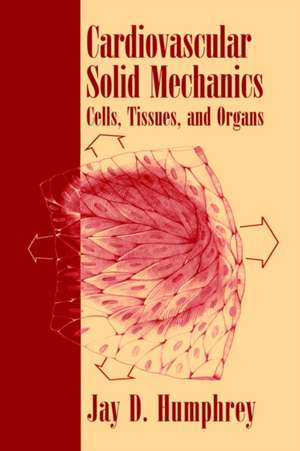
Cardiovascular Solid Mechanics
Autor Jay D. Humphreyen Limba Engleză Hardback – 8 ian 2002
În domeniul ingineriei biomedicale și al biotehnologiei, înțelegerea funcționării sistemului cardiovascular necesită o analiză riguroasă a interacțiunilor mecanice la nivel de celule, țesuturi și organe. În Cardiovascular Solid Mechanics, autorul Jay D. Humphrey oferă o sinteză tehnică a modului în care inima și arterele răspund la stimuli mecanici, utilizând instrumentele avansate ale mecanicii neliniare a solidelor. Remarcăm faptul că această lucrare nu se limitează la o descriere calitativă, ci impune o rigoare matematică necesară pentru rezolvarea problemelor de valoare la limită și inițiale, specifice condițiilor in vivo. Structura volumului reflectă o progresie logică, pornind de la preliminarii matematice și calcul tensorial, continuând cu mecanica continuumului și elasticitatea finită, pentru a culmina cu metodele experimentale de măsurare a deformării și estimare a parametrilor. Cititorul care a aplicat ideile din Biomechanics of Soft Tissue in Cardiovascular Systems de Gerhard A. Holzapfel va găsi aici o aprofundare a integrării metodelor computaționale cu cele experimentale, oferind un cadru mai vast pentru modelarea constitutivă a țesuturilor moi. Poziționată strategic în cadrul operei autorului, această carte extinde conceptele fundamentale prezentate în An Introduction to Biomechanics, trecând de la principiile generale de echilibru și stres către aplicații complexe în mecanobiologie. Considerăm că forța acestui text rezidă în capacitatea de a unifica teoria cu practica de laborator, oferind studenților și cercetătorilor un ghid metodologic pentru analiza neliniarităților geometrice și de material inerente sistemului vascular. Deși focusul principal rămâne cel cardiovascular, metodele analitice prezentate de Jay D. Humphrey sunt direct transferabile către studiul altor tipuri de țesuturi biologice moi.
Preț: 1005.08 lei
Preț vechi: 1225.71 lei
-18%
Carte tipărită la comandă
Livrare economică 30 noiembrie-14 decembrie
Specificații
ISBN-10: 0387951687
Pagini: 776
Ilustrații: XVI, 758 p.
Dimensiuni: 160 x 241 x 46 mm
Greutate: 1.26 kg
Ediția:2002
Editura: Springer
Locul publicării:New York, NY, United States
V-ar putea interesa
-
 Oxford Handbook of CardiologyPunit RamrakhaPreț: 294.76 leiRecomandat
 -
 The Exquisite MachineSian E. Harding-21%Preț: 122.47 lei155.89 lei
 -
 Netter's CardiologyGeorge Stouffer-5%Preț: 581.47 lei612.08 lei
 -
 -23%Preț: 1204.35 lei1555.12 lei
 -
 Snapshots of HemodynamicsNico Westerhof-5%Preț: 1125.32 lei1184.55 lei
 -
 BiomechanicsY. C. Fung-5%Preț: 1106.47 lei1164.70 lei
 -
 Multimodality Cardiovascular ImagingMario J. García-28%Preț: 868.39 lei1209.91 lei
 -
 Crash Course Cardiology: For UKMLA and Medical ExamsJasmine Shen-30%Preț: 227.18 lei326.56 lei
 -
 Oh's Intensive Care ManualJonathan M. Handy-29%Preț: 691.97 lei971.74 leiRecomandat
 -
 Kern's Cardiac Catheterization HandbookPaul Sorajja-27%Preț: 395.98 lei545.02 leiRecomandat
 -
 Applied Mechanics of SolidsAllan F. Bower-14%Preț: 792.43 lei921.43 lei
 -
 Methods in Cardiovascular and Lymphatic BiologyEvangelia Papadimitriou-5%Preț: 1422.25 lei1497.11 lei
 -
 -38%Preț: 314.03 lei506.39 lei
 -
 Cardiovascular GenomicsKeith Dipetrillo-5%Preț: 889.61 lei936.43 lei
 -
 The Beating Heart: The Art and Science of Our Most Vital OrganRobin Choudhury-32%Preț: 184.62 lei270.97 lei
 -
 Key Questions in Cardiac SurgeryNarain Moorjani-21%Preț: 490.81 lei620.05 lei
 -
 Cardiovascular Physiology ConceptsDr. Richard E. Klabunde PhD-21%Preț: 314.35 lei396.61 lei
 -
 -57%Preț: 1697.00 lei3908.44 lei
 -
 -22%Preț: 311.22 lei399.49 leiRecomandat
Public țintă
GraduateDe ce să citești această carte
Această lucrare este esențială pentru cercetătorii și studenții de la facultățile de bioinginerie care doresc să stăpânească modelarea matematică a inimii și a vaselor de sânge. Cititorul câștigă o înțelegere profundă a mecanicii neliniare și a metodelor experimentale riguroase. Este un instrument practic pentru cei care urmăresc să dezvolte simulări computaționale precise sau să interpreteze date experimentale complexe în contextul biomecanicii țesuturilor moi.