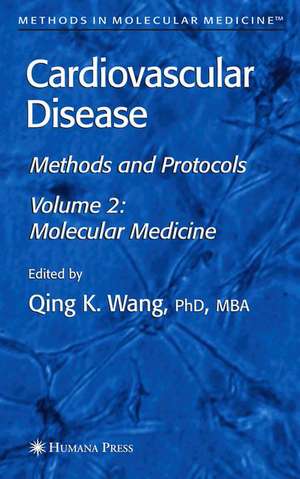
Cardiovascular Disease, Volume 2: Methods in Molecular Medicine, cartea 129
Editat de Qing Wangen Limba Engleză Paperback – sep 2006
Din seria Methods in Molecular Medicine
- 5%
 Preț: 748.47 lei
 - 5%
 Preț: 1084.56 lei
 - 15%
 Preț: 672.57 lei
 - 5%
 Preț: 1142.93 lei
 - 5%
 Preț: 699.37 lei
 - 5%
 Preț: 753.27 lei
 - 15%
 Preț: 672.39 lei
 - 5%
 Preț: 760.03 lei
 - 15%
 Preț: 676.23 lei
 - 5%
 Preț: 758.91 lei
 - 5%
 Preț: 1147.04 lei
 - 5%
 Preț: 1139.88 lei
 - 5%
 Preț: 747.37 lei
 - 5%
 Preț: 1142.38 lei
 - 5%
 Preț: 743.80 lei
 - 5%
 Preț: 1145.38 lei
 - 5%
 Preț: 756.44 lei
 - 5%
 Preț: 1077.08 lei
 - 5%
 Preț: 773.14 lei
 - 5%
 Preț: 792.58 lei
 - 5%
 Preț: 746.55 lei
 - 5%
 Preț: 1032.41 lei
 - 15%
 Preț: 634.95 lei
 - 5%
 Preț: 743.54 lei
 - 5%
 Preț: 1149.79 lei
 - 5%
 Preț: 716.67 lei
 - 5%
 Preț: 1059.28 lei
 - 5%
 Preț: 1063.72 lei
 - 5%
 Preț: 1121.08 lei
 - 18%
 Preț: 920.67 lei
Preț: 1103.93 lei
Preț vechi: 1162.03 lei
-5%
Puncte Express: 1656
Carte tipărită la comandă
Livrare economică 20 noiembrie-04 decembrie
Livrare prin curier în România Termenul estimat este afișat lângă disponibilitate.
Transport gratuit pentru acest produs Plată online sau ramburs, în funcție de opțiunile comenzii.
Retur gratuit în 14 zile Comandă securizată și suport în română.
Specificații
ISBN-13: 9781588298928
ISBN-10: 1588298922
Pagini: 380
Ilustrații: XIV, 363 p.
Dimensiuni: 155 x 235 x 21 mm
Greutate: 0.58 kg
Ediția:2007
Editura: Humana
Colecția Methods in Molecular Medicine
Seria Methods in Molecular Medicine
Locul publicării:Totowa, NJ, United States
ISBN-10: 1588298922
Pagini: 380
Ilustrații: XIV, 363 p.
Dimensiuni: 155 x 235 x 21 mm
Greutate: 0.58 kg
Ediția:2007
Editura: Humana
Colecția Methods in Molecular Medicine
Seria Methods in Molecular Medicine
Locul publicării:Totowa, NJ, United States
V-ar putea interesa
-
 -28%Preț: 420.04 lei581.33 lei
 -
 Complementary and Alternative Cardiovascular MedicineRichard A Stein-5%Preț: 1081.83 lei1138.77 lei
 -
 Cardiovascular Disease, Volume 1Qing Wang-5%Preț: 725.71 lei763.90 lei
 -
 AtherosclerosisAngela F Drew-5%Preț: 1036.75 lei1091.32 lei
 -
 Primary Angioplasty in Acute Myocardial InfarctionJames E Tcheng-5%Preț: 1125.88 lei1185.14 lei
 -
 Valvular Heart DiseaseAndrew Wang-5%Preț: 1586.90 lei1670.42 lei
 -
 Renin Angiotensin System and Cardiovascular DiseaseWalmor C. De Mello-5%Preț: 750.95 lei790.48 lei
 -
 Cardiovascular GenomicsKeith Dipetrillo-5%Preț: 889.61 lei936.43 lei
 -
 Heart FailureJosé Marín-García-5%Preț: 1571.85 lei1654.58 lei
 -
 Manual of Thoracic Endoaortic SurgeryJacques Kpodonu-5%Preț: 386.14 lei406.46 lei
 -
 Principles of Pulmonary Protection in Heart SurgeryEdmo Atique Gabriel-5%Preț: 1477.78 lei1555.55 lei
 -
 Software Process ChangeQing Wang-20%Preț: 339.07 lei423.84 lei
 -
 -20%Preț: 324.19 lei405.23 lei
 -
 -20%Preț: 342.69 lei428.36 lei
 -
 -20%Preț: 341.85 lei427.31 lei
 -
 -5%Preț: 689.53 lei725.82 lei
 -
 Electromagnetic Ultrasonic Guided WavesSongling Huang-18%Preț: 981.73 lei1197.23 lei
Public țintă
ResearchCuprins
Microarray Analysis of Cardiovascular Diseases.- Proteomics With Two-Dimensional Gel Electrophoresis and Mass Spectrometry Analysis in Cardiovascular Research.- Developing and Evaluating Genomics- or Proteomics-Based Diagnostic Tests.- Animal Models for Disease.- Generation of Transgenic Mice for Cardiovascular Research.- Quantitative Assay for Mouse Atherosclerosis in the Aortic Root.- Animal Models for Heart Failure.- Animal Models for Hypertension/Blood Pressure Recording.- Animal Models for Cardiac Arrhythmias.- Optical Mapping of Shock-Induced Arrhythmogenesis in the Rabbit Heart With Healed Myocardial Infarction.- Methods for Studying Voltage-Gated Sodium Channels in Heterologous Expression Systems.- Laser-Induced Thrombosis in Zebrafish Larvae.- Methods for Isolation of Endothelial and Smooth Muscle Cells and In Vitro Proliferation Assays.- Applications of Adenoviral Vector-Mediated Gene Transfer in Cardiovascular Research.- Murine and HIV-Based Retroviral Vectors for In Vitro and In Vivo Gene Transfer.- Efficient Transfection of Primary Cells Relevant for Cardiovascular Research by nucleofection®.- Cell Adhesion and Migration Assays.- Apoptosis Assays.- Preparation of Protein Crystals for X-Ray Structural Study.- Structural Elucidation of Integrin ?IIb?3 Cytoplasmic Domain by Nuclear Magnetic Resonance Spectroscopy.- Applications of Electron Cryo-Microscopy to Cardiovascular Research.- Stem Cells in Cardiovascular Disease.
Recenzii
From the reviews:
"Second volume … in its 22 chapters describes methods for comprehension of disease mechanism at the molecular level. … Each chapter contains detailed protocols needed for each practical step in course of experimentation so that it may serve as a guide even for beginners. … intended for undergraduate and graduate students, postdoctoral fellows, clinicians and basic researchers, who are entering new areas of cardiovascular research and/or designing new experiments. Many protocols could be applied in research of another diseases as well.” (Lubica Lacinová, General Physiology and Biophysics, January, 2007)
"Second volume … in its 22 chapters describes methods for comprehension of disease mechanism at the molecular level. … Each chapter contains detailed protocols needed for each practical step in course of experimentation so that it may serve as a guide even for beginners. … intended for undergraduate and graduate students, postdoctoral fellows, clinicians and basic researchers, who are entering new areas of cardiovascular research and/or designing new experiments. Many protocols could be applied in research of another diseases as well.” (Lubica Lacinová, General Physiology and Biophysics, January, 2007)