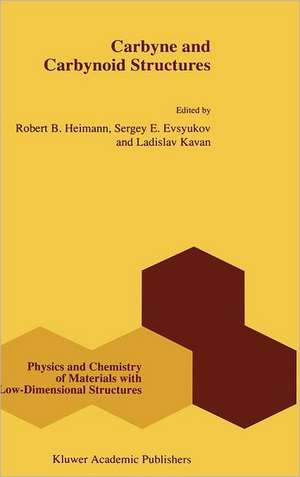
Carbyne and Carbynoid Structures: Physics and Chemistry of Materials with Low-Dimensional Structures, cartea 21
Editat de R. B. Heimann, S. E. Evsyukov, Ladislav Kavanen Limba Engleză Hardback – 28 feb 1999
| Toate formatele și edițiile | Preț | Express |
|---|---|---|
| Paperback (1) | 1177.19 lei 6-8 săpt. | |
| SPRINGER NETHERLANDS – 26 oct 2012 | 1177.19 lei 6-8 săpt. | |
| Hardback (1) | 1183.12 lei 6-8 săpt. | |
| SPRINGER NETHERLANDS – 28 feb 1999 | 1183.12 lei 6-8 săpt. |
Din seria Physics and Chemistry of Materials with Low-Dimensional Structures
- 18%
 Preț: 1759.04 lei
 -
 Preț: 383.03 lei
 - 18%
 Preț: 1184.30 lei
 - 18%
 Preț: 1175.96 lei
 - 18%
 Preț: 1177.49 lei
 - 18%
 Preț: 1177.62 lei
 - 18%
 Preț: 1761.77 lei
 - 18%
 Preț: 1182.64 lei
 - 18%
 Preț: 1180.66 lei
 -
 Preț: 387.67 lei
 -
 Preț: 372.31 lei
 - 18%
 Preț: 915.58 lei
 - 18%
 Preț: 1180.20 lei
 - 18%
 Preț: 924.82 lei
 - 18%
 Preț: 1181.87 lei
Preț: 1183.12 lei
Preț vechi: 1442.82 lei
-18%
Puncte Express: 1775
Preț estimativ în valută:
209.24€ • 242.35$ • 181.69£
209.24€ • 242.35$ • 181.69£
Carte tipărită la comandă
Livrare economică 21 aprilie-05 mai
Specificații
ISBN-13: 9780792353232
ISBN-10: 0792353234
Pagini: 446
Ilustrații: XVII, 446 p.
Dimensiuni: 170 x 244 x 25 mm
Greutate: 0.83 kg
Ediția:1999
Editura: SPRINGER NETHERLANDS
Colecția Springer
Seria Physics and Chemistry of Materials with Low-Dimensional Structures
Locul publicării:Dordrecht, Netherlands
ISBN-10: 0792353234
Pagini: 446
Ilustrații: XVII, 446 p.
Dimensiuni: 170 x 244 x 25 mm
Greutate: 0.83 kg
Ediția:1999
Editura: SPRINGER NETHERLANDS
Colecția Springer
Seria Physics and Chemistry of Materials with Low-Dimensional Structures
Locul publicării:Dordrecht, Netherlands
V-ar putea interesa
-
 -18%Preț: 1187.48 lei1448.15 lei
 -
 Polyampholytes: Synthesis, Characterization and ApplicationSarkyt E. Kudaibergenov-15%Preț: 623.52 lei733.55 lei
 -
 Metallization of Polymers 2Edward Sacher-15%Preț: 618.28 lei727.39 lei
 -
 -18%Preț: 921.64 lei1123.95 lei
 -
 -18%Preț: 912.69 lei1113.03 lei
 -
 Polymer Process EngineeringR. Griskey-18%Preț: 1340.79 lei1635.11 lei
 -
 Polymer Processing and Structure DevelopmentArthur N. Wilkinson-18%Preț: 921.17 lei1123.38 lei
 -
 -15%Preț: 617.08 lei725.97 lei
 -
 Plastics and Environmental SustainabilityAnthony L Andrady-8%Preț: 633.28 lei688.34 lei
 -
 Polymers for PEM Fuel CellsHongting Pu-9%Preț: 929.71 lei1021.67 lei
 -
 Functional Polymer CoatingsLimin Wu-9%Preț: 896.24 lei984.87 lei
 -
 Macromolecular Self-AssemblyLaurent Billon-9%Preț: 894.23 lei982.67 lei
 -
 Superhard Materials, Convection, and Optical DevicesR. B. Heimann-15%Preț: 613.00 lei721.18 lei
 -
 -15%Preț: 454.55 lei534.76 lei
Public țintă
ResearchCuprins
1: Introduction.- 1.1. The discovery of carbyne.- 1.2. The nature of carbyne: pros and cons.- 2: Carbyne and carbynoid structures in nature.- 2.1. Carbon-how many allotropes associated with meteorites and impact phenomena?.- 2.2. Other natural carbynoid structures.- 3: Syntheses of carbyne and carbynoid structures.- 3.1. Catalytic and electrochemical polycondensation reactions.- 3.1.1. Dehydropolycondensation of acetylene.- 3.1.2. Polycondensation reaction of halides.- 3.2. Chemical, photo-, and electrochemical transformations of polymers.- 3.2.1. Chemical dehydrohalogenation of polymers.- 3.2.2. Photo-and laser-induced dehydrohalogenation of polymers.- 3.2.3. Dehydrogenation of polyacetylene at high static pressure.- 3.3.1. Decomposition of hydrocarbons.- 3.3.2. Pyrolysis of organic polymers.- 3.4. Phase transformation of carbon materials.- 3.4.1. Condensation of carbon vapour.- 3.4.2. Ion-assisted condensation of carbon.- 3.4.3. Dynamic pressure synthesis.- 3.5. Electrochemical methods.- 4: Structural models of carbyne.- 4.1. Structural and electronic properties of polyyne.- 4.2. Kinked chains and layered structure.- 4.3. Carbyne intercalation compounds.- 4.4. Electron diffraction and microscopy.- 5: Properties of carbyne and carbynoid structures.- 5.1. Chemical properties.- 5.2. Thermophysical properties.- 5.3. Electrical and optical properties.- 6: Molecular and electron spectroscopy of carbyne structures.- 6.1. Raman and infrared spectroscopy.- 6.2. Electron spin resonance spectroscopy.- 6.3. Electron spectroscopy.- 6.4. Electron energy loss spectroscopy studies of carbynoid structures.- 7: Suggested technical applications of carbyne materials.- 7.1. Diamond synthesis from carbyne.- 7.2. Medical applications of carbynoid materials.