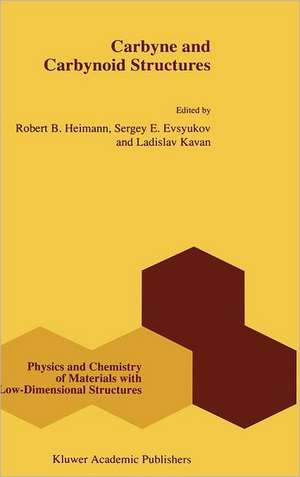
Carbyne and Carbynoid Structures: Physics and Chemistry of Materials with Low-Dimensional Structures, cartea 21
Editat de R. B. Heimann, Ladislav Kavan, S. E. Evsyukoven Limba Engleză Hardback – 28 feb 1999
Din seria Physics and Chemistry of Materials with Low-Dimensional Structures
- 18%
 Preț: 1888.35 lei
 -
 Preț: 386.79 lei
 - 18%
 Preț: 1271.11 lei
 - 18%
 Preț: 1178.23 lei
 - 18%
 Preț: 1265.00 lei
 - 18%
 Preț: 1263.31 lei
 - 18%
 Preț: 1263.54 lei
 - 18%
 Preț: 1891.41 lei
 - 18%
 Preț: 1269.37 lei
 - 24%
 Preț: 1126.08 lei
 - 18%
 Preț: 1266.91 lei
 - 18%
 Preț: 1174.45 lei
 -
 Preț: 415.08 lei
 -
 Preț: 376.01 lei
 - 18%
 Preț: 915.58 lei
 - 18%
 Preț: 1180.20 lei
 - 18%
 Preț: 990.80 lei
 - 18%
 Preț: 1268.37 lei
 - 18%
 Preț: 1175.96 lei
Preț: 1276.02 lei
Preț vechi: 1556.13 lei
-18%
Puncte Express: 1914
Carte tipărită la comandă
Livrare economică 04-18 decembrie
Livrare prin curier în România Termenul estimat este afișat lângă disponibilitate.
Transport gratuit pentru acest produs Plată online sau ramburs, în funcție de opțiunile comenzii.
Retur gratuit în 14 zile Comandă securizată și suport în română.
Specificații
ISBN-13: 9780792353232
ISBN-10: 0792353234
Pagini: 468
Ilustrații: XVII, 446 p.
Dimensiuni: 160 x 241 x 30 mm
Greutate: 0.81 kg
Ediția:1999
Editura: SPRINGER NETHERLANDS
Colecția Physics and Chemistry of Materials with Low-Dimensional Structures
Seria Physics and Chemistry of Materials with Low-Dimensional Structures
Locul publicării:Dordrecht, Netherlands
ISBN-10: 0792353234
Pagini: 468
Ilustrații: XVII, 446 p.
Dimensiuni: 160 x 241 x 30 mm
Greutate: 0.81 kg
Ediția:1999
Editura: SPRINGER NETHERLANDS
Colecția Physics and Chemistry of Materials with Low-Dimensional Structures
Seria Physics and Chemistry of Materials with Low-Dimensional Structures
Locul publicării:Dordrecht, Netherlands
V-ar putea interesa
-
 Advances in PolyolefinsT. C. Cheng-18%Preț: 1275.96 lei1556.04 lei
 -
 PolyampholytesSarkyt E. Kudaibergenov-15%Preț: 666.59 lei784.23 lei
 -
 Metallization of Polymers 2Edward Sacher-15%Preț: 671.74 lei790.29 lei
 -
 Design Data for Reinforced PlasticsN. Hancox-18%Preț: 991.76 lei1209.47 lei
 -
 Blends of Natural RubberAndrew Tinker-18%Preț: 983.79 lei1199.74 lei
 -
 Polymer Process EngineeringR. Griskey-18%Preț: 1439.67 lei1755.70 lei
 -
 Polymer Processing and Structure DevelopmentArthur N. Wilkinson-18%Preț: 921.17 lei1123.38 lei
 -
 -15%Preț: 617.08 lei725.97 lei
 -
 Plastics and Environmental SustainabilityAnthony L Andrady-8%Preț: 686.01 lei745.66 lei
 -
 Polymers for PEM Fuel CellsHongting Pu-9%Preț: 1006.49 lei1106.04 lei
 -
 Functional Polymer CoatingsLimin Wu-9%Preț: 969.54 lei1065.43 lei
 -
 Macromolecular Self-AssemblyLaurent Billon-9%Preț: 964.98 lei1060.42 lei
 -
 -15%Preț: 641.17 lei754.31 lei
 -
 Auflösung von KristallenR. B. Heimann-15%Preț: 475.64 lei559.57 lei
Public țintă
ResearchCuprins
1: Introduction.- 1.1. The discovery of carbyne.- 1.2. The nature of carbyne: pros and cons.- 2: Carbyne and carbynoid structures in nature.- 2.1. Carbon-how many allotropes associated with meteorites and impact phenomena?.- 2.2. Other natural carbynoid structures.- 3: Syntheses of carbyne and carbynoid structures.- 3.1. Catalytic and electrochemical polycondensation reactions.- 3.1.1. Dehydropolycondensation of acetylene.- 3.1.2. Polycondensation reaction of halides.- 3.2. Chemical, photo-, and electrochemical transformations of polymers.- 3.2.1. Chemical dehydrohalogenation of polymers.- 3.2.2. Photo-and laser-induced dehydrohalogenation of polymers.- 3.2.3. Dehydrogenation of polyacetylene at high static pressure.- 3.3.1. Decomposition of hydrocarbons.- 3.3.2. Pyrolysis of organic polymers.- 3.4. Phase transformation of carbon materials.- 3.4.1. Condensation of carbon vapour.- 3.4.2. Ion-assisted condensation of carbon.- 3.4.3. Dynamic pressure synthesis.- 3.5. Electrochemical methods.- 4: Structural models of carbyne.- 4.1. Structural and electronic properties of polyyne.- 4.2. Kinked chains and layered structure.- 4.3. Carbyne intercalation compounds.- 4.4. Electron diffraction and microscopy.- 5: Properties of carbyne and carbynoid structures.- 5.1. Chemical properties.- 5.2. Thermophysical properties.- 5.3. Electrical and optical properties.- 6: Molecular and electron spectroscopy of carbyne structures.- 6.1. Raman and infrared spectroscopy.- 6.2. Electron spin resonance spectroscopy.- 6.3. Electron spectroscopy.- 6.4. Electron energy loss spectroscopy studies of carbynoid structures.- 7: Suggested technical applications of carbyne materials.- 7.1. Diamond synthesis from carbyne.- 7.2. Medical applications of carbynoid materials.