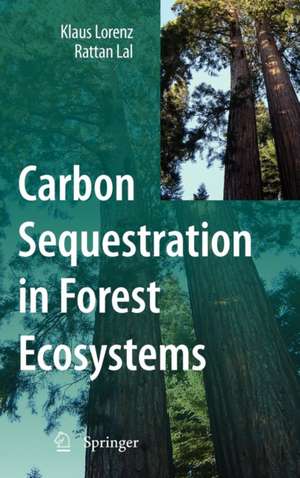
Carbon Sequestration in Forest Ecosystems
Autor Klaus Lorenz, Rattan Lalen Limba Engleză Hardback – 14 dec 2009
Preț: 982.49 lei
Preț vechi: 1198.17 lei
-18%
Puncte Express: 1474
Carte tipărită la comandă
Livrare economică 27 noiembrie-11 decembrie
Livrare prin curier în România Termenul estimat este afișat lângă disponibilitate.
Transport gratuit pentru acest produs Plată online sau ramburs, în funcție de opțiunile comenzii.
Retur gratuit în 14 zile Comandă securizată și suport în română.
Specificații
ISBN-13: 9789048132652
ISBN-10: 9048132657
Pagini: 308
Ilustrații: XIX, 279 p.
Dimensiuni: 160 x 241 x 24 mm
Greutate: 0.63 kg
Ediția:2010
Editura: Springer
Locul publicării:Dordrecht, Netherlands
ISBN-10: 9048132657
Pagini: 308
Ilustrații: XIX, 279 p.
Dimensiuni: 160 x 241 x 24 mm
Greutate: 0.63 kg
Ediția:2010
Editura: Springer
Locul publicării:Dordrecht, Netherlands
V-ar putea interesa
-
 -31%Preț: 539.46 lei780.53 lei
 -
 Dispersal Ecology and EvolutionJean Clobert-25%Preț: 602.84 lei801.13 lei
 -
 Preț: 388.66 lei
 -
 Shaping EcologyPeter G. AyresPreț: 206.38 lei
 -
 Trait-Mediated Indirect InteractionsTakayuki Ohgushi-11%Preț: 459.27 lei516.04 lei
 -
 A Primer of Ecological StatisticsNicholas J. Gotelli-27%Preț: 896.44 lei1227.99 lei
 -
 1493Charles C. MannPreț: 110.33 lei
 -
 The Ecology of Browsing and GrazingIain J. Gordon-18%Preț: 922.01 lei1124.41 lei
 -
 How Likely is Extraterrestrial Life?J. Woods HalleyPreț: 382.81 lei
Public țintă
ResearchCuprins
The Natural Dynamic of Carbon in Forest Ecosystems.- Effects of Disturbance, Succession and Management on Carbon Sequestration.- Carbon Dynamics and Pools in Major Forest Biomes of the World.- Nutrient and Water Limitations on Carbon Sequestration in Forests.- The Importance of Carbon Sequestration in Forest Ecosystems.
Recenzii
From the reviews:
“This book is the first to synthesize information on relevant processes, factors, and causes of C turnover in forest ecosystems and the technical and economic potential of C sequestration. Accordingly, the authors are able to fill an important gap between the needs of global environmental policy and local forest management. … topics and structure of this book is highly meritorious. It will perform a significant task in academic teaching … also in stimulating the dialog between different groups in policy, science, and practical land management!” (K. H. Feger, Journal of Plant Nutrition and Soil Science, Vol. 173 (2), April, 2010)
“Lorenz and Lal (both, Ohio State) developed this timely work to illustrate the science of the carbon cycle … and resource limitations on carbon sequestration. … At the end of each chapter, the authors summarize the topic and provide a list of review questions. Twenty color plates … provide visual understanding of selected issues. A valuable resource for readers seeking fundamental knowledge and guidance in managing forests for carbon sequestration. Summing Up: Highly recommended. Upper-division undergraduates through researchers/faculty, forest managers, and policy makers.” (J. Chen, Choice, Vol. 47 (11), August, 2010)
“This book is the first to synthesize information on relevant processes, factors, and causes of C turnover in forest ecosystems and the technical and economic potential of C sequestration. Accordingly, the authors are able to fill an important gap between the needs of global environmental policy and local forest management. … topics and structure of this book is highly meritorious. It will perform a significant task in academic teaching … also in stimulating the dialog between different groups in policy, science, and practical land management!” (K. H. Feger, Journal of Plant Nutrition and Soil Science, Vol. 173 (2), April, 2010)
“Lorenz and Lal (both, Ohio State) developed this timely work to illustrate the science of the carbon cycle … and resource limitations on carbon sequestration. … At the end of each chapter, the authors summarize the topic and provide a list of review questions. Twenty color plates … provide visual understanding of selected issues. A valuable resource for readers seeking fundamental knowledge and guidance in managing forests for carbon sequestration. Summing Up: Highly recommended. Upper-division undergraduates through researchers/faculty, forest managers, and policy makers.” (J. Chen, Choice, Vol. 47 (11), August, 2010)
Textul de pe ultima copertă
Carbon Sequestration in Forest Ecosystems is a comprehensive book describing the basic processes of carbon dynamics in forest ecosystems, their contribution to carbon sequestration and implications for mitigating abrupt climate change. This book provides the information on processes, factors and causes influencing carbon sequestration in forest ecosystems. Drawing upon most up-to-date references, this book summarizes the current understanding of carbon sequestration processes in forest ecosystems while identifying knowledge gaps for future research, Thus, this book is a valuable knowledge source for students, scientists, forest managers and policy makers.
Caracteristici
Describes basic processes of C dynamics in forest ecosystems Discusses effects of abrupt climate change on C sequestration in forest ecosystems Provides information on processes, factors and causes influencing C sequestration in forest ecosystems Compares C dynamics and sequestration in major global forest biomes Gives an outlook on the future role of forest ecosystems in global C cycle
Notă biografică
Klaus Lorenz, Ph.D., is Senior Research Associate and Assistant Director of the CFAES Rattan Lal Center for Carbon Management and Sequestration at The Ohio State University (OSU), Columbus, Ohio, USA. He is an experienced soil scientist with research interests in climate change, and the chemistry of soil organic carbon. His goal is to provide greater understanding of soil carbon protection and stabilization mechanisms to manage soils for climate change adaptation and mitigation, and for enhancing soil quality. He received a Diploma in Biology from University of Freiburg, Germany (1997), and a Ph.D. in Agricultural Sciences from University of Hohenheim, Germany (2001). He served as Chief Soil Scientist/Research Fellow at the Institute for Advanced Sustainability Studies e.V. in Potsdam, Germany (2011-2014), and as Postdoctoral Researcher/Research Scientist/Senior Research Associate at OSU (2004 to date). He has written articles about the importance of the composition of soilorganic matter for carbon sequestration, the potential of the subsoil to store soil carbon inputs, and the role of soil organic carbon as an indicator for soil and land degradation in relation to the Sustainable Development Goals. He has previously written books about carbon sequestration in forest and in agricultural ecosystems, and co-edited books on recarbonization of the biosphere, and on ecosystem services and carbon sequestration in the biosphere.
¿Rattan Lal, Ph.D., is a Distinguished University Professor of Soil Science and Director of the CFAES Rattan Lal Carbon Management and Sequestration Center at The Ohio State University, as well as an Adjunct Professor of University of Iceland and the Indian Agricultural Research Institute (IARI), India. He received a B.S. from Punjab Agricultural University, Ludhiana, India (1963); M.S. from Indian Agricultural Research Institute, New Delhi, India (1965); and Ph.D. from the Ohio State University, Columbus, Ohio (1968). He served as Sr. Research Fellow with the University of Sydney, Australia (1968-69), Soil Physicist at IITA, Ibadan, Nigeria (1970-87), and Professor of Soil Science at OSU (1987 to date). He has authored/co-authored over 1000 refereed journal articles and more than 550 book chapters, has written and edited/co-edited more than 100 books. He was included in the Thomson Reuters list of the World's Most Influential Scientific Minds (2014-2016), and he is among Clarivate's Highly Cited Researchers in Agriculture (2014-2020), as well as ranked #1 in Agronomy and Agriculture overall, #44 globally for the year 2019, and #110 globally for career from 1996-2019 among the top 2% of scientists by Stanford's Ioannidis (2019, 2020). He has received an Honoris Causa degree from nine universities throughout Europe, USA and Asia; the Medal of Honor from UIMP, Santander, Spain (2018); the Distinguished Service Medal of IUSS (2018); and is fellow of the five professional societies.Dr. Lal has mentored 112 graduate students and 181 visiting scholars from around the world. He was President of the World Association of Soil and Water Conservation (1987-1990), International Soil and Tillage Research Organization (1988-1991), Soil Science Society of America (2006-2008), and the International Union of Soil Sciences (2017-2018). He is Chair in Soil Science and Goodwill Ambassador for Sustainability Issues for the Inter-American Institute for Cooperation on Agriculture (IICA), and member of the 2021 United Nations Food Security Summit Science Committee and Action Track 3. Dr. Lal is laureate of the GCHERA World Agriculture Prize (2018), Glinka World Soil Prize (2018), Japan Prize (2019), U.S. Awasthi IFFCO Prize (2019), Arrell Global Food Innovation Award (2020), World Food Prize (2020), and Padma Shri Award (2021)