
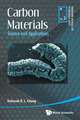
CARBON MATERIALS: Engineering Materials For Technological Needs
Autor Deborah D L Chungen Limba Engleză Hardback – 3 ian 2019
This book provides a tutorial-style and up-to-date coverage of the carbon forms. In addition to an introductory chapter on carbon materials, the book includes chapters on graphite, graphene, carbon black, activated carbon, carbon fibers, and carbon nanofibers/nanotubes. For example, the chapter on graphite covers various materials in the graphite family, including polycrystalline graphite, pyrolytic graphite, turbostratic carbon, intercalated graphite, graphite oxide, exfoliated graphite and flexible graphite, in addition to their electronic and mechanical properties.
This book is suitable for use as a textbook for undergraduate and graduate students in science and engineering, and as a reference book for professionals. It is dedicated to the memory of the author's PhD thesis advisor, Professor M S Dresselhaus (1930-2017) of Massachusetts Institute of Technology.
| Toate formatele și edițiile | Preț | Express |
|---|---|---|
| Paperback (1) | 332.51 lei 6-8 săpt. | +102.34 lei 7-13 zile |
| World Scientific – 3 ian 2019 | 332.51 lei 6-8 săpt. | +102.34 lei 7-13 zile |
| Hardback (1) | 613.84 lei 6-8 săpt. | |
| World Scientific – 3 ian 2019 | 613.84 lei 6-8 săpt. |
Preț: 613.84 lei
Preț vechi: 722.17 lei
-15%
Puncte Express: 921
Preț estimativ în valută:
108.67€ • 126.43$ • 94.24£
108.67€ • 126.43$ • 94.24£
Carte tipărită la comandă
Livrare economică 28 februarie-14 martie
Preluare comenzi: 021 569.72.76
Specificații
ISBN-13: 9789813221901
ISBN-10: 9813221909
Pagini: 382
Dimensiuni: 157 x 235 x 25 mm
Greutate: 0.68 kg
Editura: World Scientific
Seria Engineering Materials For Technological Needs
ISBN-10: 9813221909
Pagini: 382
Dimensiuni: 157 x 235 x 25 mm
Greutate: 0.68 kg
Editura: World Scientific
Seria Engineering Materials For Technological Needs
V-ar putea interesa
-
 -8%Preț: 599.63 lei651.78 lei
 -
 -8%Preț: 601.85 lei654.19 lei
 -
 The Physical Chemistry of PaintsPhillip M. Fisk-27%Preț: 661.85 lei906.65 lei
 -
 Cement Chemistry and Physics for Civil EngineersWolfgang Czernin-9%Preț: 1206.00 lei1325.27 lei
 -
 Frictional Phenomena, 2nd EditionAndrew Gemant-27%Preț: 676.31 lei926.45 lei
 -
 -18%Preț: 1281.24 lei1562.49 lei
 -
 Introduction to Composite MaterialsStephenW. Tsai-18%Preț: 1128.23 lei1375.89 lei
 -
 Composite Materials: Science and ApplicationsDeborah D. L. Chung-18%Preț: 1329.89 lei1621.82 lei
 -
 PROBABILISTIC METHODS IN THE THEORY OF STRUCTURESIsaac Elishakoff-15%Preț: 485.43 lei571.08 lei
 -
 Functional MaterialsDeborah D. L. Chung-15%Preț: 490.04 lei576.52 lei
 -
 Materials ThermodynamicsHae-Geon Lee-15%Preț: 461.69 lei543.17 lei
Descriere
Elemental carbon materials take numerous forms, including graphite, graphene, carbon black, activated carbon, nanofibers and nanotubes. In spite of the basic similarity in the chemical bonding, these forms differ greatly in the structure, carbon layer ori