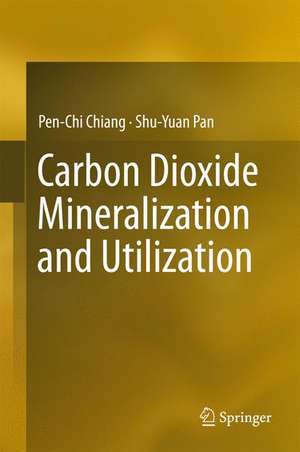
Carbon Dioxide Mineralization and Utilization
Autor Pen-Chi Chiang, Shu-Yuan Panen Limba Engleză Hardback – 10 mar 2017
Preț: 1163.41 lei
Preț vechi: 1418.79 lei
-18%
Puncte Express: 1745
Carte tipărită la comandă
Livrare economică 07-21 decembrie
Livrare prin curier în România Termenul estimat este afișat lângă disponibilitate.
Transport gratuit pentru acest produs Plată online sau ramburs, în funcție de opțiunile comenzii.
Retur gratuit în 14 zile Comandă securizată și suport în română.
Specificații
ISBN-13: 9789811032677
ISBN-10: 981103267X
Pagini: 468
Ilustrații: XVI, 452 p. 108 illus., 2 illus. in color.
Dimensiuni: 160 x 241 x 31 mm
Greutate: 0.81 kg
Ediția:1st ed. 2017
Editura: Springer
Locul publicării:Singapore, Singapore
ISBN-10: 981103267X
Pagini: 468
Ilustrații: XVI, 452 p. 108 illus., 2 illus. in color.
Dimensiuni: 160 x 241 x 31 mm
Greutate: 0.81 kg
Ediția:1st ed. 2017
Editura: Springer
Locul publicării:Singapore, Singapore
V-ar putea interesa
-
 The Green Industrial Revolution: Energy, Engineering and EconomicsWoodrow W. Clark, II-30%Preț: 591.86 lei843.44 lei
-
 Statistical Methods for the Environmental SciencesA H El-Shaarawi-15%Preț: 607.15 lei714.29 lei
-
 Microbes and Microbial TechnologyIqbal Ahmad-18%Preț: 1273.75 lei1553.35 lei
-
 Ecotoxicological Diagnosis in the Tanning IndustryMwinyikione Mwinyihija-15%Preț: 666.23 lei783.80 lei
-
 -23%Preț: 710.02 lei922.11 lei
-
 Reviews of Environmental Contamination and Toxicology Volume 217David M. Whitacre-15%Preț: 612.18 lei720.20 lei
-
 Reviews of Environmental Contamination and Toxicology Volume 218David M. Whitacre-44%Preț: 540.40 lei970.86 lei
-
 Human Pharmaceuticals in the EnvironmentBryan W. Brooks-15%Preț: 635.35 lei747.47 lei
-
 Reviews of Environmental Contamination and Toxicology Volume 228David M. Whitacre-18%Preț: 1260.06 lei1536.66 lei
-
 Physics of Semiconductor DevicesV. K. Jain-24%Preț: 1888.00 lei2484.20 lei
-
 Reviews of Environmental Contamination and Toxicology Volume 235David M. Whitacre-38%Preț: 578.07 lei928.94 lei
-
 -15%Preț: 625.26 lei735.60 lei
-
 -18%Preț: 1196.88 lei1459.61 lei
-
 -18%Preț: 3732.85 lei4552.27 lei
-
 Information Technologies in Environmental EngineeringPaulina Golinska-18%Preț: 1291.03 lei1574.42 lei
-
 The Greenhouse Gas Balance of ItalyRiccardo Valentini-15%Preț: 665.43 lei782.86 lei
-
 Control Theory for EngineersBrigitte D'Andréa-Novel-18%Preț: 1040.27 lei1268.62 lei
-
 Aktuelle Forschung in der Bodenmechanik 2013Achim Hettler-18%Preț: 926.31 lei1129.65 lei
-
 -15%Preț: 665.89 lei783.39 lei
-
 Light Scattering Reviews 5Alexander A. Kokhanovsky-18%Preț: 1214.04 lei1480.54 lei
-
 -18%Preț: 1228.94 lei1498.70 lei
-
 Altlastenhandbuch des Landes Niedersachsen: Wissenschaftlich-technische Grundlagen der ErkundungNiedersächsisches Landesamt für Ökologie-15%Preț: 521.68 lei613.74 lei
-
 Altlastenhandbuch des Landes Niedersachsen MaterialienbandWolfgang Kinzelbach-8%Preț: 381.74 lei414.94 lei
-
 Verfahrenstechnik in BeispielenJosef DraxlerPreț: 529.31 lei
-
 Preț: 462.06 lei
-
 Preț: 369.36 lei
-
 Bioremediation Technology: Recent AdvancesM. H. Fulekar-15%Preț: 620.23 lei729.69 lei
-
 Air Pollution Control and DesignPen-Chi Chiang-15%Preț: 691.99 lei814.10 lei
Cuprins
Introductions.- Part I: Global Warming Issues: Challenges and Opportunities.- Carbon Cycle from Thermodynamic Point of View.- Carbon Capture and Storage (CCS) Technologies.- Strategic Environmental Assessment (SEA).- CCS Guidance.- Part II: Types of Feedstock for CO2 Mineralization.- Natural Silicate Material.- Iron/Steelmaking Slag.- Air pollution control (APC) residue.- Other Alkaline Waste.- Part III: Integrated Wastes Treatment via Accelerated Carbonation.- Accelerated Carbonation Reaction.- Carbonation Mechanisms and Modeling.- Direct/Indirect Carbonation Processes.- Analytical Methods and Material Identification.- Part IV: Valorization of Carbonated Product for Construction Materials.- Product Utilization in Construction Engineering.- Supplementary Cementitious Materials in Cement and Concrete.- Aggregates.- Other Innovative Utilizations.- Part V: Integrated Land-use, Water and Energy Plans.- Methodologies andTools.- Waste-to-Resource Supply Chain.- System Optimization.
Notă biografică
Professor Chiang began engaging in teaching and research activities in National Taiwan University since he obtained Ph.D. degree from the Department of Civil Engineering, Purdue University, USA in 1982. He is a Distinguished Professor of Graduate Institute of Environmental Engineering and a Director of Carbon Cycle Research Center of National Taiwan University. Professor Chiang is known for his work in physicochemical treatment such as carbon adsorption, membrane and ozonation processes. In addition, he was also devoted to his teaching and research in the area of carbon capture technology, air pollution control design and cleaner production technology. He has published more than 300 paper papers in the above area of environmental engineering. Professor Chiang has received numerous awards for research achievements, including Fellow of Water Environment Federation (WEF), BCCE of American Academy of Environmental Engineers and Scientists (AAEES), and Diplomat of the American Academy of Water Resources Engineers of the American Society of Civil Engineers (ASCE), Outstanding Research Contribution Award, Executive Yuan, Outstanding Research Award, National Science Council, and Distinguished Chinese Institute of Engineer Research Award.
Xiang Gao is currently the dean and a professor of the College of Energy Engineering, Zhejiang University, Hangzhou, China, and the director of Coal-Fired Air Pollution Control Engineering Center for Ministry of National Environmental Protection, China. He received his B.S. and Ph.D. degrees from Zhejiang University. His research focuses on simultaneous removal of multi-pollutants (NOx, SOx, particulate matter, and heavy metal, etc.) in flue gas, flue gas desulphurization, flue gas denitration, PM2.5 Control, and energy-saving technology. He has won First prize of the National Award for Technological Invention, Second prize of the National Award for Scientific and Technological Progress, Second prize of the National Award for Technological Invention, Second prize of the National Award for Teaching Achievements, the Chinese Outstanding Patents Award, etc. He has published more than 200 peer-reviewed papers, more than 60 invention patents (including 3 international patents) and involved in more than 30 authorized national/industrial standards as a leading or important role.
Textul de pe ultima copertă
This book focuses on an important technology for mineralizing and utilizing CO2 instead of releasing it into the atmosphere. CO2 mineralization and utilization demonstrated in the waste-to-resource supply chain can “reduce carbon dependency, promote resource and energy efficiency, and lessen environmental quality degradation,” thereby reducing environmental risks and increasing economic benefits towards Sustainable Development Goals (SDG). In this book, comprehensive information on CO2 mineralization and utilization via accelerated carbonation technology from theoretical and practical considerations was presented in 20 Chapters. It first introduces the concept of the carbon cycle from the thermodynamic point of view and then discusses principles and applications regarding environmental impact assessment of carbon capture, storage and utilization technologies. After that, it describes the theoretical and practical considerations for “Accelerated Carbonation (Mineralization)” including analytical methods, and systematically presents the carbonation mechanism and modeling (process chemistry, reaction kinetics and mass transfer) and system analysis (design and analysis of experiments, life cycle assessment and cost benefit analysis). It then provides physico-chemical properties of different types of feedstock for CO2 mineralization and then explores the valorization of carbonated products as green materials. Lastly, an integral approach for waste treatment and resource recovery is introduced, and the carbonation system is critically assessed and optimized based on engineering, environmental, and economic (3E) analysis. The book is a valuable resource for readers who take scientific and practical interests in the current and future Accelerated Carbonation Technology for CO2 Mineralization and Utilization.
Caracteristici
Gives a detailed introduction and comprehensive description of CO2 capture-related subjects Provides an extended review of accelerated carbonation technology for CO2 emission reduction Displays several pathways of product utilization for further indirect CO2 emission reduction benefits Illustrates important performance evaluation criteria, methods and tools for achieving carbon cycle Includes supplementary material: sn.pub/extras