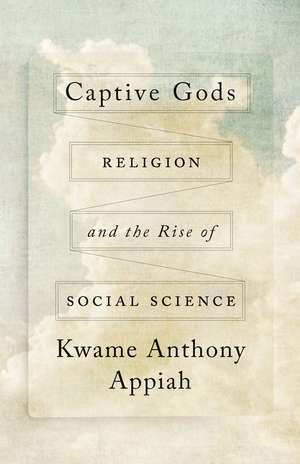
Captive Gods: Religion and the Rise of Social Science: The Terry Lectures Series
Autor Kwame Anthony Appiahen Limba Engleză Hardback – 7 oct 2025
The foundations of modern social science were built on the study of religion, the acclaimed thinker Kwame Anthony Appiah argues. Delving into the intellectual currents of the nineteenth and early twentieth centuries, he investigates how formative thinkers—notably Edward Burnett Tylor, Émile Durkheim, Georg Simmel, and Max Weber—grappled with the concepts of society and religion as interdependent categories. Appiah shows how their efforts to define religion, or evade the task, mark the power and limitations of social thought in ways that persist among theorists today. Religion was not merely an object of study but a framework through which early social scientists established sociology as a discipline.
Appiah also examines more recent work in both interpretive sociology and evolutionary and cognitive psychology about the mechanisms through which communities form beliefs and values—while underscoring the enduring significance of these earlier debates for contemporary social thought. Throughout, he intertwines storytelling, historical analysis, and philosophical reflection to show how our ideas about society and culture have been, and continue to be, forged in dialogue with religious questions.
Din seria The Terry Lectures Series
-
 Preț: 130.40 lei
 -
 Preț: 77.22 lei
 -
 Preț: 114.03 lei
 -
 Preț: 135.91 lei
 - 5%
 Preț: 202.36 lei
 -
 Preț: 110.01 lei
 -
 Preț: 264.88 lei
 -
 Preț: 506.67 lei
 -
 Preț: 379.64 lei
 -
 Preț: 521.17 lei
 -
 Preț: 457.54 lei
 -
 Preț: 430.21 lei
 -
 Preț: 400.02 lei
 -
 Preț: 451.50 lei
 -
 Preț: 430.21 lei
 -
 Preț: 416.12 lei
 -
 Preț: 441.77 lei
 -
 Preț: 423.33 lei
 -
 Preț: 242.59 lei
 -
 Preț: 333.92 lei
 -
 Preț: 209.59 lei
 -
 Preț: 398.91 lei
 -
 Preț: 398.91 lei
 -
 Preț: 449.38 lei
 -
 Preț: 400.02 lei
 - 5%
 Preț: 424.65 lei
 - 5%
 Preț: 394.53 lei
 -
 Preț: 416.12 lei
 -
 Preț: 505.82 lei
 -
 Preț: 403.77 lei
 -
 Preț: 423.12 lei
 -
 Preț: 522.58 lei
 -
 Preț: 484.40 lei
 -
 Preț: 570.12 lei
 - 25%
 Preț: 105.36 lei
 - 25%
 Preț: 130.37 lei
 - 21%
 Preț: 155.93 lei
Preț: 169.80 lei
Puncte Express: 255
Carte disponibilă
Livrare economică 16-30 noiembrie
Livrare express 30 octombrie-05 noiembrie pentru 35.76 lei
Livrare prin curier în România Termenul estimat este afișat lângă disponibilitate.
Transport gratuit de la 400.00 lei Plată online sau ramburs, în funcție de opțiunile comenzii.
Retur gratuit în 14 zile Comandă securizată și suport în română.
Specificații
ISBN-13: 9780300233063
ISBN-10: 030023306X
Pagini: 344
Dimensiuni: 156 x 235 x 34 mm
Greutate: 0.56 kg
Editura: Yale University Press
Colecția Yale University Press
Seria The Terry Lectures Series
ISBN-10: 030023306X
Pagini: 344
Dimensiuni: 156 x 235 x 34 mm
Greutate: 0.56 kg
Editura: Yale University Press
Colecția Yale University Press
Seria The Terry Lectures Series
Recenzii
“Appiah asks us to think more carefully about what we mean when we call something a religion. . . . Among the writers who might serve as a guide through this difficult terrain, Appiah stands out for both his lucidity in exposition and his sure-footed style.”—Peter E. Gordon, New York Review of Books
“Thoughtful and entertaining.”—Dominic Green, Wall Street Journal
“In this stimulating intellectual history, Appiah . . . examines the central importance of the study of religion to the thinkers who established the modern social sciences. . . . A rich and enchanting work of scholarship.”—Publishers Weekly
“Appiah’s effortless explication across countries, cultures, languages, disciplines, and periods of time is second to none.”—Brad East, Chronicle of Higher Education
“An accessible, readable book that exhibits deep erudition and extensive learnedness worn lightly. Appiah has an eye for raising the biggest questions about human nature and social existence.”—Angie Heo, University of Chicago
“In this elegant, witty, and often brilliant book, Anthony Appiah explores the fundamental significance of religion for modern development of the very idea of societies. The notion that there might be many religions to be explored comparatively shaped thinking of societies in similar plurality, exploring how religions gave them distinctive categories of thought and culture, how individuals were shaped by and dependent on these contexts, and what happened when they lost their grip.This is a rich and valuable work for all who would understand religion, social science, and modernity itself.”—Craig Calhoun, Arizona State University and Princeton University
“In this characteristically brilliant and learned book, Anthony Appiah has given us a crucial account of the emergence of disciplines in which we seek to uncover how we form and reform our beliefs and values. It is a stunning and urgent inquiry—a masterpiece of intellectual history—and it could not arrive at a better time.”—Jorie Graham, author of To 2040 and [To] The Last [Be] Human
“In Captive Gods, Appiah builds an incisive intellectual history of theories of religion and society through the minds and worlds of four giants. We see how the concepts of ‘religion’ and ‘society’ co-created each other in the early twentieth century. This is an exquisite work of reflection as we rethink those captive gods, thundering in our own time.”—Laurie L. Patton, president, American Academy of Arts & Sciences, and author, Who Owns Religion? Scholars and Their Publics in the Late Twentieth Century
“Thoughtful and entertaining.”—Dominic Green, Wall Street Journal
“In this stimulating intellectual history, Appiah . . . examines the central importance of the study of religion to the thinkers who established the modern social sciences. . . . A rich and enchanting work of scholarship.”—Publishers Weekly
“Appiah’s effortless explication across countries, cultures, languages, disciplines, and periods of time is second to none.”—Brad East, Chronicle of Higher Education
“An accessible, readable book that exhibits deep erudition and extensive learnedness worn lightly. Appiah has an eye for raising the biggest questions about human nature and social existence.”—Angie Heo, University of Chicago
“In this elegant, witty, and often brilliant book, Anthony Appiah explores the fundamental significance of religion for modern development of the very idea of societies. The notion that there might be many religions to be explored comparatively shaped thinking of societies in similar plurality, exploring how religions gave them distinctive categories of thought and culture, how individuals were shaped by and dependent on these contexts, and what happened when they lost their grip.This is a rich and valuable work for all who would understand religion, social science, and modernity itself.”—Craig Calhoun, Arizona State University and Princeton University
“In this characteristically brilliant and learned book, Anthony Appiah has given us a crucial account of the emergence of disciplines in which we seek to uncover how we form and reform our beliefs and values. It is a stunning and urgent inquiry—a masterpiece of intellectual history—and it could not arrive at a better time.”—Jorie Graham, author of To 2040 and [To] The Last [Be] Human
“In Captive Gods, Appiah builds an incisive intellectual history of theories of religion and society through the minds and worlds of four giants. We see how the concepts of ‘religion’ and ‘society’ co-created each other in the early twentieth century. This is an exquisite work of reflection as we rethink those captive gods, thundering in our own time.”—Laurie L. Patton, president, American Academy of Arts & Sciences, and author, Who Owns Religion? Scholars and Their Publics in the Late Twentieth Century
Notă biografică
Kwame Anthony Appiah is the Silver Professor of Philosophy and Law at New York University. His books include The Ethics of Identity, Lines of Descent: W. E. B. Du Bois and the Emergence of Identity, The Lies that Bind: Rethinking Identity, and As If: Idealization and Ideals. He writes the weekly “Ethicist” column for the New York Times Magazine.