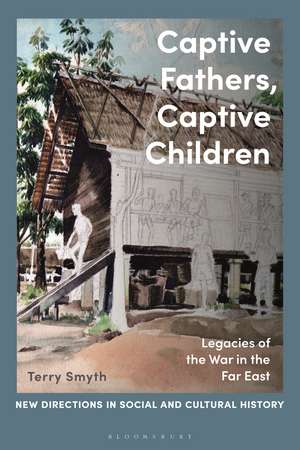
Captive Fathers, Captive Children: Legacies of the War in the Far East: New Directions in Social and Cultural History
Autor Dr Terry Smythen Limba Engleză Paperback – 27 iul 2023
By following a life course approach, and a psychosocial methodology, the book demonstrates how memory and trauma were 'worked into' the social and cultural lives of individual children, and explores how the relationship between their inner psychic worlds and subsequent memory practices unfolded against a challenging and morally ambivalent geopolitical background.
The book invites readers to engage with the author in a journey of exploration and self-reflection, with elements of auto-ethnography adding richness to the text. Enlivened by interview extracts, case study material and ethnographic observations, this work opens up fresh and ambitious perspectives on the personal legacies of war.


Preț: 198.17 lei
Preț vechi: 270.61 lei
-27%
Puncte Express: 297
Carte tipărită la comandă
Livrare economică 06-20 octombrie
Livrare prin curier în România Termenul estimat este afișat lângă disponibilitate.
Transport gratuit de la 400.00 lei Plată online sau ramburs, în funcție de opțiunile comenzii.
Retur gratuit în 14 zile Comandă securizată și suport în română.
Specificații
ISBN-13: 9781350194298
ISBN-10: 1350194298
Pagini: 264
Ilustrații: 10 bw illus
Dimensiuni: 150 x 232 x 18 mm
Greutate: 0.4 kg
Editura: Bloomsbury Publishing
Colecția Bloomsbury Academic
Seria New Directions in Social and Cultural History
Locul publicării:London, United Kingdom
ISBN-10: 1350194298
Pagini: 264
Ilustrații: 10 bw illus
Dimensiuni: 150 x 232 x 18 mm
Greutate: 0.4 kg
Editura: Bloomsbury Publishing
Colecția Bloomsbury Academic
Seria New Directions in Social and Cultural History
Locul publicării:London, United Kingdom
Cuprins
1. Introduction
Chapter 1: Life in Captivity
Chapter 2: Bringing War into the Home
Chapter 3: Remembering and Commemorating
Chapter 4: Finding Meaning in Memories
Chapter 5: Home as a Place for Remembrance
Chapter 6: The Search for Military Family Histories
Chapter 7: Place and Pilgrimage
Conclusion
Chapter 1: Life in Captivity
Chapter 2: Bringing War into the Home
Chapter 3: Remembering and Commemorating
Chapter 4: Finding Meaning in Memories
Chapter 5: Home as a Place for Remembrance
Chapter 6: The Search for Military Family Histories
Chapter 7: Place and Pilgrimage
Conclusion
Recenzii
This important study does much to address feelings of neglect and sheds light on the family dynamics and legacies of those who survived the physical and mental challenges of the prisoner-of-war camps.
Terry Smyth's book is a deeply personal, yet scholarly, account of trauma, intergenerational memory, and the lasting effects of wartime captivity. The emotions expressed and experienced are raw and often overwhelming, but his message is hopeful: through empathy and imagination, recovery is possible.
Captive Fathers, Captive Children is an extraordinary book. On the one hand it is a deeply researched and poignant account of the return and home lives of Far East Prisoners of War (FEPOWS), seen through the eyes of their children, of whom Terry is one. On the other, it investigates the historical pursuits of FEPOW children and why they are drawn to reconstruct the traumatic pasts of their fathers. It is at once a memoir, a social history of POWs, an ethnography of commemoration and an exploration of the subjectivity of descendants.
Terry Smyth's book is a deeply personal, yet scholarly, account of trauma, intergenerational memory, and the lasting effects of wartime captivity. The emotions expressed and experienced are raw and often overwhelming, but his message is hopeful: through empathy and imagination, recovery is possible.
Captive Fathers, Captive Children is an extraordinary book. On the one hand it is a deeply researched and poignant account of the return and home lives of Far East Prisoners of War (FEPOWS), seen through the eyes of their children, of whom Terry is one. On the other, it investigates the historical pursuits of FEPOW children and why they are drawn to reconstruct the traumatic pasts of their fathers. It is at once a memoir, a social history of POWs, an ethnography of commemoration and an exploration of the subjectivity of descendants.