
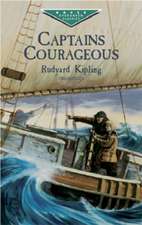
Captains Courageous
Autor Rudyard Kiplingen Limba Engleză Paperback
Preț: 81.76 lei
Puncte Express: 123
Carte disponibilă
Livrare economică 17-31 decembrie
Livrare prin curier în România Termenul estimat este afișat lângă disponibilitate.
Transport gratuit de la 400.00 lei Plată online sau ramburs, în funcție de opțiunile comenzii.
Retur gratuit în 14 zile Comandă securizată și suport în română.
Specificații
ISBN-13: 9781548202446
ISBN-10: 1548202444
Pagini: 126
Dimensiuni: 216 x 279 x 7 mm
Greutate: 0.31 kg
V-ar putea interesa
-
 Robinson CrusoeDaniel DefoePreț: 28.01 lei
-
 Just So StoriesRudyard KiplingPreț: 28.01 lei
-
 Kensuke's KingdomMichael Morpurgo-33%Preț: 38.41 lei57.56 lei
-
 Little House on the PrairieLaura Ingalls WilderPreț: 61.15 lei
-
 Farmer BoyLaura Ingalls WilderPreț: 62.37 lei
-
 On the Banks of Plum CreekLaura Ingalls WilderPreț: 61.94 lei
-
 By the Shores of Silver LakeLaura Ingalls WilderPreț: 59.95 lei
-
 The OutsidersS. E. HintonPreț: 64.54 lei
-
 Bud, Not BuddyChristopher Paul CurtisPreț: 48.72 lei
-
 The Grapes of WrathJohn Steinbeck-23%Preț: 56.02 lei73.18 lei
-
 The Red PonyJohn Steinbeck-19%Preț: 50.99 lei63.30 lei
-
 The Catcher in the Rye.J D SalingerPreț: 181.60 lei
-
 Preț: 55.46 lei
-
 Adventures of Huckleberry FinnMark TwainPreț: 40.39 lei
-
 Where the Wild Things AreMaurice SendakPreț: 166.30 lei
-
 -25%Preț: 70.52 lei93.80 lei
-
 The Call of the WildJack LondonPreț: 34.41 lei
-
 KimRudyard KiplingPreț: 28.01 lei
Recenzii
“The most complete man of genius I have ever known.”—Henry James
“Throughout the world his voice commanded more respect than any citizen other than heads of state.”—Mark Twain
“Of Kipling’s personal decency there can be no doubt….I for one cannot help wishing that I could offer some kind of tribute.”—George Orwell
Notă biografică
Joseph Rudyard Kipling (30 December 1865 - 18 January 1936) was an English journalist, short-story writer, poet, and novelist. Kipling's works of fiction include The Jungle Book (1894), Kim (1901), and many short stories, including "The Man Who Would Be King" (1888). He is regarded as a major innovator in the art of the short story; his children's books are classics of children's literature; and one critic described his work as exhibiting "a versatile and luminous narrative gift." Kipling was one of the most popular writers in the United Kingdom, in both prose and verse, in the late 19th and early 20th centuries. Henry James said: "Kipling strikes me personally as the most complete man of genius, as distinct from fine intelligence, that I have ever known." In 1907, at the age of 42, he was awarded the Nobel Prize in Literature, making him the first English-language writer to receive the prize, and its youngest recipient to date. He was also sounded out for the British Poet Laureateship and on several occasions for a knighthood, both of which he declined. Kipling's subsequent reputation has changed according to the political and social climate of the age and the resulting contrasting views about him continued for much of the 20th century. George Orwell called him a "prophet of British imperialism." Literary critic Douglas Kerr wrote: "Kipling is still an author who can inspire passionate disagreement and his place in literary and cultural history is far from settled. But as the age of the European empires recedes, he is recognised as an incomparable, if controversial, interpreter of how empire was experienced. That, and an increasing recognition of his extraordinary narrative gifts, make him a force to be reckoned with."
Descriere
Descriere de la o altă ediție sau format:
One of Kipling's most enduringly popular works, this classic tale of the sea and fable of a boy's initiation into the world of men is accompanied by a brand-new Introduction. Reissue.