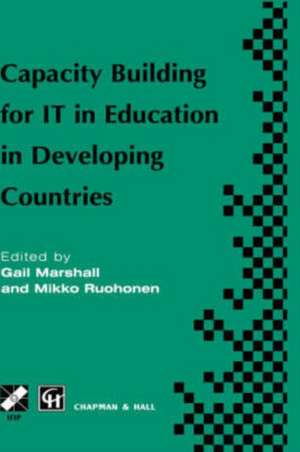
Capacity Building for It in Education in Developing Countries
Editat de Gail Marshall, Mikko Ruohonenen Limba Engleză Hardback – 28 feb 1998
Preț: 1029.34 lei
Preț vechi: 1286.67 lei
-20%
Puncte Express: 1544
Carte tipărită la comandă
Livrare economică 01-15 decembrie
Livrare prin curier în România Termenul estimat este afișat lângă disponibilitate.
Transport gratuit pentru acest produs Plată online sau ramburs, în funcție de opțiunile comenzii.
Retur gratuit în 14 zile Comandă securizată și suport în română.
Specificații
ISBN-13: 9780412814600
ISBN-10: 0412814609
Pagini: 360
Ilustrații: XIV, 360 p.
Dimensiuni: 160 x 241 x 26 mm
Greutate: 0.73 kg
Ediția:1998 edition
Editura: Springer Us
Locul publicării:New York, NY, United States
ISBN-10: 0412814609
Pagini: 360
Ilustrații: XIV, 360 p.
Dimensiuni: 160 x 241 x 26 mm
Greutate: 0.73 kg
Ediția:1998 edition
Editura: Springer Us
Locul publicării:New York, NY, United States
V-ar putea interesa
-
 ICL: A Business and Technical HistoryMartin Campbell-Kelly-37%Preț: 389.49 lei615.26 lei
 -
 Modern Cellular AutomataMichael J. B. Duff-20%Preț: 1027.52 lei1284.39 lei
 -
 -20%Preț: 670.78 lei838.48 lei
 -
 Scientific Computing on Supercomputers IIIP. E. van Camp-20%Preț: 1024.29 lei1280.36 lei
 -
 Information Systems DevelopmentGeorge Angelos Papadopoulos-20%Preț: 1972.74 lei2465.92 lei
 -
 The Cambridge Companion to the Fin de SiècleGail MarshallPreț: 215.81 lei
 -
 Jameson, Cowden Clarke, Kemble, Cushman: Great Shakespeareans: Volume VIIProfessor Gail Marshall-49%Preț: 946.56 lei1839.90 lei
 -
 Shakespeare and Victorian WomenGail MarshallPreț: 298.25 lei
 -
 -18%Preț: 1263.89 lei1541.32 lei
 -
 Victorian ShakespeareGail Marshall-15%Preț: 664.27 lei781.50 lei
 -
 Network Infrastructure SecurityAngus Wong-20%Preț: 653.90 lei817.38 lei
 -
 Pyramidal Architectures for Computer VisionVirginio Cantoni-20%Preț: 324.45 lei405.56 lei
 -
 Learning in School, Home and CommunityGail Marshall-15%Preț: 617.48 lei726.45 lei
 -
 Managing QoS in Multimedia Networks and ServicesJosé Neuman De Souza-20%Preț: 1278.53 lei1598.17 lei
 -
 Smart Card Research and Advanced ApplicationsJosep Domingo-Ferrer-20%Preț: 1248.20 lei1560.25 lei
 -
 E-Training Practices for Professional OrganizationsPaul Nicholson-20%Preț: 635.55 lei794.44 lei
 -
 Zeitverhalten synchroner SchaltwerkeHans-Otto Leilich-20%Preț: 405.44 lei506.80 lei
 -
 SIL - a Simulation LanguageNiels Houbak-20%Preț: 317.26 lei396.57 lei
 -
 -20%Preț: 351.22 lei439.02 lei
 -
 Progress in Distributed Operating Systems and Distributed Systems ManagementWolfgang Schröder-Preikschat-20%Preț: 330.54 lei413.18 lei
 -
 Advanced Information Systems EngineeringBo Steinholtz-20%Preț: 327.69 lei409.62 lei
 -
 Automata, Languages and ProgrammingMichael S. Paterson-20%Preț: 649.47 lei811.84 lei
 -
 SWAT '90John R. Gilbert-20%Preț: 328.72 lei410.89 lei
 -
 AlgorithmsTetsuo Asano-20%Preț: 345.28 lei431.59 lei
 -
 -20%Preț: 423.52 lei529.40 lei
Public țintă
ResearchCuprins
I National Perspectives.- 1 Nordic cooperation on communication and information technologies and didactics in education.- 2 Building resource capacity for IT education and training in schools — the case of Botswana.- 3 Computer education and human capacity for information technology in Namibia.- 4 Schools with SPIRIT — capacity building in The Netherlands.- 5 Information technology in Norwegian education — consistency of strategic initiatives implementing IT in primary education.- 6 Development of information technology in Hong Kong education over the past decade.- 7 Fighting a lone battle for computer education in Nepal.- II Building Skills in the National Context.- 8 Bridging the skills gap in Zimbabwe.- 9 Information technology education and training initiatives — the Nigerian experience.- 10 Using applications programs in a university to build human capacity for information technology.- III Targetted Projects.- 11 Infrastructure issues for implementation of portable computer use in schools.- 12 Capacity building with a difference.- 13 Principals, information technology and leadership — coping with professional development despite isolation.- 14 ‘Communicate and Learn’ — a collaborative project.- 15 The effect of network technology on education.- IV Classroom-based Initiatives.- 16 Technology and young children — new strategies to prevent illiteracy and create better chances of success for all.- 17 Designing Logo-based microworlds for effective learning — a road to improving teacher education.- V Research for IT-based Education.- 18 The needs and challenges of information systems education — the case of Nigerian universities.- 19 Blarne the technocentric artefact! What research tells us about problems inhibiting teacher use of IT.- 20 Measuringsuccess in the global village — resources for conducting systematic and comprehensive evaluations in IT settings.- VI Resource acquisition, allocation and utilization.- 21 The role of educational and professional bodies in guidance towards capacity planning.- 22 The European computer driving licence.- 23 Information literacy — the missing link in education, with special reference to developing countries.- 24 Maximizing the benefits of aid for information technology.- 25 Building capacity for information technology in educational management in developing countries.- 26 Information technology resources for education in developing countries.- VII A Curriculum for the Future.- 27 The need for a new perspective — creating learning networks for African teachers: change, professional development and ICTs.- 28 Informatics for secondary education — the UNESCO/IFIP curriculum as a resource for developed and developing countries.- VIII Workshop Presentations.- 29 Teaching informatics as a subject.- 30 Using hypermedia and the internez in the teaching of mathematics.- 31 Information technology and problem solving in mathematics education.- 32 Appropriate research in IT in emerging countries.- IX Discussion Group Recommendations.- Discussion Group 1 — IT in curriculum and courseware development.- 34 Discussion Group 2 — Policies, strategies and initiatives of ICT in education.- 35 Discussion Group 3 — Guidelines and directions for ICT policy in education.- 36 Discussion Group 4 — IT education delivery and learning.- 37 Discussion Group 5 — Information technology in institutional administration and management.- 38 Discussion Group 6 — Building resource accessibility in developing countries.- Alphabetical List of Participants.- Index of Contributors.- Keywordindex.