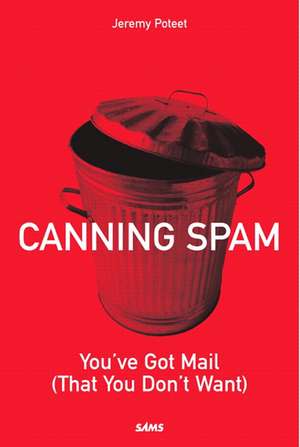
Canning Spam
Autor Jeremy Poteeten Limba Engleză Paperback – 13 mai 2004
- Spam gets frequent media attention - users are tired of spam and looking for solutions.
- Explains possible dangers of spam, viruses and other traps in malicious email.
- Includes practical advice for savvy email users and administrators.
Preț: 158.24 lei
Preț vechi: 197.80 lei
-20% Nou
Puncte Express: 237
Preț estimativ în valută:
28.00€ • 32.83$ • 24.59£
28.00€ • 32.83$ • 24.59£
Carte disponibilă
Livrare economică 19 ianuarie-02 februarie 26
Preluare comenzi: 021 569.72.76
Specificații
ISBN-13: 9780672326394
ISBN-10: 0672326396
Pagini: 239
Ilustrații: black & white illustrations
Dimensiuni: 161 x 231 x 15 mm
Greutate: 0.35 kg
Ediția:1
Editura: PEARSON TECHNOLOGY GROUP
Locul publicării:Indianapolis, United States
ISBN-10: 0672326396
Pagini: 239
Ilustrații: black & white illustrations
Dimensiuni: 161 x 231 x 15 mm
Greutate: 0.35 kg
Ediția:1
Editura: PEARSON TECHNOLOGY GROUP
Locul publicării:Indianapolis, United States
V-ar putea interesa
-
 Detecting and Combating Malicious EmailJulie JCH Ryan-20%Preț: 186.91 lei233.64 lei
 -
 SendDavid ShipleyPreț: 90.08 lei
 -
 Security in Wireless Mesh NetworksYan Zhang-34%Preț: 361.09 lei543.79 lei
 -
 End-to-End Adaptive Congestion Control in TCP/IP NetworksChristos N. Houmkozlis-20%Preț: 623.80 lei779.74 lei
 -
 -20%Preț: 1168.74 lei1460.93 lei
 -
 -20%Preț: 41.90 lei52.38 lei
 -
 DovecotPeer Heinlein-20%Preț: 260.57 lei325.72 lei
 -
 Das Postfix-BuchPeer Heinlein-20%Preț: 310.48 lei388.10 lei
 -
 Cyber Sign OffsHugh Murr-20%Preț: 77.28 lei96.60 lei
Descriere
We've all seen it — the e-mails that come to us from a sender we don't know and promise a frog that jumps across our screen, a low mortgage rate or a medical miracle pill. These e-mails are otherwise known as spam. Your inbox gets cluttered or worse, your computer is infected with a virus as you scratch your head, wondering how it ever happened. Now there is a way to stop the madness! Canning Spam: You've Got Mail (That You Don't Want) is your remedy to inbox clutter and infected computers. Learn how spammers get your e-mail address and how to stop them, how viruses are transmitted through attachments, how spammers can mask their true identity and how to ultimately block unwanted e-mails. Next time you log in to your e-mail account, be happy to hear those three little words: “You've Got Mail!”
Cuprins
Introduction.
1. Stealing Candy from a Baby: How Spammers Harvest Email Addresses.
2. Neither Confirm Nor Deny: How Email Attacks Determine that an Email Address is Active.
3. Bad Things Come in Small Packages: How Viruses are Transmitted Through Email Attachments.
4. Using Email Clients for Good and Evil: Guarding Against Script-Based Viruses and Worms.
5. Would the Real Sender Please Stand Up?: How Spammers Spoof Email Identities.
6. Unwilling Accomplices?: How Spammers Mask their Identities using Email Relaying.
7. Separating the Wheat from the Chaff: Using Filters to Block Unwanted Emails.
8. Don't Send us a Postcard: Insuring that your Email is not Sent in the Clear.
9. You've Got Some Email in my Web Site: Using Web-based Email Services Securely.
10. The Bigger they are, the Harder they Fall: Mitigating Denial of Email Services Attacks.
Appendix A. Email Protocols.
Appendix B. Popular Email Tools.
Appendix C. Email Legal Information.
Notă biografică
Jeremy Potee is the Chief Security Officer for appDefense, a consulting company specializing in application security. Jeremy has many years of experience administering Windows, Unix and Linux-based servers. He is a Certified Information Systems Security Professional (CISSP) and was the winner in the 2002 eWeek OpenLabs OpenHack IV competition. Jeremy is an active member of the Open Web Application Security Project (OWASP), including serving as a project manager for the OWASP Guide and a monthly columnist on .NET security. He is also a member of multiple OASIS technical committees that establish security standards. He can be reached at CanningSpam@appdefense.com.
Caracteristici
- Exceptionally readable—Accessible, friendly style, replete with case studies and stories from the field.
- Students wont just find this book extraordinarily useful: they will find it compelling and enjoyable, too.
- Students wont just find this book extraordinarily useful: they will find it compelling and enjoyable, too.
- How spammers and attackers work—Clearly explains how spammers harvest email addresses and “spoof” identities, how email attacks determine that an address is active, and how viruses are transmitted through attachments.
- Gives students practical insight into how spammers and other adversaries work, so they can implement more effective countermeasures.
- Gives students practical insight into how spammers and other adversaries work, so they can implement more effective countermeasures.
- Best practices for users and administrators—Systematically shows how users and administrators can reduce spam and virus attacks, and avoid being victimized.
- Helps students learn from the lessons of experienced system, network, and email administrators.
- Helps students learn from the lessons of experienced system, network, and email administrators.
- Extensive coverage of email clients—Shows why email clients can be vulnerable to script-based viruses and worms, and how to make them more resistant.
- Shows students how to protect themselves against the most widespread and dangerous email attacks.
- Shows students how to protect themselves against the most widespread and dangerous email attacks.
- Practical guidance on email filtering—Introduces email filters and shows how to use them without generating unacceptable rates of “false positives.”
- Helps students master one of the key anti-spam weapons available to administrators.
- Helps students master one of the key anti-spam weapons available to administrators.
- Basic email cryptography—Introduces cryptography tools designed to protect email against unauthorized reading.
- Teaches students how to use cryptography to protect the contents of their email.
- Teaches students how to use cryptography to protect the contents of their email.
Textul de pe ultima copertă
We've all seen it -- the e-mails that come to us from a sender we don't know and promise a frog that jumps across our screen, a low mortgage rate or a medical miracle pill. These e-mails are otherwise known as spam. Your inbox gets cluttered or worse, your computer is infected with a virus as you scratch your head, wondering how it ever happened. Now there is a way to stop the madness! "Canning Spam: You've Got Mail (That You Don't Want)" is your remedy to inbox clutter and infected computers. Learn how spammers get your e-mail address and how to stop them, how viruses are transmitted through attachments, how spammers can mask their true identity and how to ultimately block unwanted e-mails. Next time you log in to your e-mail account, be happy to hear those three little words: "You've Got Mail!"