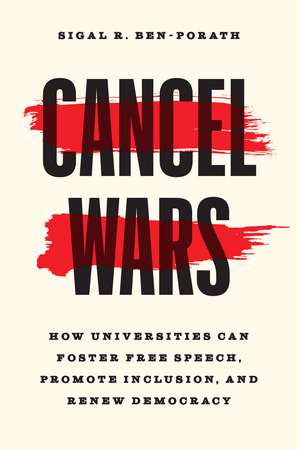
Cancel Wars: How Universities Can Foster Free Speech, Promote Inclusion, and Renew Democracy
Autor Sigal R. Ben-Porathen Limba Engleză Hardback – 16 ian 2023
Notăm cu interes apariția volumului Cancel Wars, o analiză echilibrată a politizării mediului universitar, publicată de University of Chicago Press. Lucrarea se încadrează în nucleul filosofiei educației contemporane, abordând modul în care instituțiile de învățământ superior pot naviga între protejarea incluziunii și garantarea libertății de exprimare. Într-un context în care campusurile americane au devenit puncte de conflict în „războaiele culturale”, Sigal R. Ben-Porath refuză simplificările care infantilizează studenții, alegând în schimb să exploreze responsabilitatea instituțională în fața discursului extremist.
Structura volumului urmărește o progresie logică, de la analiza democrației polarizate și a distincției dintre faptele partizane și adevărul științific, până la rolul specific al școlilor K-12 în cultivarea civismului. Autorul argumentează că universitățile au datoria de a stabili granițe ale discursului acceptabil, recunoscând în același timp daunele reale produse de discursul instigator la ură. Comparabil cu The Value and Limits of Academic Speech de Donald Alexander Downs în ceea ce privește rigoarea analizei cenzurii progresive, volumul de față este actualizat pentru contextul „degradării adevărului”, oferind o perspectivă mai nuanțată asupra modului în care incluziunea și libertatea pot coexista.
În contextul operei sale, Cancel Wars continuă preocupările din Citizenship under Fire privind educația civică în perioade de conflict, dar se distinge prin focalizarea pe mecanismele interne ale universității ca motor de reînnoire democratică. Spre deosebire de Tough Choices, unde Ben-Porath analiza intervenția statului în alegerile personale, aici accentul cade pe construcția colectivă a cunoașterii ca scut împotriva polarizării.
Preț: 581.38 lei
Preț vechi: 755.04 lei
-23%
Carte tipărită la comandă
Livrare economică 04-18 decembrie
Livrare express 29 octombrie-04 noiembrie pentru 78.47 lei
Specificații
ISBN-10: 0226823784
Pagini: 208
Dimensiuni: 152 x 229 x 20 mm
Greutate: 0.48 kg
Ediția:First Edition
Editura: University of Chicago Press
Colecția University of Chicago Press
De ce să citești această carte
Recomandăm această carte cadrelor didactice, administratorilor universitari și studenților la științe politice care caută o cale rațională prin labirintul „culturii anulării”. Cititorul va câștiga o înțelegere profundă a modului în care spațiile sigure și libertatea de exprimare nu sunt neapărat opuse, ci pot fi armonizate pentru a reconstrui încrederea civică și a proteja adevărul științific în fața dezinformării partizane.
Despre autor
Sigal R. Ben-Porath este profesor la Graduate School of Education și asistent special al președintelui universității University of Pennsylvania. Expertiza sa în teoria politică și educație este reflectată în lucrări de referință precum Citizenship under Fire: Democratic Education in Times of Conflict, publicată de Princeton University Press, și Tough Choices. Prin rolurile sale administrative și academice, Ben-Porath se află în prima linie a dezbaterilor despre libertatea academică, contribuind constant la definirea rolului democratic al instituțiilor de învățământ în societatea contemporană.
Descriere scurtă
College campuses have become flashpoints of the current culture war and, consequently, much ink has been spilled over the relationship between universities and the cultivation or coddling of young American minds. Philosopher Sigal R. Ben-Porath takes head-on arguments that infantilize students who speak out against violent and racist discourse on campus or rehash interpretations of the First Amendment. Ben-Porath sets out to demonstrate the role of the university in American society and, specifically, how it can model free speech in ways that promote democratic ideals.
In Cancel Wars, she argues that the escalating struggles over “cancel culture,” “safe spaces,” and free speech on campus are a manifestation of broader democratic erosion in the United States. At the same time, she takes a nuanced approach to the legitimate claims of harm put forward by those who are targeted by hate speech. Ben-Porath’s focus on the boundaries of acceptable speech (and on the disproportional impact that hate speech has on marginalized groups) sheds light on the responsibility of institutions to respond to extreme speech in ways that proactively establish conversations across difference. Establishing these conversations has profound implications for political discourse beyond the boundaries of collegiate institutions. If we can draw on the truth, expertise, and reliable sources of information that are within the work of academic institutions, we might harness the shared construction of knowledge that takes place at schools, colleges, and universities against truth decay. Of interest to teachers and school leaders, this book shows that by expanding and disseminating knowledge, universities can help rekindle the civic trust that is necessary for revitalizing democracy.
Notă biografică
Extras
We can understand and begin to address some of the most pressing challenges to democracy by paying careful attention to struggles over truth and to disagreements over belonging and inclusion. These controversies have taken center stage at many college campuses in recent years, especially in debates over the regulation and protection of speech on campus. I argue that the challenges of campus speech are the result of contestations over broader societal fractures concerning truth and inclusion and that campuses need to, in most cases, address these challenges through efforts to engage across differences rather than as breaches to be corrected through regulation or punishment.
The boundaries of acceptable expression on a campus should be set by the mission of the institution, by the call to search for truth through shared work, and through the inclusion of diverse perspectives and voices in the process of inquiry.1 If a form of expression excludes some people on campus, it is the institution’s responsibility to correct the outcomes of that speech. In the vast majority of cases, this does not mean censorship, firing, or “canceling” but rather other types of action taken by the institution to ensure that equity and continued dialogue are both preserved. In this way, speech remains robust while inclusion is reaffirmed and sustained. This is a modified version of the “more speech” response encouraged by Justice Louis Brandeis: it seeks to not simply encourage more speech but also to place the burden of expressing, supporting, and sometimes sponsoring more and better speech on the institution as part of its educational and democratic role.
College campuses have become flashpoints in the current culture war. In this book, I argue that the escalating struggles over “cancel culture,” “safe spaces,” and free speech on campus are a manifestation of broader democratic erosion in the United States. I take a closer look at how these tensions play out to illuminate a path toward revitalizing American democracy. In what follows, I consider the gray areas of permissible speech, taking a close look at their sources and offering solutions to the tensions they create. I situate open expression on campus within the broader polarization occurring in the political sphere to show that the fight over the future of democracy takes place in two battlegrounds: one revolving around truth, how to identify it, and how it is distorted; and the other around inclusion, exclusion, and “cancellation” from the public sphere. Taken together, tensions around truth and inclusion reshape the civic culture of contemporary democracies. Colleges and universities, along with K– 12 schools, are among the main arenas where these battles are fought, and they hold a key to surmounting the current democratic impasse.
Cuprins
1 A Polarized Democracy
2 Scientific Truth, Partisan Facts, and Knowledge We Can Share
3 Do I Belong Here? Inclusion and Harm
4 Freedom of Speech and Habits of Democracy in K–12 Schools
5 Campus Speech and Democratic Renewal
A Final Word
Acknowledgments
Notes
Index