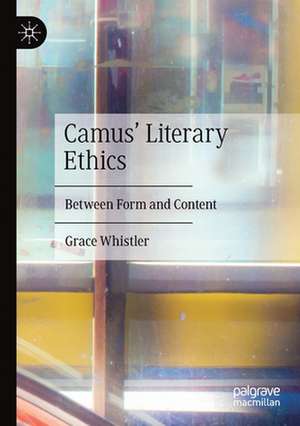
Camus' Literary Ethics
Autor Grace Whistleren Limba Engleză Paperback – 26 ian 2021
Preț: 553.83 lei
Preț vechi: 651.57 lei
-15%
Puncte Express: 831
Carte tipărită la comandă
Livrare economică 08-22 iunie
Specificații
ISBN-13: 9783030377588
ISBN-10: 303037758X
Pagini: 220
Ilustrații: IX, 209 p.
Dimensiuni: 148 x 210 x 13 mm
Greutate: 0.29 kg
Ediția:1st ed. 2020
Editura: Springer
Locul publicării:Cham, Switzerland
ISBN-10: 303037758X
Pagini: 220
Ilustrații: IX, 209 p.
Dimensiuni: 148 x 210 x 13 mm
Greutate: 0.29 kg
Ediția:1st ed. 2020
Editura: Springer
Locul publicării:Cham, Switzerland
Cuprins
Chapter 1: Introduction: Context, Form, and Content.- Chapter 2: A Post-Christian Ethics.- Chapter 3: Narrating the Absurd.- Chapter 4: Myths, Fables, Parables, Allegories.- Chapter 5: Dialogic Ethics.- Chapter 6: Absurd Theatre: Caligula and Beyond.- Chapter 7: A Novelistic Afterlife.- Chapter 8: Conclusion: Ethics Through Interdisciplinarity.
Notă biografică
Grace Whistler gained her PhD in Philosophy at the University of York. She has published articles in numerous journals including Literature and Theology and the Journal of Life Writing, as well as having written the chapter on ‘The Absurd’ for Brill’s Companion to Albert Camus.
Textul de pe ultima copertă
This book seeks to establish the relevance of Albert Camus’ philosophy and literature to contemporary ethics. By examining Camus’ innovative methods of approaching moral problems, Whistler demonstrates that Camus’ work has much to offer the world of ethics— Camus does philosophy differently, and the insights his methodologies offer could prove invaluable in both ethical theory and practice. Camus sees lived experience and emotion as ineliminable in ethics, and thus he chooses literary methods of communicating moral problems in an attempt to draw positively on these aspects of human morality. Using case studies of Camus’ specific literary methods, including dialogue, myth, mime and syntax, Whistler pinpoints the efficacy of each of Camus’ attempts to flesh-out moral problems, and thus shows just how much contemporary ethics could benefit from such a diversification in method.
Caracteristici
Analyses a wealth of diverse critical approaches to philosophical style and form Provides an in-depth account of Camus' distinctive vision of the role of fiction in provoking moral reflection Examines the particular rhetorical techniques and forms of discourse utilised by Camus in order to provoke reflection in the reader