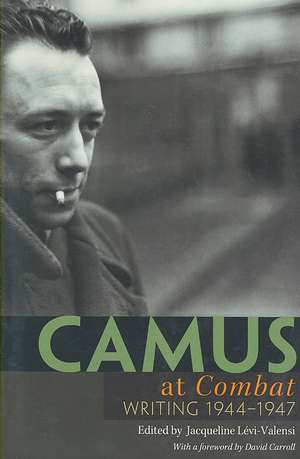
Camus at Combat
Autor Albert Camus Editat de Jacqueline Lévi-Valensien Limba Engleză Paperback – 2 sep 2007
Suntem de părere că interdisciplinaritatea acestui volum transformă lectura într-o experiență care pendulează între jurnalismul politic de front, filozofia morală și istoria socială a Franței postbelice. Camus at Combat nu este doar o culegere de texte de arhivă, ci o cronică vie a eliberării Parisului, scrisă sub presiunea istoriei de un autor care vedea în cuvântul tipărit o armă împotriva opresiunii. Credem că relevanța acestui volum pentru curriculumul de istorie și științe politice este incontestabilă, oferind o perspectivă primară asupra dilemelor etice ale justiției de tranziție. Putem afirma că structura celor 165 de articole, editate cu rigoare de Jacqueline Lévi-Valensi, dezvăluie o latură a lui Albert Camus mai puțin explorată în romanele sale celebre: cea de editor-șef implicat în gestionarea tensiunilor dintre dreapta reacționară și stânga radicală. Volumul este comparabil cu Resistance, Rebellion, and Death în rigurozitate, dar actualizat pentru cercetarea contemporană prin includerea integrală a editorialelor din perioada 1944-1947, oferind astfel o imagine mult mai granulară a tranziției de la rezistență la guvernare. În contextul operei sale, această lucrare funcționează ca o punte documentară între eseistica filozofică din The Myth of Sisyphus și pozițiile etice radicale din Reflections on the Guillotine. Dacă în beletristică Albert Camus explora absurdul existențial, în paginile ziarului Combat el aplică această luciditate asupra problemelor pragmatice: lipsa hranei, soarta prizonierilor de război și necesitatea unei prese libere în democrație. Este o lectură esențială pentru a înțelege cum s-a format viziunea umanistă care i-a adus ulterior Premiul Nobel.
Preț: 311.98 lei
Carte tipărită la comandă
Livrare economică 07-21 decembrie
Specificații
ISBN-10: 069113376X
Pagini: 380
Ilustrații: 20 tables.
Dimensiuni: 156 x 234 x 23 mm
Greutate: 0.53 kg
Editura: Princeton University Press
Locul publicării:Princeton, United States
V-ar putea interesa
-
 George Eliot and the Conflict of InterpretationsDavid CarrollPreț: 362.91 lei
 -
 The CreationDavid CarrollPreț: 90.30 lei
 -
 Marxism and FormFredric JamesonPreț: 311.50 lei
 -
 Reading Asian American LiteratureSau-Ling Cynthia WongPreț: 430.90 lei
 -
 The Literary ChannelMargaret CohenPreț: 413.69 lei
 -
 French Literary FascismDavid CarrollPreț: 469.92 lei
 -
 Transparent MindsDorrit Claire CohnPreț: 414.37 lei
 -
 The Way We Argue NowAmanda AndersonPreț: 337.10 lei
 -
 In Spite of Partition in Spite of PartitionGil Z. HochbergPreț: 505.35 lei
 -
 William Faulkner – An Economy of Complex WordsRichard Godden-23%Preț: 429.63 lei557.95 lei
 -
 The Law Is a White DogColin DayanPreț: 233.52 lei
 -
 The Fiction of the PoetAnna Elizabeth BalakianPreț: 288.31 lei
 -
 Proust's BinocularsRoger ShattuckPreț: 284.94 lei
 -
 Literary History of CanadaWilliam NewPreț: 324.79 lei
 -
 Medieval Christian Literary ImageryR E KaskePreț: 353.63 lei
 -
 -23%Preț: 1284.87 lei1668.66 lei
 -
 An Introduction to MaloryTerence McCarthyPreț: 232.15 lei
 -
 ExposureDavid CarrollPreț: 202.82 lei
 -
 Marketing 101: How Smart Schools Get and Keep Community SupportDavid J. Carroll-23%Preț: 277.76 lei361.80 lei
 -
 -23%Preț: 817.32 lei1061.45 lei
 -
 Volunteer Bama DawgDavid CarrollPreț: 128.11 lei
De ce să citești această carte
Recomandăm această carte cititorilor interesați de istoria europeană și de etica jurnalistică. Veți câștiga o înțelegere profundă a modului în care un intelectual de talia lui Camus a navigat haosul postbelic. Este o resursă rară care demonstrează că lupta pentru dreptate și adevăr necesită o vigilență constantă, oferind lecții politice la fel de actuale astăzi ca în 1944.
Despre autor
Albert Camus (1913–1960) a fost un filozof, scriitor și jurnalist francez, laureat al Premiului Nobel pentru Literatură în 1957. Născut în Algeria, el a devenit una dintre cele mai influente voci ale secolului XX prin explorarea conceptului de absurd. În timpul celui de-al Doilea Război Mondial, Camus s-a stabilit la Paris și s-a alăturat Rezistenței Franceze, conducând ziarul clandestin Combat. Opera sa, care include titluri fundamentale precum The Outsider și The Fall, reflectă un umanism încăpățânat și o opoziție fermă față de totalitarism, marcând profund gândirea politică și literară modernă.