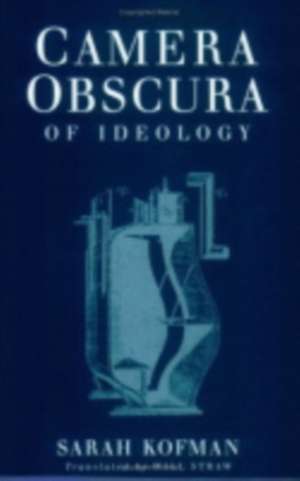
Camera Obscura
Autor Sarah Kofman Traducere de Will Strawen Limba Engleză Paperback – 16 dec 1998
Marx, Freud, Nietzsche--in vastly different ways all three employed the metaphor of the camera obscura in their work. In this classic book--at last available in an English translation--the distinguished French philosopher Sarah Kofman offers an extended reflection on this metaphor. She contrasts the mechanical function of the camera obscura as a kind of copy machine, rendering a mirror-image of the work, with its use in the writings of master thinkers. In her opening chapter on Marx, Kofman provides a reading of inversion as necessary to the ideological process. She then explores the metaphor of the camera obscura in Freud's description of the unconscious. For Nietzsche the camera obscura is a "metaphor for forgetting." Kofman asks here whether the "magical apparatus" of the camera obscura, rather than bringing about clarity, serves some thinkers as fetish. Camera Obscura is a powerful discussion of a metaphor that dominates contemporary theory from philosophy to film.
Preț: 323.39 lei
Carte tipărită la comandă
Livrare economică 08-22 decembrie
Specificații
ISBN-10: 0801485932
Pagini: 112
Ilustrații: black & white illustrations
Dimensiuni: 138 x 215 x 10 mm
Greutate: 0.15 kg
Editura: Cornell University Press
V-ar putea interesa
-
 The Feeling Of What HappensAntonio Damasio-18%Preț: 77.92 lei94.84 lei
 -
 The SwerveStephen Greenblatt-18%Preț: 88.26 lei107.70 lei
 -
 BoundlessKathleen WinterPreț: 115.57 lei
 -
 Good Reasons for Bad FeelingsRandolph M. NessePreț: 79.96 lei
 -
 A World Without WorkDaniel Susskind-30%Preț: 65.92 lei93.54 lei
 -
 What Color Is the Sacred?Michael TaussigPreț: 284.60 lei
 -
 Preț: 258.39 lei
 -
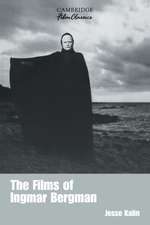 The Films of Ingmar BergmanJesse KalinPreț: 153.25 lei
 -
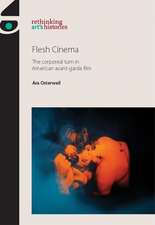 Flesh CinemaAra OsterweilPreț: 237.53 lei
 -
 Isambard Kingdom BrunelRichard Tames-31%Preț: 37.07 lei53.87 lei
 -
 -25%Preț: 69.80 lei93.54 lei
 -
 The Forgotten Genius: Biography of Leroy James LeishmanDorothy J. VarneyPreț: 38.67 lei
 -
 Travelswithsheila GuideSheila SimkinPreț: 37.10 lei
 -
 The Many Tongues of LoveHeidi DeepkissPreț: 58.72 lei
 -
 The Universe of InfinityPatrice BlouinPreț: 147.77 lei
 -
 Feng Shui for the SoulDenise LinnPreț: 103.65 lei
 -
 Sacred SpaceDenise Linn-21%Preț: 83.98 lei105.84 lei
 -
 SkyquakeVicente HuidobroPreț: 92.66 lei
 -
 Feeling Is The Secret ( Metaphysical Pocket Book )Neville GoddardPreț: 46.12 lei
 -
 More Ruins of Rome (Book II)Laine CunninghamPreț: 82.74 lei
 -
 A.V.A.T.A.RPulido, RickPreț: 51.28 lei
 -
 Self-Discipline Mental ToughnessDavid A. HunterPreț: 81.34 lei
 -
 GnosisPatrice BlouinPreț: 51.22 lei
Descriere
Marx, Freud, Nietzsche--in vastly different ways all three employed the metaphor of the camera obscura in their work. In this classic book--at last available in an English translation--the distinguished French philosopher Sarah Kofman offers an extended reflection on this metaphor. She contrasts the mechanical function of the camera obscura as a kind of copy machine, rendering a mirror-image of the work, with its use in the writings of master thinkers. In her opening chapter on Marx, Kofman provides a reading of inversion as necessary to the ideological process. She then explores the metaphor of the camera obscura in Freud's description of the unconscious. For Nietzsche the camera obscura is a "metaphor for forgetting." Kofman asks here whether the "magical apparatus" of the camera obscura, rather than bringing about clarity, serves some thinkers as fetish. Camera Obscura is a powerful discussion of a metaphor that dominates contemporary theory from philosophy to film.