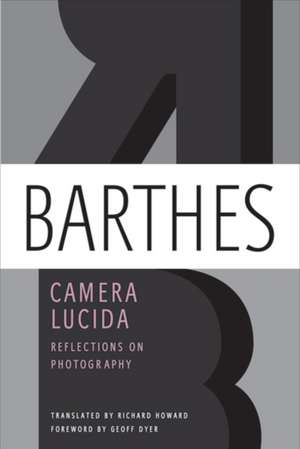
Camera Lucida
Autor Roland Barthes Traducere de Richard Howarden Limba Engleză Paperback – 12 oct 2010
Explorăm în Camera Lucida o incursiune profundă în tehnica fotografiei, privită nu doar ca proces chimic sau digital, ci ca o prezență ontologică ce sfidează codurile culturale. Remarcăm felul în care Roland Barthes abandonează rigoarea semiotică pură pentru o abordare senzorială, aproape viscerală. Apreciem distincția celebră pe care o face între 'studium' — interesul cultural, istoric sau politic pentru o imagine — și 'punctum' — acel detaliu neașteptat care 'înțeapă' privitorul și creează o conexiune personală, dureroasă cu subiectul fotografiat. Subliniem dimensiunea melancolică a volumului, unde fotografia devine un instrument de redare a absenței și a morții. Analizând portretele realizate de Richard Avedon sau Robert Mapplethorpe, Barthes ne invită să experimentăm 'timpul fotografic' ca pe o dovadă incontestabilă a ceea ce 'a fost acolo'. Ca și Light In The Dark Room, lucrarea pune în valoare fotografia ca memento mori, dar cu un accent pe subiectivitatea radicală a privitorului și pe doliul personal al autorului. În contextul operei sale, Camera Lucida se distanțează de analizele structurale din Mythologies sau Image Music Text. Dacă în lucrările anterioare Barthes era interesat de modul în care semnele construiesc mituri sociale, aici el caută esența 'ireductibilă' a imaginii. Este o lucrare de maturitate care completează temele intime din Mourning Diary, oferind o perspectivă unică asupra modului în care privim lumea prin obiectiv.
Preț: 100.32 lei
Carte disponibilă
Livrare economică 05-19 noiembrie
Specificații
ISBN-10: 0374532338
Pagini: 144
Dimensiuni: 139 x 210 x 12 mm
Greutate: 0.15 kg
Editura: Farrar, Straus and Giroux
V-ar putea interesa
-
 The Interpretation of CulturesClifford Geertz-5%Preț: 104.97 lei110.42 lei
 -
 Rite out of Place: Ritual, Media, and the ArtsRonald L. Grimes-13%Preț: 249.43 lei287.53 lei
 -
 Ritual: Perspectives and DimensionsCatherine Bell-12%Preț: 276.06 lei314.69 lei
 -
 The Ritual Process: Structure and Anti-StructureVictor TurnerPreț: 407.09 lei
 -
 -15%Preț: 478.28 lei562.68 lei
 -
 Oneself as AnotherPaul RicoeurPreț: 259.48 lei
 -
 Image-Music-TextRoland BarthesPreț: 106.22 lei
 -
 Culture/MetacultureFrancis MulhernPreț: 226.65 lei
 -
 Preț: 167.03 lei
 -
 Preț: 215.95 lei
 -
 Foundations of Measurement Volume IIDavid H KrantzPreț: 156.47 lei
 -
 Foundations of Measurement Volume IIIPatrick SuppesPreț: 125.07 lei
 -
 Culture and CommunicationEdmund Ronald LeachPreț: 180.03 lei
 -
 The Culture CodeClotaire Rapaille-31%Preț: 77.70 lei112.04 lei
 -
 Analyzing Decision MakingJordan J. LouvierePreț: 318.76 lei
 -
 Ansel AdamsMary Street AlinderPreț: 189.10 lei
 -
 Preț: 293.04 lei
 -
 TotemismClaude Levi-StraussPreț: 120.56 lei
De ce să citești această carte
Recomandăm această carte oricărui pasionat de arta vizuală care dorește să înțeleagă de ce anumite fotografii ne tulbură dincolo de estetică. Cititorul va câștiga un nou vocabular critic și o înțelegere profundă a relației dintre imagine, memorie și timp. Este o lectură esențială pentru a trece de la simpla observare a unei poze la trăirea ei conștientă.
Despre autor
Roland Barthes (1915–1980) a fost un influent teoretician literar, filosof și semiotician francez, a cărui operă a modelat structuralismul și post-structuralismul. Profesor la Collège de France, Barthes a explorat sistemele de semne din cultura populară și literatură. Camera Lucida, ultima sa carte publicată înainte de moarte, reprezintă chintesena gândirii sale despre imagine, combinând analiza teoretică cu reflecția autobiografică profundă asupra pierderii mamei sale.
Descriere scurtă
Commenting on artists such as Avedon, Clifford, Mapplethorpe, and Nadar, Barthes presents photography as being outside the codes of language or culture, acting on the body as much as on the mind, and rendering death and loss more acutely than any other medium.
This groundbreaking approach established Camera Lucida as one of the most important books of theory on the subject, along with Susan Sontag's On Photography.