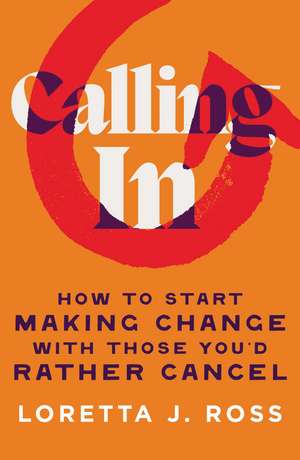
Calling in
Autor Loretta J Rossen Limba Engleză Hardback – 4 feb 2025
In 1979, Loretta Ross was a single mother who’d had to drop out of Howard University. She was working at Washington, DC’s Rape Crisis Center when she got a letter from a man in prison saying he wanted to learn how to not be a rapist anymore. At first, she was furious. As a survivor of sexual violence, she wanted to write back pouring out her rage. But instead, she made a different choice, a choice to reject the response her trauma was pushing her towards, a choice that set her on the path towards developing a philosophy that would come to guide her whole career: rather than calling people out, try to call even your unlikeliest allies in. Hold them accountable—but do so with love.
Calling In is at once a handbook, a manifesto, and a memoir—because the power of Loretta Ross’s message comes from who she is and what she’s lived through. She’s a Black woman who’s deprogrammed white supremacists, a survivor who’s taught convicted rapists the principles of feminism. With stories from her five remarkable decades in activism, she vividly illustrates why calling people in—inviting them into conversation instead of conflict by focusing on your shared values over a desire for punishment—is the more strategic choice if you want to make real change. And she shows you how to do so, whether in the workplace, on a college campus, or in your living room.
Courageous, awe-inspiring, and blisteringly authentic, Calling In is a practical new solution from one of our country’s most extraordinary change-makers—one anyone can learn to use to transform frustrating and divisive conflicts that stand in the way of real connection with the people in your life.
| Toate formatele și edițiile | Preț | Express |
|---|---|---|
| Paperback (2) | 60.15 lei 27-39 zile | +24.92 lei 7-13 zile |
| Simon&Schuster – 12 mar 2026 | 60.15 lei 27-39 zile | +24.92 lei 7-13 zile |
| Simon&Schuster – 17 iul 2025 | 81.54 lei 27-39 zile | |
| Hardback (1) | 103.41 lei 27-39 zile | |
| Simon&Schuster – 4 feb 2025 | 103.41 lei 27-39 zile |
Preț: 103.41 lei
Preț vechi: 136.63 lei
-24%
Puncte Express: 155
Preț estimativ în valută:
18.28€ • 20.97$ • 15.80£
18.28€ • 20.97$ • 15.80£
Carte disponibilă
Livrare economică 17-29 aprilie
Specificații
ISBN-13: 9781982190798
ISBN-10: 1982190795
Pagini: 288
Dimensiuni: 146 x 215 x 27 mm
Greutate: 0.36 kg
Editura: Simon&Schuster
ISBN-10: 1982190795
Pagini: 288
Dimensiuni: 146 x 215 x 27 mm
Greutate: 0.36 kg
Editura: Simon&Schuster
V-ar putea interesa
-
 The PersuadersAnand Giridharadas-20%Preț: 60.63 lei75.78 lei
 -
 -27%Preț: 80.67 lei110.39 lei
 -
 Hungry HeartsJennifer Rudolph WalshPreț: 85.70 lei
 -
 Preț: 117.45 lei
 -
 Killing RageBell HooksPreț: 103.56 lei
 -
 We Gon’ Be Alright: Resistance and Healing in Black Movement Spaces, 2012–2021Stephanie M. CrumptonPreț: 165.71 lei
 -
 Women Who Change the WorldLoretta RossPreț: 96.44 lei
 -
 -22%Preț: 92.92 lei119.11 lei
 -
 -28%Preț: 74.29 lei102.82 lei
 -
 Preț: 96.02 lei
 -
 -23%Preț: 58.72 lei76.26 lei
 -
 How to Have Antiracist ConversationsRoxy Manning-31%Preț: 112.76 lei164.42 lei
 -
 "No Offence, But..."Gina Martin-20%Preț: 60.35 lei75.66 lei
 -
 -21%Preț: 97.18 lei122.53 lei
 -
 You Are Your Best ThingTarana Burke-21%Preț: 80.80 lei102.19 lei
 -
 Loving Correctionsadrienne maree brownPreț: 93.20 lei
 -
 -21%Preț: 53.50 lei67.75 lei
 -
 Fierce VulnerabilityKazu HagaPreț: 97.94 lei
 -
 No Straight Road Takes You ThereRebecca SolnitPreț: 86.51 lei
Notă biografică
Loretta J. Ross is an activist, professor, and public intellectual. In her five decades in the human rights movement, she’s deprogramed white supremacists, taught convicted rapists the principles of feminism, and co-organized the second largest march on Washington (surpassed only by the 2017 Women’s March). The founder of the National Center for Human Rights Education and a cofounder of the SisterSong Women of Color Reproductive Justice Collective, her many accolades and honors include a 2022 MacArthur Fellowship and a 2024 induction into the National Women’s Hall of Fame. Today, Ross is an associate professor at Smith College in Northampton, Massachusetts, and the founder of LoRossta Consulting, with which she runs “Calling In” training sessions online and for organizations around the country.
Recenzii
“A master class in constructive confrontation—and Loretta J. Ross is the ideal teacher, with profound insights about how to get through to others and maintain your own dignity along the way.”
—Adam Grant, #1 New York Times bestselling author of Think Again and host of the podcast Re:Thinking
“Calling in is far more crucial to human survival than calling out, and Loretta J. Ross has written a personal and political book that proves it! There is no one whose experience I would trust more.”
—Gloria Steinem
“A survival guide for American progressives. If you are on the left and want to make lasting change in our world, please read this book.”
—Amanda Ripley, New York Times bestselling author of High Conflict
“What a refreshing and necessary book. Loretta J. Ross has offered us an escape hatch here—with wisdom, experience, and integrity. We would all do well to follow her lead.”
—Abigail Disney, activist and philanthropist
"A rich and compelling narrative. Courageous, practical and ultimately, very hopeful."
—BookPage (Starred Review)
"With humor and grace, Ross... offers advice on how to find harmony among those with diametrically opposing viewpoints."
—Booklist
“A highly recommended, necessary read for anyone who finds themself grating against those with different political beliefs. Ross’s book has plenty of potential for discussions and healing relations between friends and family and maybe even strangers.”
—Library Journal
—Adam Grant, #1 New York Times bestselling author of Think Again and host of the podcast Re:Thinking
“Calling in is far more crucial to human survival than calling out, and Loretta J. Ross has written a personal and political book that proves it! There is no one whose experience I would trust more.”
—Gloria Steinem
“A survival guide for American progressives. If you are on the left and want to make lasting change in our world, please read this book.”
—Amanda Ripley, New York Times bestselling author of High Conflict
“What a refreshing and necessary book. Loretta J. Ross has offered us an escape hatch here—with wisdom, experience, and integrity. We would all do well to follow her lead.”
—Abigail Disney, activist and philanthropist
"A rich and compelling narrative. Courageous, practical and ultimately, very hopeful."
—BookPage (Starred Review)
"With humor and grace, Ross... offers advice on how to find harmony among those with diametrically opposing viewpoints."
—Booklist
“A highly recommended, necessary read for anyone who finds themself grating against those with different political beliefs. Ross’s book has plenty of potential for discussions and healing relations between friends and family and maybe even strangers.”
—Library Journal
Descriere
From a pioneering Black feminist, an urgent and exhilarating memoir-manifesto-handbook about how to rein in the excesses of cancel culture and better communicate, as activists and as people.
Extras
ProloguePROLOGUE
In the course of history, there comes a time when humanity is called to shift to a new level of consciousness. To reach a higher moral ground. A time when we have to shed our fear and give hope to each other.
—Wangari Maathai, Nobel lecture, 2014
I’m a reformed call out queen. I’ve furiously called out enemies. I’ve righteously called out friends. I’ve gleefully called out strangers. I even once called out President Barack Obama, although that’s a story for another time. My ego sure gets the appeal of putting people on blast. But I also realized a long time ago that running my mouth never did seem to accomplish what I wanted it to.
I have been a human rights activist since the early 1970s. I’ve been the voice who picks up the phone to help rape victims in the most humiliating times of their lives—times they’d rather forget. I’ve been an opposition researcher, attending Klan rallies and working to deprogram white supremacists who’ve spent their lives devoted to hate. I’ve been a bridge between warring factions of feminists and progressives, finding new conversations that can unite us, pursuing common goals instead of prying us apart.
In the past five decades, I’ve learned a lot about what works to create change. And I’ve learned a lot about what doesn’t—often, the hard way. I’ve been proud to watch the human rights values I’ve espoused take hold in our culture, turning ideas that once seemed radical into mainstream beliefs. I’ve been proud to watch movements like Black Lives Matter, Reproductive Justice, and #MeToo spread far and wide, and to witness how new generations have joined the fight for justice, demanding action on global warming, insisting that health care and affordable housing are human rights, and asserting that a college education should not be a ticket to lifelong debt.
Those most likely to have their human rights violated are typically the ones who believe the most in the promise of human rights, while our critics and skeptics tend to be those whose human rights are most protected by the status quo. Opponents mockingly call us SJWs—social justice warriors—but we’re really human rights activists with a forward-facing global vision for the twenty-first century. Opponents fear us because their idealized society is fixated on centuries past when violence against political opponents was normal and when we stayed in our place. If another world is possible, then another America is necessary. I’m so inspired by how many people are doing the work to bring it about.
But, in the past decade, I’ve also seen a spike of infighting, cruelty, and call outs among could-be allies. This has always been a danger among radical movements: it’s what hamstrung the groups I worked with in DC in the 1970s when I started my journey as a social justice activist. I now often talk to people who are clear-eyed and adamant about their values and yet who feel unbearably drained by the toxic atmosphere in which they’re working. Or I speak with well-meaning people who want to help but are afraid to lend their efforts—because they don’t know the right language or where to begin without being reamed out.
This isn’t how it should be—nor how it has to be.
The terms “cancel culture” and “call out culture” have become a political Rorschach test. Since Trump’s first run for president, the Right has bemoaned cancel culture, even as they seek to ban more books, more history, more art, and more ways of living than anyone on the Left. They don’t want to teach an honest history of America because they want to repeat the sins of the past. They carp about wokeness, pronouns, and feminism, while they lack any discernible agenda for addressing the country’s problems. Stroking the outrage culture is their priority. And call outs are an easy target for their rage.
Progressives, meanwhile, have responded reactively, defending call outs as mere “consequences” or “accountability” measures for bad actors. Sometimes this is true. But cancel culture can also be weaponized, by the Right or the Left. Offenses—someone’s not woke enough, someone’s not patriotic enough—can get treated as five-alarm fires, until we’ve reached a point where it becomes difficult to critique cancel culture without risking being canceled ourselves.
I know the allure of calling people out all too well. I’ve scorched others with righteous anger, and I’ve been burned by my ego. I have to trap words in my brain before they come out of my mouth a dozen times a day. Because I know it’s better if I do. I’ve seen families torn apart over political differences because they don’t know how to love each other despite their disagreements. I’ve been part of movements that have disintegrated due to their inability to distinguish between allies and enemies. I’ve seen how a moment of opportunity can slip away while we’re caught up in morality plays or power fights.
And I see the warning signs right now, for progressives and our country as a whole. Bitter partisanship has caused many of us to hate fellow Americans. It’s made people afraid to build community. It’s divided families. Almost everyone is anxious for fear of saying the wrong thing. People are distancing themselves and suffering emotionally. Powerless to do anything about geopolitical conflicts, we turn on family and friends.
Anyone who thinks this is okay doesn’t care about our country and doesn’t care about honesty, integrity, or mercy. These are, perhaps, old-fashioned terms, but they matter to me and they should matter to all of us. I have no interest in respectability politics—no interest in being polite and uncontroversial in the hope of gaining others’ approval. But I am interested in living out my values.
I get why it can be easy to forget all this. We are sensitive to our despair and the despair of others. We are all struggling to make sense of everything that is going on. We refuse to accept the status quo that judges us because of our skin color, sexual orientation, gender identity, class, citizenship, abilities, political affiliation, or any other infuriating, irrelevant reason. We witness our loved ones pulling in a different direction in ways that often don’t make sense to us. We yearn to be part of something bigger than ourselves, something that gives our life meaning. But it is not enough to be correct; we must take correct action.
People opposed to human rights—opposed to ending poverty, addressing racism, or accepting women’s rights to control their bodies—think they’re fighting the human rights movement, but I believe they’re wrong. They’re fighting truth, history, and evidence. Most importantly, they’re fighting time. These existential forces are beyond their power to command. With truth, history, evidence, and time on our side, we hold the winning hand despite our fears of powerlessness and failure. Our opponents are simply pimples on the ass of time. But my biggest fear is that despite our winning hand, we’ll be defeated—at least in our lifetimes—because we can’t stop calling one another out.
I’ve learned that there is a better way. We can skip the viral shaming and reputational warfare. We can skip the ideological litmus tests that don’t help to build a diverse coalition. Whether persuading another individual or launching an entire cultural movement, real change requires bringing people in. Even people you expected not to need or not to be able to reach.
This is why I’ve come to embrace Calling In.
Calling in considers whether we can connect with others before we start shouting them down. It allows us to reach other people as people, to breathe a little easier, and, ultimately, to get things done. Calling in builds bridges instead of burning them down so that we might walk together along the path toward collective liberation.
The difference is tactical—and so I’ll suggest new words, methods, and attitudes throughout this book—but it’s also philosophical. Calling in can help us model the world we want to achieve at the end of our efforts: a world with more joy and forgiveness and less shame and cruelty, a world where people don’t need to feel afraid and can feel empowered to pursue the common good, even if we make mistakes along the way. We can avoid the shame of not being enough, or not knowing enough.
For more than forty years now, I’ve oriented my philosophy for enacting change and building movements around calling in. In the first four chapters of this book, I’ll explore the theory behind this approach and show you how it gets results. I’ll also diagnose where call out culture came from, why it’s become a cultural monster—especially on social media—and why no one seems to be able to talk about it without losing their head. Then, in the last four chapters, I’ll show you the techniques you’ll need to put the principles of calling in into action.
Most of us respond emotionally to call outs without recognizing their patterns and intentions. We need to think more systematically. We need to create strategies for engaging with disagreements, so we’re prepared in advance. I’ve created what I call the “5Cs”—a spectrum of accountability measures to help us figure out how to respond depending on the situation, whether by calling out (yes, I think call outs do have their uses, as I’ll discuss in chapter 2), canceling, calling in, calling on (asking people to do better, but without investing your time and energy in helping them to change), or calling it off. When it’s not possible to call in people with love and respect, we can choose another option that better suits where we are emotionally at the time. There’s no shame in deciding to call it off. As I’ll discuss in chapters 5 and 7, I think it’s essential to recognize when saying nothing is the healthiest tactic for you in the moment.
We can recognize the patterns of call outs and understand our options for deploying these techniques, and we’ll realize we’re more knowledgeable about how to have challenging conversations than we think. Together, over time, we can transform our culture that excludes and impugns people into a culture that invites people in.
I’m not alone in thinking this. In this book, I’ve combined stories and lessons from my life as an activist with the wisdom of many younger thinkers, including Ng?c Loan Tr?n (who coined the term “Calling In”), Mariame Kaba, Kelly Hayes, and especially adrienne maree brown, who constantly awes me with her grace and brilliance. I also reference our iconic guiding lights like Audre Lorde, James Baldwin, and Martin Luther King Jr. I’ve woven in insights from experts in psychology, philosophy, history, and other disciplines that probe how people experience and respond to criticism. I’ve also included perspectives from analysts on the right and center of US politics, and from many people who exist somewhere in between the labels we use. Of course, I don’t agree with everything someone who I cite has ever said, but I find that to be an unnecessarily high bar; my life has taught me many lessons from the most unlikely people when I dared to listen.
I believe the practical advice in these pages is essential for anyone who wants to be part of a vibrant human rights movement. But it’s important for less politically active people too. These are techniques that any leader or activist, any friend or partner, any family member or acquaintance can learn to practice to be kinder to one another.
I’m so excited to share them with you. But first, let me show you how I got here—how calling in entered my life.
In the course of history, there comes a time when humanity is called to shift to a new level of consciousness. To reach a higher moral ground. A time when we have to shed our fear and give hope to each other.
—Wangari Maathai, Nobel lecture, 2014
I’m a reformed call out queen. I’ve furiously called out enemies. I’ve righteously called out friends. I’ve gleefully called out strangers. I even once called out President Barack Obama, although that’s a story for another time. My ego sure gets the appeal of putting people on blast. But I also realized a long time ago that running my mouth never did seem to accomplish what I wanted it to.
I have been a human rights activist since the early 1970s. I’ve been the voice who picks up the phone to help rape victims in the most humiliating times of their lives—times they’d rather forget. I’ve been an opposition researcher, attending Klan rallies and working to deprogram white supremacists who’ve spent their lives devoted to hate. I’ve been a bridge between warring factions of feminists and progressives, finding new conversations that can unite us, pursuing common goals instead of prying us apart.
In the past five decades, I’ve learned a lot about what works to create change. And I’ve learned a lot about what doesn’t—often, the hard way. I’ve been proud to watch the human rights values I’ve espoused take hold in our culture, turning ideas that once seemed radical into mainstream beliefs. I’ve been proud to watch movements like Black Lives Matter, Reproductive Justice, and #MeToo spread far and wide, and to witness how new generations have joined the fight for justice, demanding action on global warming, insisting that health care and affordable housing are human rights, and asserting that a college education should not be a ticket to lifelong debt.
Those most likely to have their human rights violated are typically the ones who believe the most in the promise of human rights, while our critics and skeptics tend to be those whose human rights are most protected by the status quo. Opponents mockingly call us SJWs—social justice warriors—but we’re really human rights activists with a forward-facing global vision for the twenty-first century. Opponents fear us because their idealized society is fixated on centuries past when violence against political opponents was normal and when we stayed in our place. If another world is possible, then another America is necessary. I’m so inspired by how many people are doing the work to bring it about.
But, in the past decade, I’ve also seen a spike of infighting, cruelty, and call outs among could-be allies. This has always been a danger among radical movements: it’s what hamstrung the groups I worked with in DC in the 1970s when I started my journey as a social justice activist. I now often talk to people who are clear-eyed and adamant about their values and yet who feel unbearably drained by the toxic atmosphere in which they’re working. Or I speak with well-meaning people who want to help but are afraid to lend their efforts—because they don’t know the right language or where to begin without being reamed out.
This isn’t how it should be—nor how it has to be.
The terms “cancel culture” and “call out culture” have become a political Rorschach test. Since Trump’s first run for president, the Right has bemoaned cancel culture, even as they seek to ban more books, more history, more art, and more ways of living than anyone on the Left. They don’t want to teach an honest history of America because they want to repeat the sins of the past. They carp about wokeness, pronouns, and feminism, while they lack any discernible agenda for addressing the country’s problems. Stroking the outrage culture is their priority. And call outs are an easy target for their rage.
Progressives, meanwhile, have responded reactively, defending call outs as mere “consequences” or “accountability” measures for bad actors. Sometimes this is true. But cancel culture can also be weaponized, by the Right or the Left. Offenses—someone’s not woke enough, someone’s not patriotic enough—can get treated as five-alarm fires, until we’ve reached a point where it becomes difficult to critique cancel culture without risking being canceled ourselves.
I know the allure of calling people out all too well. I’ve scorched others with righteous anger, and I’ve been burned by my ego. I have to trap words in my brain before they come out of my mouth a dozen times a day. Because I know it’s better if I do. I’ve seen families torn apart over political differences because they don’t know how to love each other despite their disagreements. I’ve been part of movements that have disintegrated due to their inability to distinguish between allies and enemies. I’ve seen how a moment of opportunity can slip away while we’re caught up in morality plays or power fights.
And I see the warning signs right now, for progressives and our country as a whole. Bitter partisanship has caused many of us to hate fellow Americans. It’s made people afraid to build community. It’s divided families. Almost everyone is anxious for fear of saying the wrong thing. People are distancing themselves and suffering emotionally. Powerless to do anything about geopolitical conflicts, we turn on family and friends.
Anyone who thinks this is okay doesn’t care about our country and doesn’t care about honesty, integrity, or mercy. These are, perhaps, old-fashioned terms, but they matter to me and they should matter to all of us. I have no interest in respectability politics—no interest in being polite and uncontroversial in the hope of gaining others’ approval. But I am interested in living out my values.
I get why it can be easy to forget all this. We are sensitive to our despair and the despair of others. We are all struggling to make sense of everything that is going on. We refuse to accept the status quo that judges us because of our skin color, sexual orientation, gender identity, class, citizenship, abilities, political affiliation, or any other infuriating, irrelevant reason. We witness our loved ones pulling in a different direction in ways that often don’t make sense to us. We yearn to be part of something bigger than ourselves, something that gives our life meaning. But it is not enough to be correct; we must take correct action.
People opposed to human rights—opposed to ending poverty, addressing racism, or accepting women’s rights to control their bodies—think they’re fighting the human rights movement, but I believe they’re wrong. They’re fighting truth, history, and evidence. Most importantly, they’re fighting time. These existential forces are beyond their power to command. With truth, history, evidence, and time on our side, we hold the winning hand despite our fears of powerlessness and failure. Our opponents are simply pimples on the ass of time. But my biggest fear is that despite our winning hand, we’ll be defeated—at least in our lifetimes—because we can’t stop calling one another out.
I’ve learned that there is a better way. We can skip the viral shaming and reputational warfare. We can skip the ideological litmus tests that don’t help to build a diverse coalition. Whether persuading another individual or launching an entire cultural movement, real change requires bringing people in. Even people you expected not to need or not to be able to reach.
This is why I’ve come to embrace Calling In.
Calling in considers whether we can connect with others before we start shouting them down. It allows us to reach other people as people, to breathe a little easier, and, ultimately, to get things done. Calling in builds bridges instead of burning them down so that we might walk together along the path toward collective liberation.
The difference is tactical—and so I’ll suggest new words, methods, and attitudes throughout this book—but it’s also philosophical. Calling in can help us model the world we want to achieve at the end of our efforts: a world with more joy and forgiveness and less shame and cruelty, a world where people don’t need to feel afraid and can feel empowered to pursue the common good, even if we make mistakes along the way. We can avoid the shame of not being enough, or not knowing enough.
For more than forty years now, I’ve oriented my philosophy for enacting change and building movements around calling in. In the first four chapters of this book, I’ll explore the theory behind this approach and show you how it gets results. I’ll also diagnose where call out culture came from, why it’s become a cultural monster—especially on social media—and why no one seems to be able to talk about it without losing their head. Then, in the last four chapters, I’ll show you the techniques you’ll need to put the principles of calling in into action.
Most of us respond emotionally to call outs without recognizing their patterns and intentions. We need to think more systematically. We need to create strategies for engaging with disagreements, so we’re prepared in advance. I’ve created what I call the “5Cs”—a spectrum of accountability measures to help us figure out how to respond depending on the situation, whether by calling out (yes, I think call outs do have their uses, as I’ll discuss in chapter 2), canceling, calling in, calling on (asking people to do better, but without investing your time and energy in helping them to change), or calling it off. When it’s not possible to call in people with love and respect, we can choose another option that better suits where we are emotionally at the time. There’s no shame in deciding to call it off. As I’ll discuss in chapters 5 and 7, I think it’s essential to recognize when saying nothing is the healthiest tactic for you in the moment.
We can recognize the patterns of call outs and understand our options for deploying these techniques, and we’ll realize we’re more knowledgeable about how to have challenging conversations than we think. Together, over time, we can transform our culture that excludes and impugns people into a culture that invites people in.
I’m not alone in thinking this. In this book, I’ve combined stories and lessons from my life as an activist with the wisdom of many younger thinkers, including Ng?c Loan Tr?n (who coined the term “Calling In”), Mariame Kaba, Kelly Hayes, and especially adrienne maree brown, who constantly awes me with her grace and brilliance. I also reference our iconic guiding lights like Audre Lorde, James Baldwin, and Martin Luther King Jr. I’ve woven in insights from experts in psychology, philosophy, history, and other disciplines that probe how people experience and respond to criticism. I’ve also included perspectives from analysts on the right and center of US politics, and from many people who exist somewhere in between the labels we use. Of course, I don’t agree with everything someone who I cite has ever said, but I find that to be an unnecessarily high bar; my life has taught me many lessons from the most unlikely people when I dared to listen.
I believe the practical advice in these pages is essential for anyone who wants to be part of a vibrant human rights movement. But it’s important for less politically active people too. These are techniques that any leader or activist, any friend or partner, any family member or acquaintance can learn to practice to be kinder to one another.
I’m so excited to share them with you. But first, let me show you how I got here—how calling in entered my life.