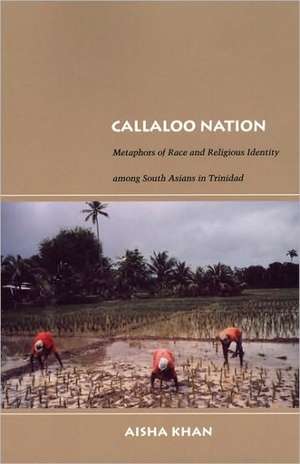
Callaloo Nation
Autor Aisha Khanen Limba Engleză Paperback – 11 oct 2004
Preț: 257.71 lei
Puncte Express: 387
Carte tipărită la comandă
Livrare economică 03-17 decembrie
Livrare prin curier în România Termenul estimat este afișat lângă disponibilitate.
Transport gratuit de la 400.00 lei Plată online sau ramburs, în funcție de opțiunile comenzii.
Retur gratuit în 14 zile Comandă securizată și suport în română.
Specificații
ISBN-13: 9780822333883
ISBN-10: 0822333880
Pagini: 280
Ilustrații: 9 b&w photographs, 2 maps
Dimensiuni: 147 x 234 x 15 mm
Greutate: 0.39 kg
Ediția:New.
Editura: Duke University Press
ISBN-10: 0822333880
Pagini: 280
Ilustrații: 9 b&w photographs, 2 maps
Dimensiuni: 147 x 234 x 15 mm
Greutate: 0.39 kg
Ediția:New.
Editura: Duke University Press
V-ar putea interesa
-
 Intangible Cultural Heritage in International LawLucas Lixinski-31%Preț: 696.00 lei1002.26 lei
 -
 The Mormon Quest for Glory: The Religious World of the Latter-Day SaintsMelvyn Hammarberg-19%Preț: 380.14 lei466.97 lei
 -
 -28%Preț: 511.18 lei714.90 lei
 -
 -13%Preț: 279.30 lei320.96 lei
 -
 Jewish Poland Revisited – Heritage Tourism in Unquiet PlacesErica T. LehrerPreț: 215.85 lei
 -
 Preț: 226.92 lei
 -
 Preț: 215.03 lei
 -
 A History of AnthropologyThomas Hylland EriksenPreț: 229.99 lei
 -
 Techniques of PleasureMargot WeissPreț: 219.99 lei
 -
 JapanoiseDavid NovakPreț: 221.32 lei
 -
 The Soul of AnimeIan CondryPreț: 145.14 lei
 -
 Speculative Markets – Drug Circuits and Derivative Life in NigeriaKristin PetersonPreț: 236.85 lei
 -
 Preț: 241.50 lei
 -
 Biosocial BecomingsTim Ingold-11%Preț: 665.21 lei747.43 lei
Cuprins
Introduction: This rainbow has teeth; A crazy quilt society; Locations and dislocations; The problem of Simi-dimi; Carving knowledge from ways of knowing; No bhakti, only gyan; You get honor for your knowledge; Conclusion: Mixing metaphors
Recenzii
Callaloo Nation is a solid contribution to anthropological theory and Caribbean ethnography. In helping us to understand that group identity is in constant flux, Aisha Khan shows, far better than just about anybody else, what the term essentialize really means.Sidney Mintz, author of Caribbean TransformationsAisha Khan is an exceptional ethnographer. Callaloo Nation brings to fruition her many years of ethnographic research focused on both Indo-Trinidadians and the social construction of their identities. There is nothing like this work in the literature on the Caribbean or on postcolonial societies in any region. It will be a shaping force in social science research on the Caribbean.Dan Segal, coauthor of Jane Austen and the Fiction of Culture: An Essay on the Narration of Social Realities
Textul de pe ultima copertă
"Aisha Khan is an exceptional ethnographer. "Callaloo Nation" brings to fruition her many years of ethnographic research focused on both Indo-Trinidadians and the social construction of their identities. There is nothing like this work in the literature on the Caribbean or on postcolonial societies in any region. It will be a shaping force in social science research on the Caribbean."--Dan Segal, coauthor of "Jane Austen and the Fiction of Culture: An Essay on the Narration of Social Realities"
Descriere
Analyzes the relationship between conceptions of racial and ethnic identity and the ways social stratification and inequality are reproduced and experienced in the Republic of Trinidad and Tobago.