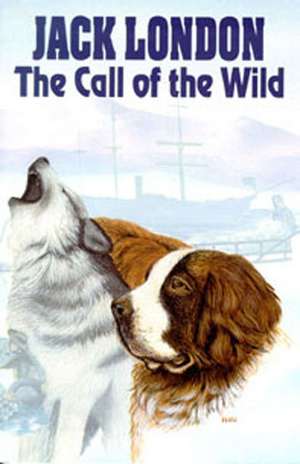
Call of the Wild
Autor Jack Londonen Limba Engleză Paperback – 1995
Preț: 63.17 lei
Preț vechi: 72.62 lei
-13%
Puncte Express: 95
Preț estimativ în valută:
11.17€ • 13.25$ • 9.73£
11.17€ • 13.25$ • 9.73£
Carte disponibilă
Livrare economică 10-24 martie
Specificații
ISBN-13: 9780888392596
ISBN-10: 0888392591
Pagini: 104
Ilustrații: 14 line drawings.
Dimensiuni: 140 x 216 x 6 mm
Greutate: 0.14 kg
Editura: Hancock House
Colecția HANCOCK HOUSE
Locul publicării:Canada
ISBN-10: 0888392591
Pagini: 104
Ilustrații: 14 line drawings.
Dimensiuni: 140 x 216 x 6 mm
Greutate: 0.14 kg
Editura: Hancock House
Colecția HANCOCK HOUSE
Locul publicării:Canada
V-ar putea interesa
-
 In Search of Lost Time, Vol 4Marcel Proust-18%Preț: 64.38 lei78.06 lei
 -
 Brave New WorldAldous HuxleyPreț: 54.85 lei
 -
 MythologiesRoland Barthes-21%Preț: 53.22 lei67.79 lei
 -
 Manufacturing ConsentEdward S. Herman-30%Preț: 71.61 lei103.01 lei
 -
 Postwar: A History of Europe Since 1945Tony Judt-17%Preț: 100.52 lei120.98 lei
 -
 -21%Preț: 59.29 lei74.96 lei
 -
 HerzogSaul Bellow-20%Preț: 55.80 lei69.32 lei
 -
 On the Origin of SpeciesCharles Darwin-18%Preț: 51.77 lei63.16 lei
 -
 Preț: 202.46 lei
 -
 Things Fall ApartChinua AchebePreț: 141.44 lei
 -
 On Becoming a LeaderWarren G. Bennis-16%Preț: 111.17 lei132.93 lei
 -
 The Shock of the NewRobert Hughes-18%Preț: 223.52 lei273.58 lei
 -
 A Brief History of TimeStephen HawkingPreț: 114.22 lei
 -
 VeniceJan MorrisPreț: 75.56 lei
 -
 The Book of Laughter and ForgettingMilan KunderaPreț: 69.08 lei
 -
 The Charterhouse of ParmaStendhalPreț: 127.29 lei
 -
 Men Without WomenErnest HemingwayPreț: 83.63 lei
 -
 The Story of ArtE. H. Gombrich-19%Preț: 236.40 lei292.06 lei
 -
 Preț: 360.65 lei
 -
 Thus Spake ZarathustraFriedrich Wilhelm NietzschePreț: 316.93 lei
 -
 The Count of Monte CristoAlexandre Dumas-28%Preț: 137.51 lei190.19 lei
 -
 The Portrait Of A LadyHenry James-17%Preț: 89.57 lei107.50 lei
 -
 If On A Winter's Night A TravellerItalo Calvino-19%Preț: 84.26 lei104.28 lei
Notă biografică
Jack London is best known for his books The Call of the Wild, White Fang, and The Sea-Wolf, but he was an incredibly prolific writer who left behind more than fifty volumes of novels, stories, journalism, and essays, many of which are still read around the world. Born in San Francisco in 1876 and named John, he adopted the name Jack during an adolescence spent working various hard-labor jobs, and later decided to become a writer in order to escape the fate of life as a factory worker. A summer spent in the Yukon in his twenties provided ample material to launch a career that would see him manipulate the media and embrace the writer persona as few before him had. The first full-length feature film made in America was based on The Sea-Wolf, and London would live to see several of his works adapted for the big screen. A committed if conflicted socialist, he possessed a strong desire for capitalist success (he endorsed commercial products in advertisements), but would use the platform his fame afforded him to endorse socialism, women's suffrage, and prohibition, and to break the taboo of leprosy. Somewhat ironically, a posthumous myth that London was a womanizing alcoholic who took his own life (despite his actual death of renal failure in 1916) would diminish the weight granted his body of work in the annals of literary and social history.
Cuprins
Acknowledgements
References and Abbreviations
Illustrations
Introduction
Jack London: A Brief Chronology
A Note on the Text
The Call of the Wild
Appendix A: The Klondike in Reality and Myth
Jack London, “Bâtard” (1902, 1904)
Appendix G: Extracts from London’s Correspondence (1902–1916)
References and Abbreviations
Illustrations
Introduction
Jack London: A Brief Chronology
A Note on the Text
The Call of the Wild
Appendix A: The Klondike in Reality and Myth
- From Tappan Adney, The Klondike Stampede (1900)
- From A.C. Harris, Alaska and the Klondike Gold Fields (1897)
- From Charles G.D. Roberts, The Kindred of the Wild:A Book of Animal Life (1902)
- From Charles Darwin, The Variation of Animals and Plants under Domestication (1868)
- From Charles Darwin, The Descent of Man, and Selection in Relation to Sex (1871)
- From Charles Darwin, The Expression of the Emotions in Man and Animals (1872)
- From Edward Jesse, Anecdotes of Dogs (1858)
- From Tappan Adney, The Klondike Stampede (1900)
- From Jack London, “Husky—The Wolf-Dog of the North” (1900)
- From Herbert Spencer, The Principles of Psychology (1855, 1890)
- From Ernst Haeckel, The History of Creation (1868, 1880)
- From Samuel Butler, Life and Habit (1878)
- From Charles Darwin, The Variation of Animals and Plants under Domestication (1868)
- John Myers O’Hara, “Atavism” (1902)
Jack London, “Bâtard” (1902, 1904)
Appendix G: Extracts from London’s Correspondence (1902–1916)
- From Letter to Cloudesley Johns (6 January 1902)
- From Letter to Anna Strunsky (11 February 1902)
- From Letter to George P. Brett (28 April 1902)
- From Letter to George P. Brett (21 November 1902)
- From Letter to Anna Strunsky (20 December 1902)
- From Letter to Anna Strunsky (7 January 1903)
- From Letter to George P. Brett (12 February 1903)
- From Letter to George P. Brett (25 February 1903)
- From Letter to George P. Brett (10 March 1903)
- From Letter to Anna Strunsky (13 March 1903)
- From Letter to George P. Brett (25 March 1903)
- From Letter to George P. Brett (2 April 1903)
- From Letter to George P. Brett (10 April 1903)
- From Letter to George P. Brett (24 July 1903)
- From Letter to George P. Brett (10 August 1903)
- From Letter to George P. Brett (15 August 1903)
- From Letter to Merle Maddern (28 August 1903)
- From Letter to Marshall Bond (17 December 1903)
- From Letter to George P. Brett (5 December 1904)
- From Letter to John M. O’Hara (25 July 1907)
- From Letter to Karl E. Harriman (12 December 1910)
- From Letter to Edgar G. Sisson (30 January 1915)
- From Letter to Frank A. Garbutt (5 February 1915)
- From Letter to H.E. Kelsey (3 April 1915)
- From Letter to Loen Weilskov (16 October 1916)
- From New York Times Saturday Review of Books and Art (25 July 1903)
- From Outlook (25 July 1903)
- From George Hamlin Fitch, San Francisco Chronicle (2 August 1903)
- From Argonaut (3 August 1903)
- From Mary Calkins Brooke, [San Francisco] Bulletin (23 August 1903)
- From Athenaeum (29 August 1903)
- From Comrade (September 1903)
- From Florence Jackson, Overland Monthly (September 1903)
- From J. Stewart Doubleday, Reader (September 1903)
- From Literary Digest (3 October 1903)
- From Nation (8 October 1903)
- From H.W. Boynton, Atlantic Monthly (November 1903)
- From Egerton R.Young, My Dogs in the Northland (1902)
- From Jack London, The Call of the Wild (1903)
- From L.A.M. Bosworth and Jack London, “Is Jack London a Plagiarist?” (14 February 1907)
- From “Against Jack London,” New York Times Saturday Review of Books (23 February 1907)
- From Egerton R.Young, letter in New York Times, Saturday Review of Books (9 March 1907)
- From Jack London, letter to Egerton R.Young (18 March 1907)
- Map 1. To the Northland
- Map 2. The Klondike Trail
- Map 3. Salt Water
Textul de pe ultima copertă
An unusual dog, part St. Bernard, part Scotch shepherd, is forcibly taken to Alaska where he eventually becomes leader of a wolf pack.
Recenzii
A best-seller from its first publication in 1903, The Call of the Wild tells the story of Buck, a big mongrel dog who is shipped from his comfortable life in California to Alaska, where he must adapt to the harsh life of a sled dog during the Klondike Gold Rush. The narrative recounts Buck’s brutal obedience training, his struggle to meet the demands of human masters, and his rise to the position of lead sled dog as a result of his superior physical and mental qualities. Finally, Buck is free to respond to the “call” of the wilderness. Over a hundred years after its publication, Jack London’s “dog story” retains the enduring appeal of a classic.
This Broadview Edition includes a critical introduction that explores London’s life and legacy and the complex scientific and psychological ideas drawn upon by London in writing the story. The appendices include material on the Klondike, Darwin’s writings on dogs, other contemporary writings on instinct and atavism, and maps of the regions in which the story takes place.
“This is the best scholarly edition of The Call of the Wild currently available, with a superb, wide-ranging introduction by Nicholas Ruddick that is a model of judicious lucidity. The edition is also greatly enhanced by a series of fascinating primary documents situating the novella in an array of turn-of-the-twentieth-century cultural contexts, including the Klondike gold rush, Darwin on dogs and men, theories of atavism and instinct, and controversies surrounding charges of plagiarism against Jack London. Highly recommended.” — Jonathan Auerbach, University of Maryland
This Broadview Edition includes a critical introduction that explores London’s life and legacy and the complex scientific and psychological ideas drawn upon by London in writing the story. The appendices include material on the Klondike, Darwin’s writings on dogs, other contemporary writings on instinct and atavism, and maps of the regions in which the story takes place.
“This is the best scholarly edition of The Call of the Wild currently available, with a superb, wide-ranging introduction by Nicholas Ruddick that is a model of judicious lucidity. The edition is also greatly enhanced by a series of fascinating primary documents situating the novella in an array of turn-of-the-twentieth-century cultural contexts, including the Klondike gold rush, Darwin on dogs and men, theories of atavism and instinct, and controversies surrounding charges of plagiarism against Jack London. Highly recommended.” — Jonathan Auerbach, University of Maryland