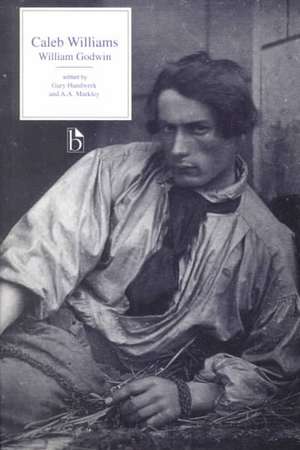
Caleb Williams
Autor William Godwin Editat de Gary Handwerk, A.A. Markleyen Limba Engleză Paperback – 14 sep 2000
Caleb Williams is the riveting account of a young man whose curiosity leads him to pry into a murder from the past. The first novel of crime and detection in English literature, Caleb Williams is also a powerful exposé of the evils and inequities of the political and social system in 1790s Britain.
In addition to the text itself, the editors have included an extensive selection of primary source materials from the period, ranging from Godwin’s original manuscript ending and excerpts from his political writings to contemporary reviews, the political writings of Burke and Paine, and materials on criminals and the English prison system.
Preț: 176.55 lei
Preț vechi: 225.83 lei
-22%
Puncte Express: 265
Carte disponibilă
Livrare economică 07-21 noiembrie
Livrare prin curier în România Termenul estimat este afișat lângă disponibilitate.
Transport gratuit de la 400.00 lei Plată online sau ramburs, în funcție de opțiunile comenzii.
Retur gratuit în 14 zile Comandă securizată și suport în română.
Specificații
ISBN-13: 9781551112497
ISBN-10: 1551112493
Pagini: 576
Dimensiuni: 140 x 216 x 24 mm
Greutate: 0.61 kg
Editura: BROADVIEW PR
Colecția Broadview Press
Locul publicării:Peterborough, Canada
ISBN-10: 1551112493
Pagini: 576
Dimensiuni: 140 x 216 x 24 mm
Greutate: 0.61 kg
Editura: BROADVIEW PR
Colecția Broadview Press
Locul publicării:Peterborough, Canada
V-ar putea interesa
-
 Robinson CrusoeDaniel DefoePreț: 28.01 lei
 -
 Three Gothic NovelsHorace Walpole-18%Preț: 78.04 lei94.71 lei
 -
 Wieland; or The Transformation, and Memoirs of Carwin, The BiloquistCharles Brockden Brown-18%Preț: 64.98 lei79.50 lei
 -
 -17%Preț: 61.09 lei73.45 lei
 -
 An Enquiry Concerning Political JusticeWilliam Godwin-18%Preț: 89.20 lei108.74 lei
 -
 -16%Preț: 24.79 lei29.58 lei
 -
 CandideVoltairePreț: 32.48 lei
 -
 The Scarlet PimpernelEmmuska OrczyPreț: 36.11 lei
 -
 RevoltingTerry DearyPreț: 158.90 lei
 -
 Locke: Political WritingsJohn Locke-17%Preț: 141.78 lei171.31 lei
 -
 -24%Preț: 61.31 lei80.85 lei
 -
 A Fire Beneath the WorldJames Treadwell-25%Preț: 59.15 lei79.17 lei
 -
 MandevilleWilliam Godwin-21%Preț: 234.28 lei295.65 lei
 -
 To Kill the TruthSam BournePreț: 93.01 lei
 -
 GabriëleAnne BerestPreț: 138.86 lei
 -
 The Wolf of WhindaleJacob Kerr-18%Preț: 59.87 lei72.86 leiNou
 -
 The RevolutionistsJason BurkePreț: 143.02 lei
 -
 Preț: 169.95 lei
 -
 Histoires de Masques (Éd.1900)Jean LorrainPreț: 174.95 lei
 -
 La Doublure: Roman (Éd.1897)Raymond RousselPreț: 183.15 lei
 -
 La Peau de Chagrin, (Éd.1833)Honoré de BalzacPreț: 168.52 lei
 -
 Preț: 224.00 lei
 -
 Bruges-La-Morte, Roman (Éd.1892)Georges RodenbachPreț: 144.03 lei
 -
 Felicia ou Mes fredaines, orné de Figures en taille-douce. 1-4 P T. 2 (Éd.1782)André-Robert Andréa de NerciatPreț: 130.85 lei
 -
 Preț: 177.00 lei
 -
 L'Élixir Du Diable (Éd.1873)Ernst-Théodor-Amadeus HoffmannPreț: 94.99 lei
 -
 Mon Oncle Benjamin. Oeuvres de Claude Tillier (Éd.1862)Claude TillierPreț: 136.36 lei
 -
 Patira (12e Édition) (Éd.1884)Raoul De NaveryPreț: 214.42 lei
 -
 UtopiaThomas MorePreț: 33.19 lei
Recenzii
William Godwin was one of the most popular novelists of the Romantic era; P.B. Shelley praised him, Byron drew heavily on his narrative style, and Mary Shelley, Godwin’s daughter, dedicated Frankenstein to him.
Caleb Williams is the riveting account of a young man whose curiosity leads him to pry into a murder from the past. The first novel of crime and detection in English literature, Caleb Williams is also a powerful exposé of the evils and inequities of the political and social system in 1790s Britain.
In addition to the text itself, the editors have included an extensive selection of primary source materials from the period, ranging from Godwin’s original manuscript ending and excerpts from his political writings to contemporary reviews, the political writings of Burke and Paine, and materials on criminals and the English prison system.
“The originality of Caleb Williams will be obvious to the student or general reader who encounters it in this exemplary addition to the Broadview [Editions] series. The editors provide a clear, thorough introduction that places the novel in its political, philosophical, and literary contexts, as well as a chronology and bibliography. Six appendices serve up generous helpings of the fruits of recent scholarship that illuminate the fiction’s relation to things as they were. Providing glimpses of Godwin at work, samples of ardent political discourse of the 1790s, and snippets of narrative by Holcroft, Wollstonecraft, Richardson, Defoe, and less well-known writers, the supplementary materials are fascinating in themselves.” — Rachel M. Brownstein, The Graduate School and University Center, CUNY
Caleb Williams is the riveting account of a young man whose curiosity leads him to pry into a murder from the past. The first novel of crime and detection in English literature, Caleb Williams is also a powerful exposé of the evils and inequities of the political and social system in 1790s Britain.
In addition to the text itself, the editors have included an extensive selection of primary source materials from the period, ranging from Godwin’s original manuscript ending and excerpts from his political writings to contemporary reviews, the political writings of Burke and Paine, and materials on criminals and the English prison system.
“The originality of Caleb Williams will be obvious to the student or general reader who encounters it in this exemplary addition to the Broadview [Editions] series. The editors provide a clear, thorough introduction that places the novel in its political, philosophical, and literary contexts, as well as a chronology and bibliography. Six appendices serve up generous helpings of the fruits of recent scholarship that illuminate the fiction’s relation to things as they were. Providing glimpses of Godwin at work, samples of ardent political discourse of the 1790s, and snippets of narrative by Holcroft, Wollstonecraft, Richardson, Defoe, and less well-known writers, the supplementary materials are fascinating in themselves.” — Rachel M. Brownstein, The Graduate School and University Center, CUNY
Cuprins
Acknowledgments
Introduction
William Godwin: A Brief Chronology
A Note on the Text
Preface to the 1794 Edition
Caleb Williams
Appendix A: The Composition of the Novel
Introduction
William Godwin: A Brief Chronology
A Note on the Text
Preface to the 1794 Edition
Caleb Williams
Appendix A: The Composition of the Novel
- The Original Manuscript Ending of the Novel
- Godwin’s Account of the Composition of the Novel fromthe Preface to the 1832 “Standard Novels” Edition ofFleetwood
- Godwin’s Account of the Novel’s Aims, from the BritishCritic (July 1795)
- Godwin’s Essay, “Of History and Romance” (1797)
- Select British Responses to the French Revolution
- From Edmund Burke, Reflections on the Revolution in France(1790)
- From Thomas Paine, Rights of Man (1791)
- From William Godwin, Enquiry Concerning Political Justice(1793)
- From William Godwin, Enquiry Concerning Political Justice(1796)
- From Godwin’s Correspondence
- From the Account of Jack Sheppard, in The Malefactor’sRegister; or the Newgate Calendar (1779)
- From John Howard, The State of the Prisons (1777)
- From Mateo Alemán, Guzmán de Alfarache (1599)
- From The History of Mile, de St. Phale (1691)
- From Daniel Defoe, Colonel Jack (1722)
- From Samuel Richardson, Pamela (1740-41)
- From Thomas Holcroft, Anna St. Ives (1792)
- From George Colman, The Iron Chest (1796)
- From Mary Wollstonecraft, The Wrongs of Woman: or, Maria (1798)
- From the Critical Review (July 1794)
- From the British Critic (July 1794)
- From the British Critic (April 1795)
- From the Monthly Review (September 1794)
- From the Analytical Review (January 1795)
- From James Mackintosh, Review of Godwin’s “Lives ofEdward and John Philips,” Edinburgh Review (October1815)
- From William Hazlitt, The Spirit of the Age (1825)
- Review of the 1831 edition of Caleb Williams, NewMonthly Magazine (May 1831)
Notă biografică
William Godwin was an important figure in the transition from Enlightenment thinking to Romanticism during the early nineteenth century. A radical philosopher, novelist, historian, and progressive educationalist, he was in East Anglia in 1756 and trained for five years for the Dissenting ministry at Hoxton Academy, before abandoning a career as a minister to become a writer. The lover of Mary Wollstonecraft, his followers included Wordsworth, Coleridge and Shelley, and Charles Dickens, Edgar Allan Poe and Nathaniel Hawthorne were all influenced by his work. He died in London in 1836.
Maurice Hindle divides his time between freelance writing and teaching for the Open University. He has also edited Frankenstein for the Penguin Classics.
Maurice Hindle divides his time between freelance writing and teaching for the Open University. He has also edited Frankenstein for the Penguin Classics.