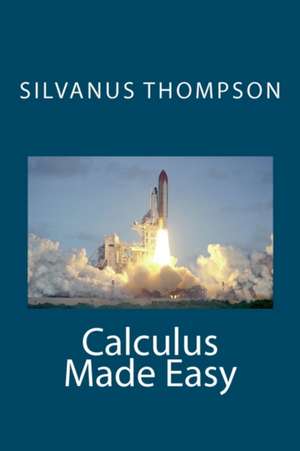
Calculus Made Easy
Autor Silvanus Phillips Thompsonen Limba Engleză Paperback – 31 dec 2010
Analizăm aici ediția a 2-a a lucrării Calculus Made Easy, o resursă istorică fundamentală scrisă de Silvanus Phillips Thompson, care rămâne la fel de relevantă și astăzi pentru cei intimidați de rigoarea excesivă a manualelor standard. Față de versiunile anterioare, această ediție păstrează farmecul explicațiilor directe din 1902, dar vine cu precizări metodologice care facilitează înțelegerea conceptelor de derivare și integrare. Descoperim în paginile sale o tranziție lină de la teorie la aplicații concrete, cum ar fi utilizarea calcului infinitezimal în astronomie pentru a determina raza lunii sau viteza unghiulară a planetei Venus. Suntem de părere că forța acestui volum rezidă în capacitatea autorului de a elimina „numele terifiante” ale metodelor matematice, înlocuindu-le cu o logică accesibilă. Această ediție extinde cadrul propus de Calculus: A Complete Introduction de Hugh Neill cu date noi extrase din aplicațiile practice ale începutului de secol XX, oferind o perspectivă istorică asupra modului în care matematica a modelat înțelegerea noastră despre sistemul solar. În comparație cu Calculus for the Practical Man de J. E. Thompson, care este mai degrabă un ghid de exerciții post-1945, volumul de față servește drept manifest împotriva jargonului academic inutil, fiind ideal pentru studenții care caută o bază intuitivă înainte de a trece la demonstrații complexe. Stilul este unul conversațional, transformând analiza matematică dintr-o barieră într-un instrument de lucru eficient.
Preț: 87.57 lei
Carte disponibilă
Livrare economică 17 noiembrie-01 decembrie
Specificații
ISBN-10: 1456531980
Pagini: 278
Dimensiuni: 152 x 229 x 15 mm
Greutate: 0.38 kg
Editura: CreateSpace Independent Publishing Platform
V-ar putea interesa
-
 Stochastic Calculus for Finance ISteven Shreve-17%Preț: 410.51 lei494.59 lei
 -
 CalculusMorris KlinePreț: 334.98 lei
 -
 Calculus of VariationsI. M. GelfandPreț: 90.15 lei
 -
 CalculusJames Stewart-23%Preț: 657.49 lei853.88 lei
 -
 CalculusMichael SpivakPreț: 465.91 lei
 -
 A Course in Financial CalculusAlison EtheridgePreț: 406.23 lei
 -
 Was Sind Und Was Sollen Die Zahlen?Richard DedekindPreț: 334.13 lei
 -
 Calculus For Dummies, 2nd EditionMark RyanPreț: 109.93 lei
 -
 Introduction to Stochastic Calculus Applied to FinanceDamien Lamberton-18%Preț: 715.44 lei872.49 lei
De ce să citești această carte
Recomandăm această carte oricărui student sau profesionist care dorește să înțeleagă esența calculului infinitezimal fără a se pierde în demonstrații abstracte. Veți câștiga o perspectivă intuitivă asupra matematicii, învățând să aplicați derivarea și integrarea în probleme reale de fizică și inginerie. Este alegerea perfectă pentru a depăși teama de calcul matematic printr-o metodă care a rezistat testului timpului timp de peste un secol.
Descriere scurtă
Descriere
This historic book may have numerous typos and missing text. Purchasers can download a free scanned copy of the original book (without typos) from the publisher. Not indexed. Not illustrated. 1902 Excerpt: ...earth. r' = radius of moon, or other body. P = moon's horizontal parallax = earth's angular semidiameter as seen from the moon. f = moon's angular semidiameter. Now = P (in circular measure), r'-r = r (in circular measure);.'. r: r':: P: P', or (radius of earth): (radios of moon):: (moon's parallax): (moon's semidiameter). Examples. 1. Taking the moon's horizontal parallax as 57', and its angular diameter as 32', find its radius in miles, assuming the earth's radius to be 4000 miles. Here moon's semidiameter = 16';.-. 4000::: 57': 16';.-. r = 400 16 = 1123 miles. 2. The sun's horizontal parallax being 8"8, and his angular diameter 32V find his diameter in miles. ' Am. 872,727 miles. 3. The synodic period of Venus being 584 days, find the angle gained in each minute of time on the earth round the sun as centre. Am. l"-54 per minute. 4. Find the angular velocity with which Venus crosses the sun's disc, assuming the distances of Venus and the earth from the sun are as 7 to 10, as given by Bode's Law. Since (fig. 50) S V: VA:: 7: 3. But Srhas a relative angular velocity round the sun of l"-54 per minute (see Example 3); therefore, the relative angular velocity of A V round A is greater than this in the ratio of 7: 3, which gives an approximate result of 3"-6 per minute, the true rate being about 4" per minute. Annual ParaUax. 95. We have already seen that no displacement of the observer due to a change of position on the earth's surface could apparently affect the direction of a fixed star. However, as the earth in its annual motion describes an orbit of about 92 million miles radius round the sun, the different positions in space from which an observer views the fixed stars from time to time throughout the year must be separated ...