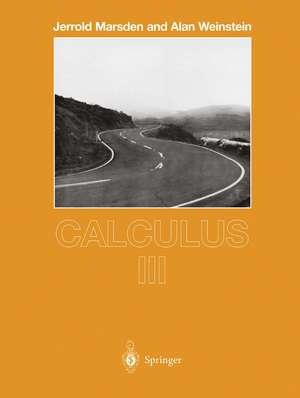
Calculus III
Autor Jerrold Marsden, Alan Weinsteinen Limba Engleză Paperback – 7 iun 1985
Acest manual de Calculus III semnat de Jerrold Marsden și Alan Weinstein reprezintă volumul final al unei serii pedagogice riguroase, dezvoltate în cadrul cursurilor susținute de autori la universitatea Berkeley. Publicat de Springer, textul este conceput pentru a ghida studenții de la nivel licență în utilizarea inteligentă a analizei matematice pentru rezolvarea problemelor fizice și matematice complexe. Notăm cu interes că această a doua ediție încorporează numeroase îmbunătățiri metodice rezultate din utilizarea primei ediții la curs, punând un accent deosebit pe tranziția de la calculul algoritmic la înțelegerea conceptuală. Structura volumului este una progresivă, debutând cu studiul vectorilor în plan și spațiu, continuând cu analiza curbelor și suprafețelor (secțiuni conice, coordonate cilindrice și sferice) și culminând cu teme avansate de diferențiere parțială, gradienți și integrare multiplă. Un element distinctiv îl reprezintă organizarea exercițiilor: acestea sunt grupate în seturi de câte două sau patru probleme similare, fiind gradate de la sarcini de rutină, menite să construiască încrederea studentului, până la probleme marcate cu steluță, care solicită o viziune profundă asupra aplicațiilor practice. Poziționată în contextul operei autorilor, lucrarea continuă rigoarea începută în Calculus I și Calculus II, pregătind terenul pentru tratate mai avansate precum Elementary Classical Analysis. Cititorii familiarizați cu Thomas' Calculus de Maurice Weir vor aprecia în acest volum abordarea mai aplicată și structura exercițiilor, care este mai strâns legată de exemplele rezolvate, oferind un suport mai granular pentru studiul individual. În timp ce Calculus of Several Variables de Serge Lang oferă o perspectivă teoretică condensată, volumul de față rămâne fidel spiritului de la Berkeley, echilibrând intuiția geometrică cu rigoarea calculului diferențial și integral.
Preț: 394.17 lei
Carte tipărită la comandă
Livrare economică 28 noiembrie-12 decembrie
Specificații
ISBN-10: 0387909850
Pagini: 368
Ilustrații: XV, 344 p.
Dimensiuni: 210 x 279 x 20 mm
Greutate: 0.9 kg
Ediția:Second Edition 1985
Editura: Springer
Locul publicării:New York, NY, United States
V-ar putea interesa
-
 Stochastic Calculus for Finance ISteven Shreve-17%Preț: 409.92 lei493.88 lei
 -
 Calculus IJerrold MarsdenPreț: 389.06 lei
 -
 Calculus IIJerrold MarsdenPreț: 386.11 lei
 -
 CalculusMorris KlinePreț: 334.98 lei
 -
 Preț: 90.15 lei
 -
 CalculusJames Stewart-23%Preț: 657.49 lei853.88 lei
 -
 CalculusMichael SpivakPreț: 465.91 lei
 -
 A Course in Financial CalculusAlison EtheridgePreț: 406.23 lei
 -
 Was Sind Und Was Sollen Die Zahlen?Richard DedekindPreț: 334.13 lei
 -
 Calculus For Dummies, 2nd EditionMark RyanPreț: 109.93 lei
 -
 Introduction to Stochastic Calculus Applied to FinanceDamien Lamberton-18%Preț: 715.44 lei872.49 lei
Public țintă
Lower undergraduateDe ce să citești această carte
Recomandăm acest manual studenților la matematică, fizică sau inginerie care doresc o stăpânire solidă a analizei multivariabile. Prin structura sa pedagogică unică, ce include exerciții gradate și exemple derivate din practica universitară, Calculus III facilitează trecerea de la memorarea formulelor la aplicarea lor creativă în probleme reale. Este o resursă esențială pentru consolidarea fundamentelor matematice necesare în anii superiori de licență.