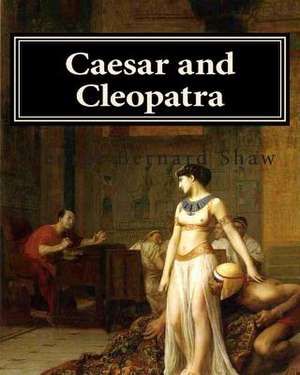
Caesar and Cleopatra
Autor George Bernard Shawen Limba Engleză Paperback
Preț: 68.05 lei
Puncte Express: 102
Carte disponibilă
Livrare economică 31 octombrie-14 noiembrie
Livrare prin curier în România Termenul estimat este afișat lângă disponibilitate.
Transport gratuit de la 400.00 lei Plată online sau ramburs, în funcție de opțiunile comenzii.
Retur gratuit în 14 zile Comandă securizată și suport în română.
Specificații
ISBN-13: 9781461180463
ISBN-10: 1461180465
Pagini: 126
Dimensiuni: 203 x 254 x 7 mm
Greutate: 0.26 kg
Editura: CREATESPACE
ISBN-10: 1461180465
Pagini: 126
Dimensiuni: 203 x 254 x 7 mm
Greutate: 0.26 kg
Editura: CREATESPACE
V-ar putea interesa
-
 Great ExpectationsCharles DickensPreț: 28.01 lei
 -
 Gulliver's TravelsJonathan SwiftPreț: 28.01 lei
 -
 The Adventures Of Huckleberry FinnMark TwainPreț: 28.01 lei
 -
 The Great GatsbyF. Scott FitzgeraldPreț: 28.01 lei
 -
 Mrs DallowayVirginia WoolfPreț: 28.01 lei
 -
 Leaves of GrassWalt WhitmanPreț: 28.46 lei
 -
 The Rime of the Ancient Mariner and Other PoemsSamuel Taylor ColeridgePreț: 28.47 lei
 -
 Heart of DarknessJoseph Conrad-19%Preț: 23.12 lei28.58 lei
 -
 Preț: 27.62 lei
 -
 Lord of the FliesWilliam GoldingPreț: 71.68 lei
 -
 The Lottery of Love: In a Translation by John FowlesPierre MarivauxPreț: 73.72 lei
 -
 Mr Melancholy and Footprints on WaterMatt CameronPreț: 133.29 lei
 -
 Maz and BricksEva O'Connor-24%Preț: 83.79 lei110.62 lei
 -
 Everything Between UsDavid Ireland-20%Preț: 84.55 lei105.22 lei
 -
 Nuclear War & The Songs for WendeSimon Stephens-22%Preț: 71.61 lei91.79 lei
 -
 Madame RubinsteinJohn Misto-24%Preț: 86.04 lei112.92 lei
 -
 Tirso de MolinaRaymond ConlonPreț: 222.88 lei
 -
 Mr. Burns and Other PlaysAnne WashburnPreț: 123.30 lei
 -
 Evening at the Talk House (TCG Edition)Wallace ShawnPreț: 79.79 lei
 -
 Letters to LindyAlana ValentinePreț: 105.74 lei
 -
 WealdDaniel Foxsmith-25%Preț: 70.88 lei94.21 lei
 -
 SavageClaudio Macor-16%Preț: 86.35 lei103.07 lei
 -
 City of GlassDuncan Macmillan-25%Preț: 73.08 lei97.78 lei
 -
 OctopusAfsaneh Gray-20%Preț: 70.88 lei88.09 lei
 -
 This Is LivingLiam BorrettPreț: 91.34 lei
 -
 Pride and PrejudiceJane AustenPreț: 31.55 lei
 -
 Tess of the d'UrbervillesThomas HardyPreț: 31.11 lei
 -
 Moby DickHerman MelvillePreț: 39.32 lei
 -
 Lord JimJoseph ConradPreț: 28.01 lei
 -
 The Portrait of a LadyHenry JamesPreț: 38.21 lei
Notă biografică
George Bernard Shaw (1856-1950) is one of the world's greatest literary figures. Born in Dublin, Ireland, he left school at fourteen and in 1876 went to London, where he began his literary career with a series of unsuccessful novels. In 1884 he became a founder of the Fabian Society, the famous British socialist organization. After becoming a reviewer and drama critic, he published a study of the Norwegian dramatist Henrik Ibsen in 1891 and became determined to create plays as he felt Ibsen did: to shake audiences out of their moral complacency and to attack social problems. However, Shaw was an irrepressible wit, and his plays are as entertaining as they are socially provocative. Basically shy, Shaw created a public persona for himself: G.B.S., a bearded eccentric, crusading social critic, antivivisectionist, language reformer, strict vegetarian, and renowned public speaker. The author of fifty-three plays, hundreds of essays, reviews, and letters, and several books, Shaw is best known for Widowers' Houses, Mrs. Warren's Profession, Arms and the Man, Caesar and Cleopatra, Man and Superman, Major Barbara, Pygmalion, Heartbreak House, and Saint Joan. He was awarded the Nobel Prize in Literature in 1925. Stanley Weintraub (introducer) is the Evan Pugh Professor Emeritus of Arts and Humanities at Pennsylvania State University, and the author of numerous histories and biographies, including Silent Night. Dan H. Laurence (series editor; 1920-2008) was series editor for the works of George Bernard Shaw in Penguin. Formerly a New York University faculty member, Mr. Laurence left his tenured position in 1970 to dedicated his life to the collection and curation of Shaw's life, work, and letters. He served as the official literary advisor to Shaw's estate and published four volumes of his correspondence.