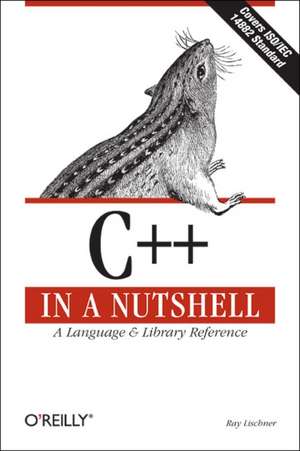
C++ in a Nutshell
Autor Ray Lischneren Limba Engleză Paperback – 17 iun 2003
Preț: 224.00 lei
Preț vechi: 280.00 lei
-20%
Puncte Express: 336
Carte disponibilă
Livrare economică 09-23 noiembrie
Livrare prin curier în România Termenul estimat este afișat lângă disponibilitate.
Transport gratuit de la 400.00 lei Plată online sau ramburs, în funcție de opțiunile comenzii.
Retur gratuit în 14 zile Comandă securizată și suport în română.
Specificații
ISBN-13: 9780596002985
ISBN-10: 059600298X
Pagini: 808
Dimensiuni: 154 x 230 x 45 mm
Greutate: 1.07 kg
Editura: O'Reilly
ISBN-10: 059600298X
Pagini: 808
Dimensiuni: 154 x 230 x 45 mm
Greutate: 1.07 kg
Editura: O'Reilly
V-ar putea interesa
-
 C: A Reference Manual: United States EditionSamuel P. Harbison-20%Preț: 545.12 lei681.41 lei
 -
 C Programming LanguageDennis Ritchie-20%Preț: 385.40 lei481.75 lei
 -
 C++20 for ProgrammersPaul Deitel-20%Preț: 373.07 lei466.34 lei
 -
 C++ in One Hour a Day, Sams Teach YourselfSiddhartha Rao-20%Preț: 278.04 lei347.55 lei
 -
 -20%Preț: 306.44 lei383.05 lei
 -
 C++ PrimerStanley B. Lippman-20%Preț: 395.14 lei493.92 lei
 -
 The C++ Programming LanguageBjarne Stroustrup-20%Preț: 507.21 lei634.02 lei
 -
 C++ Pocket ReferenceKyle Loudon-20%Preț: 110.10 lei137.63 lei
 -
 C++ in 24 Hours, Sams Teach YourselfRogers Cadenhead-20%Preț: 184.48 lei230.60 lei
 -
 Rao, S: C++ in One Hour a Day, Sams Teach YourselfSiddhartha Rao-20%Preț: 239.24 lei299.05 lei
 -
 C++ All-in-One For DummiesJohn Paul Mueller-20%Preț: 227.58 lei284.48 lei
 -
 C Programming for DummiesDan Gookin-20%Preț: 170.73 lei213.41 lei
 -
 C++ How to Program, Global EditionPaul Deitel-20%Preț: 496.44 lei620.55 lei
 -
 C++ Essentials for DummiesJohn Paul Mueller-20%Preț: 65.48 lei81.85 lei
 -
 C++Torsten T. Will-20%Preț: 396.39 lei495.49 lei
 -
 C++ Crash Course: A Fast-Paced IntroductionJoshua Alfred Lospinoso-35%Preț: 306.92 lei470.46 lei
 -
 Modern C, Third EditionJens Gustedt-20%Preț: 350.34 lei437.92 lei
 -
 C++ Programming in Easy StepsMike Mcgrath-20%Preț: 92.33 lei115.41 lei
 -
 C++ Programming in Easy Steps, 6th EditionMike McgrathPreț: 108.24 lei
 -
 .NET 10 RevealedKajetan Duszy¿ski-20%Preț: 240.60 lei300.75 lei
Notă biografică
Ray Lischner began his career as a software developer, but dropped out of the corporate rat race to become an author. He started using C++ in the late 1980s, working at a company that was rewriting its entire product line in C++. Over the years, he has witnessed the evolution of C++ from cfront to native compilers to integrated development environments to visual, component-based tools. Ray has taught C++ at Oregon State University. He is the author of Delphi in a Nutshell and O'Reilly's upcoming C++ in a Nutshell, as well as other books.
Cuprins
Preface; Structure of This Book; About the Examples; Conventions Used in This Book; For More Information; Comments and Questions; Acknowledgments; Chapter 1: Language Basics; 1.1 Compilation Steps; 1.2 Tokens; 1.3 Comments; 1.4 Character Sets; 1.5 Alternative Tokens; 1.6 Trigraphs; Chapter 2: Declarations; 2.1 Declarations and Definitions; 2.2 Scope; 2.3 Name Lookup; 2.4 Linkage; 2.5 Type Declarations; 2.6 Object Declarations; 2.7 Namespaces; Chapter 3: Expressions; 3.1 Lvalues and Rvalues; 3.2 Type Conversions; 3.3 Constant Expressions; 3.4 Expression Evaluation; 3.5 Expression Rules; Chapter 4: Statements; 4.1 Expression Statements; 4.2 Declarations; 4.3 Compound Statements; 4.4 Selections; 4.5 Loops; 4.6 Control Statements; 4.7 Handling Exceptions; Chapter 5: Functions; 5.1 Function Declarations; 5.2 Function Definitions; 5.3 Function Overloading; 5.4 Operator Overloading; 5.5 The main Function; Chapter 6: Classes; 6.1 Class Definitions; 6.2 Data Members; 6.3 Member Functions; 6.4 Inheritance; 6.5 Access Specifiers; 6.6 Friends; 6.7 Nested Types; Chapter 7: Templates; 7.1 Overview of Templates; 7.2 Template Declarations; 7.3 Function Templates; 7.4 Class Templates; 7.5 Specialization; 7.6 Partial Specialization; 7.7 Instantiation; 7.8 Name Lookup; 7.9 Tricks with Templates; 7.10 Compiling Templates; Chapter 8: Standard Library; 8.1 Overview of the Standard Library; 8.2 C Library Wrappers; 8.3 Wide and Multibyte Characters; 8.4 Traits and Policies; 8.5 Allocators; 8.6 Numerics; Chapter 9: Input and Output; 9.1 Introduction to I/O Streams; 9.2 Text I/O; 9.3 Binary I/O; 9.4 Stream Buffers; 9.5 Manipulators; 9.6 Errors and Exceptions; Chapter 10: Containers, Iterators, and Algorithms; 10.1 Containers; 10.2 Iterators; 10.3 Algorithms; Chapter 11: Preprocessor Reference; Chapter 12: Language Reference; Chapter 13: Library Reference; 13.1 ; 13.2 ; 13.3 ; 13.4 ; 13.5 ; 13.6 ; 13.7 ; 13.8 ; 13.9 ; 13.10 ; 13.11 ; 13.12 ; 13.13 ; 13.14 ; 13.15 ; 13.16 ; 13.17 ; 13.18 ; 13.19 ; 13.20 ; 13.21 ; 13.22 ; 13.23 ; 13.24 ; 13.25 ; 13.26 ; 13.27 ; 13.28 ; 13.29 ; 13.30 ; 13.31 ; 13.32 ; 13.33 ; 13.34 ; 13.35