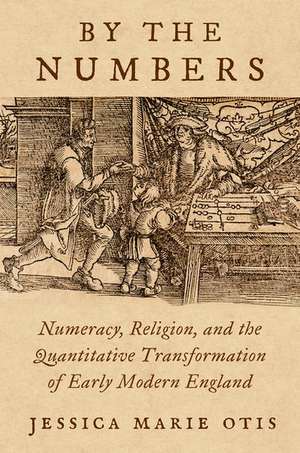
By the Numbers: Numeracy, Religion, and the Quantitative Transformation of Early Modern England
Autor Jessica Marie Otisen Limba Engleză Paperback – 22 apr 2024
Observăm o lacună persistentă în istoriografia britanică timpurie: deși alfabetizarea este intens studiată, evoluția competențelor numerice (numeracy) și integrarea lor în viața cotidiană a rămas adesea un subiect secundar. By the Numbers de Jessica Marie Otis vine să corecteze această omisiune, oferind o analiză riguroasă a modului în care societatea engleză a trecut, între secolele XVI și XVIII, de la o înțelegere mistică a numerelor la una instrumentală. Suntem de părere că această lucrare demonstrează convingător cum matematica nu a fost doar un instrument de calcul, ci o forță culturală care a redefinit percepția asupra timpului, șansei și structurii sociale.
Putem afirma că volumul completează excelent titluri precum A Cultural History of Mathematics in the Early Modern Age de Volker Remmert. Dacă lucrarea lui Remmert se concentrează pe dezvoltarea algebrei simbolice și a calculului infinitezimal în mediile academice, Jessica Marie Otis își mută atenția către omul de rând, analizând cum manualele de aritmetică și creșterea producției editoriale au democratizat gândirea cantitativă. Remarcăm o structură narativă care urmărește tranziția de la ideea că Dumnezeu a creat omul „numerat” în mod universal, la o realitate în care tabelele de mortalitate și probabilitatea defineau ordinea socială. Cartea este comparabilă cu From Discrete to Continuous de K. Neal în rigurozitatea cu care tratează conceptele matematice, dar este actualizată pentru a include dimensiunea religioasă și impactul Reformei asupra educației maselor. Textul este susținut de 12 ilustrații relevante, facilitând înțelegerea practicilor de calcul din epocă.
Preț: 144.49 lei
Preț vechi: 173.16 lei
-17%
Carte disponibilă
Livrare economică 13-24 noiembrie
Livrare express 31 octombrie-06 noiembrie pentru 55.27 lei
Specificații
ISBN-10: 0197608787
Pagini: 280
Ilustrații: 12 black and white halftones
Dimensiuni: 226 x 160 x 28 mm
Greutate: 0.39 kg
Editura: Oxford University Press
Colecția OUP USA
Locul publicării:New York, United States
De ce să citești această carte
Recomandăm această carte cercetătorilor și studenților interesați de istoria mentalităților și a științei. Cititorul va obține o perspectivă inedită asupra modului în care Anglia a devenit o societate bazată pe date, mult înainte de era digitală. Este o resursă esențială pentru a înțelege cum cuantificarea a încetat să fie o curiozitate academică, devenind un limbaj universal de organizare a realității sociale și religioase.
Despre autor
Jessica Marie Otis este un istoric specializat în perioada modernă timpurie a Marii Britanii, cu un interes marcat pentru istoria matematicii, a științei și a culturii materiale. În prezent, este profesor asistent de istorie și director de proiecte la Center for History and New Media din cadrul George Mason University. Expertiza sa îmbină metodele tradiționale de cercetare arhivistică cu umanioarele digitale, o abordare care se reflectă în precizia datelor prezentate în By the Numbers, lucrare publicată de Oxford University Press.
Descriere
Recenzii
This illuminating study provides a pathbreaking account of the characteristics of early modern numeracy and of the dynamics of change.
This is a remarkable book, much the best introduction to a fascinating subject and at the same time full of interest for the specialist who wants to learn more.
This interesting history...highlights how the transition was initiated to a numerate population and a more data driven society, which we know all too well these days.
This book is an enjoyable read. It is full of interesting information on how people usednumerical information in their daily lives during the early modern period in England. The historical accounts included make for fascinating reading. There are copious notes for each chapter. This book is a welcome and important addition to the history of mathematics literature.
Otis's By the Numbers brings new energy to discussions first opened by the brilliant Eva Germaine Rivington Taylor, E.P. Thompson, Keith Wrightson, and Bill Sherman, and others, across the important intersections of the histories of practice, social history, and the histories of the book. In doing so, she makes an important contribution to this critical yet long under-examined field of early modern British culture.
One of the key points of this excellent book is that numbers were no more a single technology than mills. As Otis carefully shows, the use of numbers was complex, multifaceted, and dynamic, involving a number (so to speak) of techniques; tools; media; and social, cultural, and intellectual commitments.
In the span of just 160 pages, Otis manages successfully to give a picture of the process of deep transformation in the uses of numbers and numerical thinking that characterised early modern England by documenting in detail the historical situatedness of multiple forms of numeracy, their material aspects, and social pervasiveness. This is a welcome contribution that shows the importance of the quantitative transformation of early modern England, and in so doing opens several important questions for further research.
Notă biografică
Cuprins
- Acknowledgments
- A Note on Style, Dating, Money, and References
- Introduction "Number, Weight and Measure": Numeracy in Early Modern England
- Chapter 1 "The Dyuers Wittes of Man": The Multiplicity and Materiality of Numbers
- Chapter 2 "Finding Out False Reckonings": Trust and the Function of Numbers
- Chapter 3 "Set Them To the Cyphering Schoole": Reading, Writing, and Arithmetical Education
- Chapter 4 "According To Our Computation Here": Quantifying Time
- Chapter 5 "It is Odds of Many To One": Quantifying Chance and Risk
- Chapter 6 "Davids Arithmetic": Quantifying the People
- Epilogue "Heau'ns Great Arithmetician": Living in a Numerical World
- Appendix Marginalia in Arithmetic Textbooks
- Notes
- Bibliography
- Index