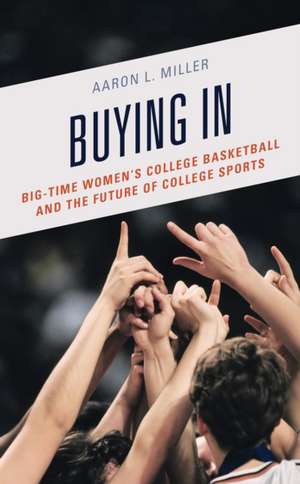
Buying In: Big-Time Women's College Basketball and the Future of College Sports
Autor Aaron L. Milleren Limba Engleză Paperback – 21 mar 2022
With insights drawn from - and applicable to - a wide range of scholarly fields in the humanistic social sciences, this book will be of particular interest to scholars, researchers and educators working in the fields of sports studies, gender studies, education, sociology, history, and anthropology, as well as anyone interested in the future of big-time college sport and higher education. This book poses and answers the question: "How can scholars help envision a brighter future for all college athletes, male and female?"
Preț: 260.47 lei
Preț vechi: 337.26 lei
-23%
Puncte Express: 391
Carte tipărită la comandă
Livrare economică 08-22 decembrie
Livrare prin curier în România Termenul estimat este afișat lângă disponibilitate.
Transport gratuit de la 400.00 lei Plată online sau ramburs, în funcție de opțiunile comenzii.
Retur gratuit în 14 zile Comandă securizată și suport în română.
Specificații
ISBN-13: 9781538166437
ISBN-10: 1538166437
Pagini: 392
Ilustrații: 12 b/w photos; 10 tables;
Dimensiuni: 148 x 228 x 24 mm
Greutate: 0.53 kg
Editura: Bloomsbury Publishing
Colecția Rowman & Littlefield
Locul publicării:New York, United States
ISBN-10: 1538166437
Pagini: 392
Ilustrații: 12 b/w photos; 10 tables;
Dimensiuni: 148 x 228 x 24 mm
Greutate: 0.53 kg
Editura: Bloomsbury Publishing
Colecția Rowman & Littlefield
Locul publicării:New York, United States
V-ar putea interesa
-
 Rise of a DynastyBill ReynoldsPreț: 148.98 lei
 -
 Cheering for SelfJames S. Jr. VassPreț: 79.01 lei
 -
 The NBA From Top to BottomKyle WrightPreț: 112.75 lei
 -
 -21%Preț: 260.87 lei328.56 lei
 -
 From Behind the BenchVinny PezzimentiPreț: 95.08 lei
 -
 Heads of StateMark HostutlerPreț: 119.25 lei
 -
 BackcourtRodney FaucettPreț: 166.10 lei
 -
 The Golden Age of BasketballMR Steven a. RoseboroPreț: 258.17 lei
 -
 Fine Tuning Your Man-To-Man DefenseKevin SivilsPreț: 131.68 lei
 -
 College Basketball Prospectus 2011-12John GasawayPreț: 146.34 lei
 -
 The Darkside of High School SportsAntonio CarnovalePreț: 61.73 lei
 -
 Michael Jordan's NBAMatt ZeiglerPreț: 51.84 lei
 -
 The Phoenix SunsHoward a. DeWittPreț: 111.50 lei
 -
 Finding Our GameGary HollinsPreț: 69.24 lei
 -
 The Parents Blueprint for Athletic ScholarshipsJermaine WarePreț: 59.76 lei
 -
 Ashley's LegacyMR Charles Edison FlowerPreț: 112.09 lei
 -
 Dedication, Desire and the Magic of EmpowermentCoach AhmadPreț: 81.51 lei
 -
 Bouncing Back on the ReboundMR Charles E. FlowerPreț: 80.76 lei
 -
 Basketball EssentialsTarrence GarrisonPreț: 101.30 lei
 -
 Pride of the PanthersBilly L. PowellPreț: 132.08 lei
 -
 Dribbles of ChampionsSam AmicoPreț: 79.94 lei
 -
 Full Court PressBill HaltomPreț: 107.57 lei
 -
 Baseball America 2023 Prospect HandbookThe Editors at Baseball AmericaPreț: 243.87 lei
 -
 Divided CitiesKevin PogorzelskiPreț: 105.47 lei
 -
 Drazen - The Years of the DragonCrnogaj, MarjanPreț: 165.65 lei
 -
 Preț: 177.58 lei
Cuprins
Acknowledgments
Prologue: The Stories We Tell
Introduction: Big Time
Chapter 1: We're Still Trying to Find Our Identity
Chapter 2: The Engine of the Train
Chapter 3: Unselfish Play
Chapter 4: Enlightened Leadership
Chapter 5: A Coach of Coaches
Chapter 6: Everybody Is Capable, Everybody Is Fearless
Chapter 7: Deep in the Woods
Chapter 8: I Am Stanford
Chapter 9: I Am Not a Celebrity at Stanford
Chapter 10: We Need People to Take Ownership
Conclusion: Give Women's Sports a Chance
Epilogue: Big-Time College Sports amid Two Pandemics
Bibliography
About the Author
Prologue: The Stories We Tell
Introduction: Big Time
Chapter 1: We're Still Trying to Find Our Identity
Chapter 2: The Engine of the Train
Chapter 3: Unselfish Play
Chapter 4: Enlightened Leadership
Chapter 5: A Coach of Coaches
Chapter 6: Everybody Is Capable, Everybody Is Fearless
Chapter 7: Deep in the Woods
Chapter 8: I Am Stanford
Chapter 9: I Am Not a Celebrity at Stanford
Chapter 10: We Need People to Take Ownership
Conclusion: Give Women's Sports a Chance
Epilogue: Big-Time College Sports amid Two Pandemics
Bibliography
About the Author
Recenzii
"Buying In: Big-Time Women's College Basketball and the Future of College Sports by Aaron L. Miller is the stellar work of a meticulous scholar/researcher and compelling story teller. Miller traces the separate and diametrically opposed histories of men's and women's intercollegiate sport through their intersectional clash in 1975 when Congress adopted Title IX's athletics regulations mandating a future reflecting gender equality in educational sport. Miller chronicles the next 46 years of painstaking progress through up close and personal vignettes told through the voices and team experiences of an iconic Stanford University women's basketball coach and her athletes. These women confront discrimination and explode myths about the skill, toughness and tenacity of female athletes and the economic viability of women's sports. While gender equality has still not been realized and academic integrity seriously damaged by the corrosive aspects of commercialized sport programs, Miller closes with an insightful analysis of what must be fixed, what Stanford has done right, and why the future should be hopeful."
"Without being an apologist, Aaron Miller has written a celebration of college sports as part of higher education. Using close observation of a big-time women's basketball program, he applies interdisciplinary insights, as well as a full historical perspective to his analysis of the issues that pertain to all of intercollegiate athletics today. This is a timely book."
Who benefits and in what ways from intercollegiate sport? How can we support a more equitable distribution of the benefits? How can we as fans, coaches, policy makers, and academics create a more educationally empowering experience for athletes? These are some of the questions Miller poses in Buying In. He draws on a year of observing Stanford University Women's basketball to provide key insights into the constraints and opportunities to address these important questions. Miller situates this contemporary example within the broader historical context of U.S. intercollegiate sport. He thoroughly describes the structural inequalities that have organized sport, and assesses how racism, classism, and sexism are currently expressed. He then uses Stanford's Women's Basketball program to illustrate some of the ways in which people can create educationally robust sport programs.
At the center of Miller's argument, is the critique of taking a binary position on college sport: assuming that it is either inherently good or that it is fundamentally flawed. Miller is concerned that this binary perspective encourages us to either opt out of social action or to opt out of the joy that sport can bring. Instead, he poses that our communities are simultaneously riddled with problems and benefits; that we live with this complexity and have a role to play in making our communities better. Ultimately, he argues that we have agency to make college sport more fair and more educationally sound.
Well-written and thoroughly researched, Buying In makes an important contribution to the broader conversation about the value of sport in education and strategies to create positive change.
"Without being an apologist, Aaron Miller has written a celebration of college sports as part of higher education. Using close observation of a big-time women's basketball program, he applies interdisciplinary insights, as well as a full historical perspective to his analysis of the issues that pertain to all of intercollegiate athletics today. This is a timely book."
Who benefits and in what ways from intercollegiate sport? How can we support a more equitable distribution of the benefits? How can we as fans, coaches, policy makers, and academics create a more educationally empowering experience for athletes? These are some of the questions Miller poses in Buying In. He draws on a year of observing Stanford University Women's basketball to provide key insights into the constraints and opportunities to address these important questions. Miller situates this contemporary example within the broader historical context of U.S. intercollegiate sport. He thoroughly describes the structural inequalities that have organized sport, and assesses how racism, classism, and sexism are currently expressed. He then uses Stanford's Women's Basketball program to illustrate some of the ways in which people can create educationally robust sport programs.
At the center of Miller's argument, is the critique of taking a binary position on college sport: assuming that it is either inherently good or that it is fundamentally flawed. Miller is concerned that this binary perspective encourages us to either opt out of social action or to opt out of the joy that sport can bring. Instead, he poses that our communities are simultaneously riddled with problems and benefits; that we live with this complexity and have a role to play in making our communities better. Ultimately, he argues that we have agency to make college sport more fair and more educationally sound.
Well-written and thoroughly researched, Buying In makes an important contribution to the broader conversation about the value of sport in education and strategies to create positive change.