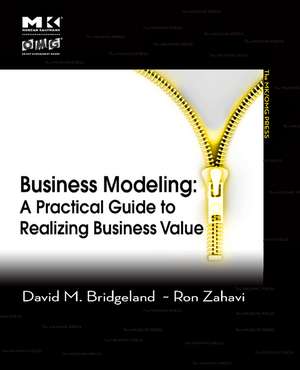
Business Modeling
Autor David M. Bridgeland, Ron Zahavien Limba Engleză Paperback – oct 2008
Experiența vastă a autorilor David M. Bridgeland și Ron Zahavi în consultanță pentru companii și agenții guvernamentale transformă această lucrare dintr-un manual teoretic într-un instrument de execuție. Găsim în Business Modeling o abordare riguroasă, menită să elimine improvizația din planificarea strategică. Descoperim o structură logică în patru părți: de la fundamentele modelării, la explorarea disciplinelor de interacțiune și reguli de business, culminând cu pragmatica atelierelor de lucru și rezultatele concrete prin simulare. Apreciem modul în care autorii integrează cele patru discipline esențiale — proces, motivație, organizație și reguli — oferind cititorului nu doar concepte, ci și standardele necesare pentru a lucra eficient cu experții în domeniu (SMEs). Cele aproximativ 190 de ilustrații și exemplul practic recurent facilitează înțelegerea modului în care un model este analizat și, ulterior, implementat în realitatea organizațională. Abordarea diferă de Business Process Modelling de Bernd Scholz-Reiter prin faptul că este mai puțin abstractă și mult mai aplicabilă; în timp ce Scholz-Reiter se concentrează pe fluxul informațional, Bridgeland și Zahavi oferă un ghid complet care include modelarea motivațională și regulile de business, elemente critice pentru realizarea valorii de afaceri. De asemenea, spre deosebire de Perspectives on Business Modelling, care explorează teorii diverse, această carte din seria The MK/OMG Press se concentrează pe o metodologie unificată și pe bune practici de atelier (workshops).
Preț: 448.06 lei
Preț vechi: 560.08 lei
-20%
Carte tipărită la comandă
Livrare economică 01-15 iunie
Specificații
ISBN-10: 0123741513
Pagini: 406
Ilustrații: Approx. 190 illustrations
Dimensiuni: 187 x 237 x 27 mm
Greutate: 0.83 kg
Editura: Elsevier Inc
V-ar putea interesa
-
 Research in Accounting RegulationGary Previts-23%Preț: 455.43 lei591.47 lei
 -
 Best Practices for Environmental Project TeamsStephen Massey-27%Preț: 1025.54 lei1404.01 lei
 -
 Logistics of Production and InventoryS.C. Graves-21%Preț: 363.71 lei463.00 lei
 -
 Computer-Aided Process PlanningH.P. Wang-27%Preț: 907.57 lei1243.24 lei
 -
 Essentials of Balanced ScorecardMohan NairPreț: 245.08 lei
 -
 -18%Preț: 1088.63 lei1327.60 lei
 -
 -15%Preț: 523.44 lei615.82 lei
 -
 HBR 20-Minute Manager Boxed Set (10 Books) (HBR 20-Minute Manager Series)Harvard Business Review-8%Preț: 548.51 lei596.20 lei
 -
 -20%Preț: 65.47 lei82.14 lei
Public țintă
Professionals involved with business modeling, business process and workflow modeling, strategic planning, including IT mgt, CIOs, information and enterprise architectsDe ce să citești această carte
Această carte este esențială pentru arhitecții de enterprise, managerii IT și planificatorii strategici care doresc să treacă de la diagrame simple la modele de business funcționale. Veți învăța cum să organizați ateliere de modelare productive și cum să simulați impactul deciziilor înainte de implementare. Este un ghid pragmatic ce oferă rigoarea necesară pentru a transforma viziunea strategică în procese operaționale clare, reducând riscul de eșec în proiectele complexe.
Descriere scurtă
Written by two business modeling experts, this book shows you how to make your business modeling efforts successful. It provides in-depth coverage of each of the four distinct business modeling disciplines, helping you master them all and understand how to effectively combine them. It also details best practices for working with subject matter experts. And it shows how to develop models, and then analyze, simulate, and deploy them. This is essential, authoritative information that will put you miles ahead of everyone who continues to approach business modeling haphazardly.
* Provides in-depth coverage of the four business modeling disciplines:
process modeling, motivation modeling, organization modeling, and rules modeling.
* Offers guidance on how to work effectively with subject matter experts and how to run business modeling workshops.
* Details today's best practices for building effective business models, and describes common mistakes that should be avoided.
* Describes standards for each business modeling discipline.
* Explains how to analyze, simulate, and deploy business models.
* Includes examples both from the authors' work with clients and from a single running example that spans the book.
Cuprins
Chapter 1: Modeling fundamentals
Chapter 2: Why business modeling?
Part II: Business modeling disciplines
Chapter 3: Business motivation modeling
Chapter 4: Business interaction modeling
Chapter 5: Business process modeling
Chapter 6: Business rule modeling
Part III: Modeling pragmatics
Chapter 7: Building a model
Chapter 8: Model-based workshops
Chapter 9: Running a workshop
Part IV: Modeling results
Chapter 10: Analyzing a business model
Chapter 11: Simulating a business model
Chapter 12: Deploying a business model