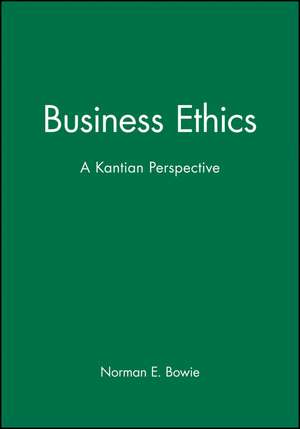
Business Ethics
Autor Norman E. Bowie, Andrew Bowieen Limba Engleză Paperback – noi 1998
Preț: 393.07 lei
Puncte Express: 590
Carte tipărită la comandă
Livrare economică 30 noiembrie-14 decembrie
Livrare prin curier în România Termenul estimat este afișat lângă disponibilitate.
Transport gratuit de la 400.00 lei Plată online sau ramburs, în funcție de opțiunile comenzii.
Retur gratuit în 14 zile Comandă securizată și suport în română.
Specificații
ISBN-13: 9780631211747
ISBN-10: 0631211748
Pagini: 196
Dimensiuni: 152 x 229 x 11 mm
Greutate: 0.33 kg
Ediția:New.
Editura: Wiley
Locul publicării:Chichester, United Kingdom
ISBN-10: 0631211748
Pagini: 196
Dimensiuni: 152 x 229 x 11 mm
Greutate: 0.33 kg
Ediția:New.
Editura: Wiley
Locul publicării:Chichester, United Kingdom
Public țintă
advanced undergraduate and graduate students of ethics, business leaders and managers, business ethics academicsNotă biografică
Norman E. Bowie is Elmer L. Anderson Chair in Corporate Responsibility at the University of Minnesota. He is the author of fourteen books and over 50 articles on business ethics and political philosophy. He was a recent fellow in The Program in Ethics and Professions at Harvard University.
Cuprins
Introduction.
1. The Self-Defeating Nature of Immoral Business Practice.
Introduction Immoral Actions Are Based on Self-Defeating Maxims Inconsistency and Immorality Applications to Business.
It Seems Right in Theory But Does It Work in Practice?.
Objections to the Application of Kantian Ethics to Business.
Extending the Reach of Categorical Imperatives: Pragmatically Inconsistent Maxims.
Why Neither Being Trustworthy nor Not Trusting in Business Involves a Pragmatic Contradiction.
Transition to Chapter 2.
2. Treating the Humanity of Stakeholders as Ends rather than as Means Merely.
Introduction.
The Respect for Persons Principle.
Not Using Employees: Neither Coercion nor Deceit.
Business Practices That Reduce or Remove Coercion and Deception.
An Objection and Replies.
Positive Freedom ad Meaningful Work: Respecting the Humanity in a Person.
Kant's Reflection s on Work.
Meaningful Work and Contemporary Business.
3. The Firm as a Moral Community.
Introduction.
Viewing Organizations and Human Nature.
Creating the Kantian Moral Firm: The Kingdom of Ends Formulation of the Categorical Imperative.
The Principles of a Moral Firm.
Implications for Organizational Studies.
4. Acting from Duty: How Pure a Motive.
Introduction.
Kant's Position on the Purity of Moral Motives.
Strategic Payoffs and Moral Motives.
Reasons and Emotions: A Brief Aside.
Multiple Moral Motives.
5. The Cosmopolitan Perspective.
Introduction.
The Morality of the Market.
International Business Can Contribute to World Peace, Universal Rights, and Democracy.
Objections and Replies.
Conclusion.
Bibliography.
Further Reading.
Index
Introduction Immoral Actions Are Based on Self-Defeating Maxims Inconsistency and Immorality Applications to Business.
It Seems Right in Theory But Does It Work in Practice?.
Objections to the Application of Kantian Ethics to Business.
Extending the Reach of Categorical Imperatives: Pragmatically Inconsistent Maxims.
Why Neither Being Trustworthy nor Not Trusting in Business Involves a Pragmatic Contradiction.
Transition to Chapter 2.
2. Treating the Humanity of Stakeholders as Ends rather than as Means Merely.
Introduction.
The Respect for Persons Principle.
Not Using Employees: Neither Coercion nor Deceit.
Business Practices That Reduce or Remove Coercion and Deception.
An Objection and Replies.
Positive Freedom ad Meaningful Work: Respecting the Humanity in a Person.
Kant's Reflection s on Work.
Meaningful Work and Contemporary Business.
3. The Firm as a Moral Community.
Introduction.
Viewing Organizations and Human Nature.
Creating the Kantian Moral Firm: The Kingdom of Ends Formulation of the Categorical Imperative.
The Principles of a Moral Firm.
Implications for Organizational Studies.
4. Acting from Duty: How Pure a Motive.
Introduction.
Kant's Position on the Purity of Moral Motives.
Strategic Payoffs and Moral Motives.
Reasons and Emotions: A Brief Aside.
Multiple Moral Motives.
5. The Cosmopolitan Perspective.
Introduction.
The Morality of the Market.
International Business Can Contribute to World Peace, Universal Rights, and Democracy.
Objections and Replies.
Conclusion.
Bibliography.
Further Reading.
Index
Descriere
Offers an introduction to business ethics. This book applies the essential features of Kantian moral philosophy to the business firm by addressing the question, 'How should a business firm in a capitalist economy be structured and managed according to the principles of Kant's ethics?